Get Full Government Meeting Transcripts, Videos, & Alerts Forever!
Get email alerts on the Land Use topic
No spam. Unsubscribe anytime.
Coweta County adopts data‑center ordinance after hours of testimony; vote 4–1
Summary
After nearly three hours of public comment from residents, industry representatives and technical staff, the Coweta County Board of Commissioners adopted zoning amendments for data centers that set height limits, buffering and screening requirements and require utility verification; the measure passed 4–1.
Coweta County commissioners adopted a set of zoning amendments for data‑center development on Dec. 16 after an extended public hearing and a 4–1 recorded outcome.
Community development director Ben Sewell told the board the draft revisions reflected months of public meetings and a survey of commissioners. The final text keeps a 60‑foot limit on primary building height while allowing up to 10 additional feet for parapet walls and rooftop equipment (a 70‑foot cap), preserves a 300‑foot buffer from residentially used property, removes a specific arterial‑road classification requirement so projects default to existing industrial standards, strengthens screening for mechanical equipment and requires applicants to submit a letter of intent from utility providers confirming preliminary coordination and feasibility.
"All mechanical equipment, emergency generators, substations and appurtenances shall be screened from view from any public right of way or adjoining property zoned or used for residential purposes," staff told the board, proposing at least an 8‑foot fence, wall or vegetated berm providing 95% opacity.
Supporters argued the ordinance strikes a balance between protecting residents and allowing economic development. "The future of our economy and our democracy will run on data and on AI," said Jason Peace, a District 3 resident who urged the county to capture tax revenue and infrastructure investment. Resident and development‑authority member Dennis McIntyre said the draft was "fair to all," noting the county needs industrial tax base to fund services.
Opponents urged delay and asked for stronger environmental protections and further study. "Protections are being loosened rather than strengthened," said Rob Cole, who pressed commissioners for more transparency and independent financial verification. Other residents raised concerns about water use, low‑frequency noise, long‑term job creation and impacts on rural character; several urged extending the moratorium or handling projects on a case‑by‑case basis rather than via a single ordinance.
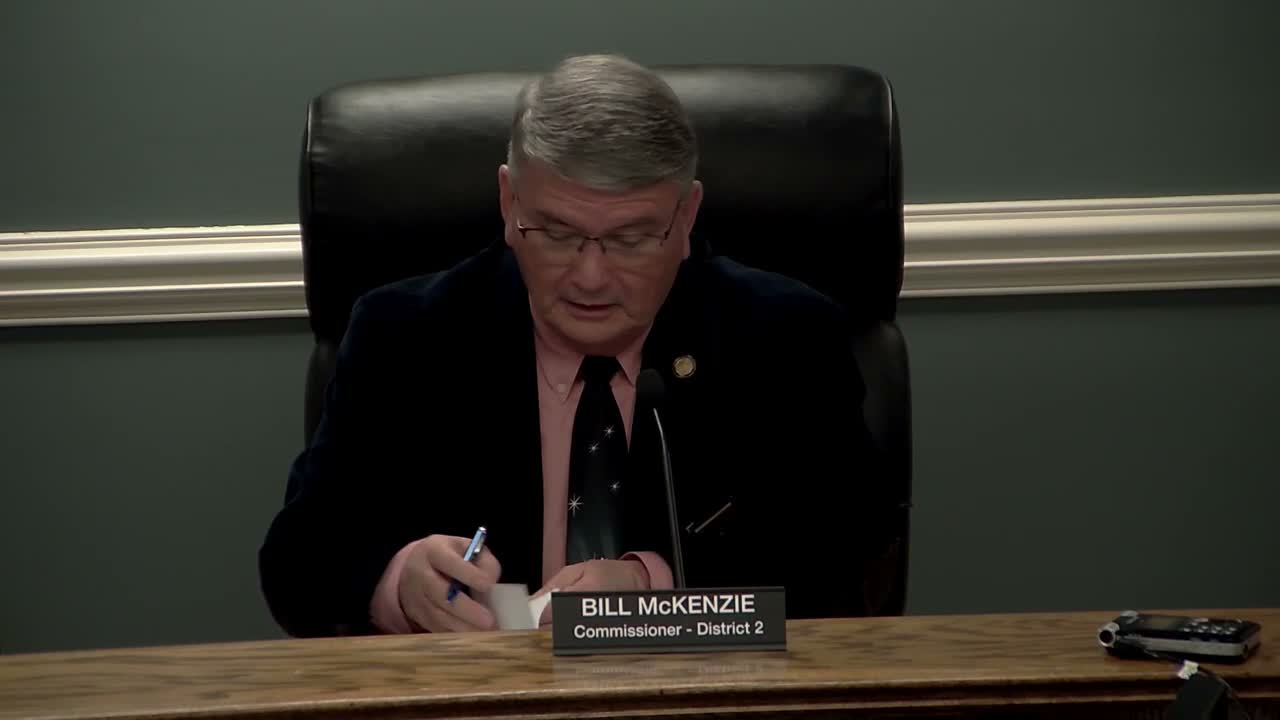
Commissioners debated the ordinance briefly after public comment. A motion to approve the amendments passed by voice vote; the chair announced the motion carried 4–1. Commissioners noted that specific data‑center projects would still require separate rezoning petitions and site‑specific review, and that the ordinance could be revised in the future as staff and the board learn from implemented projects.
The adopted changes also include revised enforcement language for noise provisions—staff may issue written notice of violations but the notice is not a prerequisite to enforcement, and recurring noise infractions may lead to legal remedies against operators—and an approach to decommissioning that relies on site‑specific zoning conditions rather than a one‑size‑fits‑all requirement in the ordinance.
Votes at a glance: the data‑center ordinance amendments were approved (board announced 4–1). Other actions at the meeting included a unanimous approval of a sign ordinance text amendment (deleting the movement/animation subsection), approval of a rezoning withdrawal request (REZ25‑09) with a waiver of the six‑month reapplication period (4–1), and a denial of a front‑setback variance (VAR25‑23) for a Bears Bend lot (4–1). Several routine contracts, a bid award and administrative items were also approved.
The ordinance text discussed tonight will be posted with staff materials on the county website; any specific rezoning applications under the new rules will return to the board for separate hearings.