
Barnstable County officials say multiagency response limited fatalities after Blizzard Hernando; shelters, 17,000 meals supported residents
Get AI-powered insights, summaries, and transcripts
Subscribe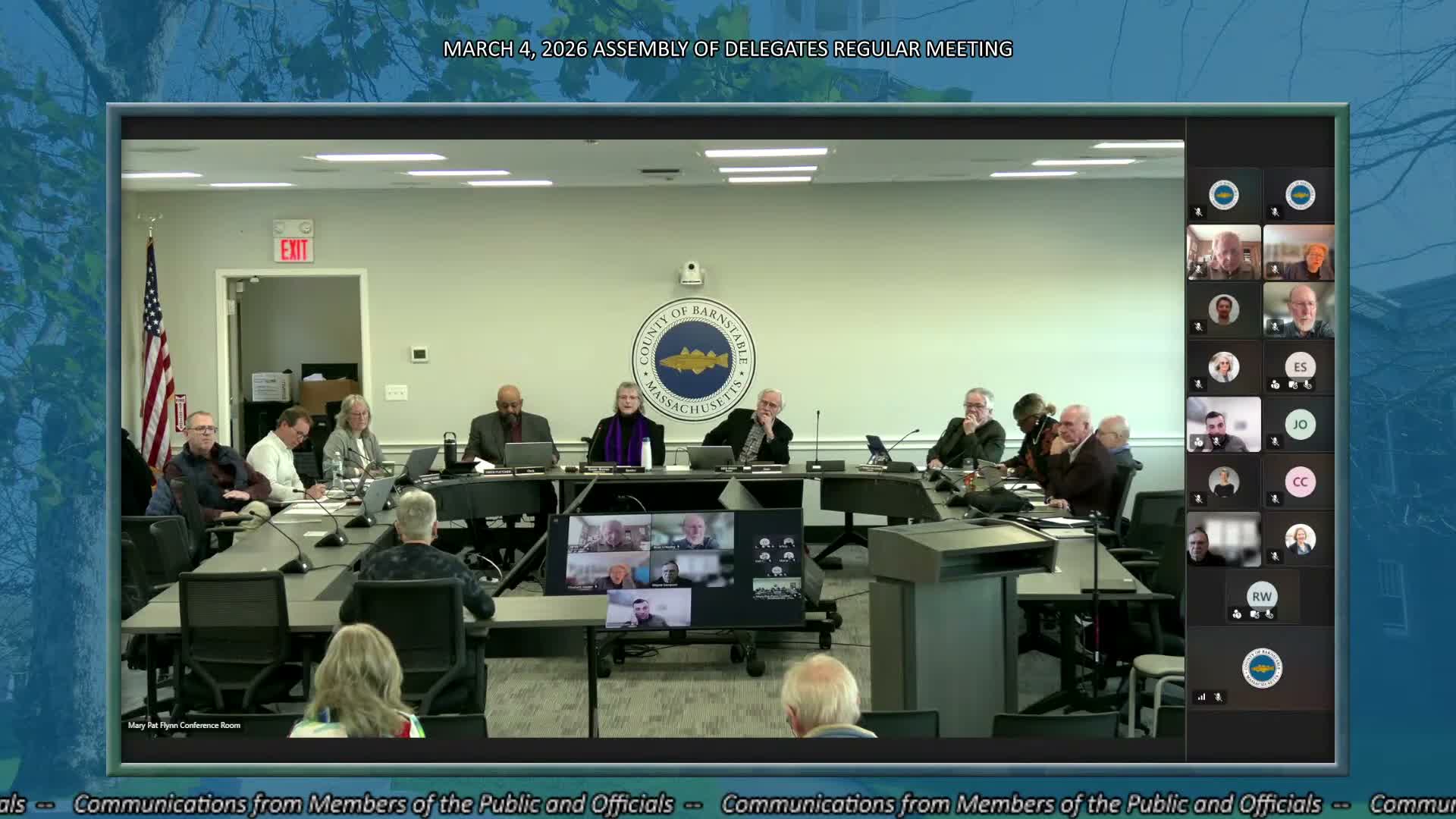
Summary
Assistant County Administrator Vera Haric told delegates the county opened a multiagency coordination center and operated regional shelters and warming centers during Blizzard Hernando; partners including MEMA, Eversource, RTA and AmeriCorps supported operations and Haric said about 17,000 meals were delivered to shelters and warming centers.
Vera Haric, assistant county administrator, briefed the Barnstable County Assembly of Delegates on the county's response to Blizzard Hernando, saying officials opened a multiagency coordination center (MAC) Sunday evening and kept it staffed through Friday.
"We opened the MAC for informational purposes on Sunday evening, and the MAC stayed open until Friday at 3PM," Haric said, describing the MAC as the "nerve center" of regional coordination with embedded staff from Massachusetts Emergency Management Agency (MEMA), Eversource, the Red Cross and other partners.
Haric said the county stood up four regional shelters and multiple warming centers during the storm; the Family Table Collaborative, led by Jenny Wheeler, prepared food that was distributed with substantial support from the Regional Transit Authority. "They produced and delivered 17,000 meals over the period to both shelters and warming centers," Haric said.
Delegates questioned whether the county had completed an after-action review. Haric said the formal "hot wash" had not yet produced conclusions: "Not yet. I think everyone is still catching up on their sleep... It's gonna be a process that has outcomes and written reports," she said, adding that incident commanders and regional partners will pull together recommendations.
Several delegates pressed Haric on specific failures during the response: one delegate said police at the Eastham station could not be reached by phone when residents needed transport before streets were plowed and reported widespread cellular outages. Haric said the county was not directly responsible for local police communications or cell service but noted that backup generators for cell systems can run only so long and that prolonged outages likely overwhelmed generator shifts.
Other delegates highlighted volunteer support and tribal and nonprofit partners. A delegate thanked the Wampanoag tribe and World Central Kitchen for opening a shelter in Mashpee; Haric said Nelson Andrews of the Wampanoag tribe participated in planning calls and the county was prepared to surge resources if needed.
Haric also updated delegates on related county business reported at a commissioners' meeting: two ordinances had taken effect after the statutory 10‑day period, and commissioners discussed consent-agenda items tied to Massachusetts Department of Transportation takings for the Bourne Bridge replacement. She also noted a virtual public meeting on PFAS cleanup at the former fire training academy scheduled for Tuesday, March 10 at 6 p.m.
Haric said she had not heard of any storm-related fatalities and praised AmeriCorps volunteers and municipal emergency managers who staffed shelters and response operations. The assembly did not take formal action on the storm update; Haric said the county will follow up with written after-action materials and a public meeting series for PFAS cleanup.