
Senate committee advances bill to codify objective licensure standards for five trades
Get AI-powered insights, summaries, and transcripts
Subscribe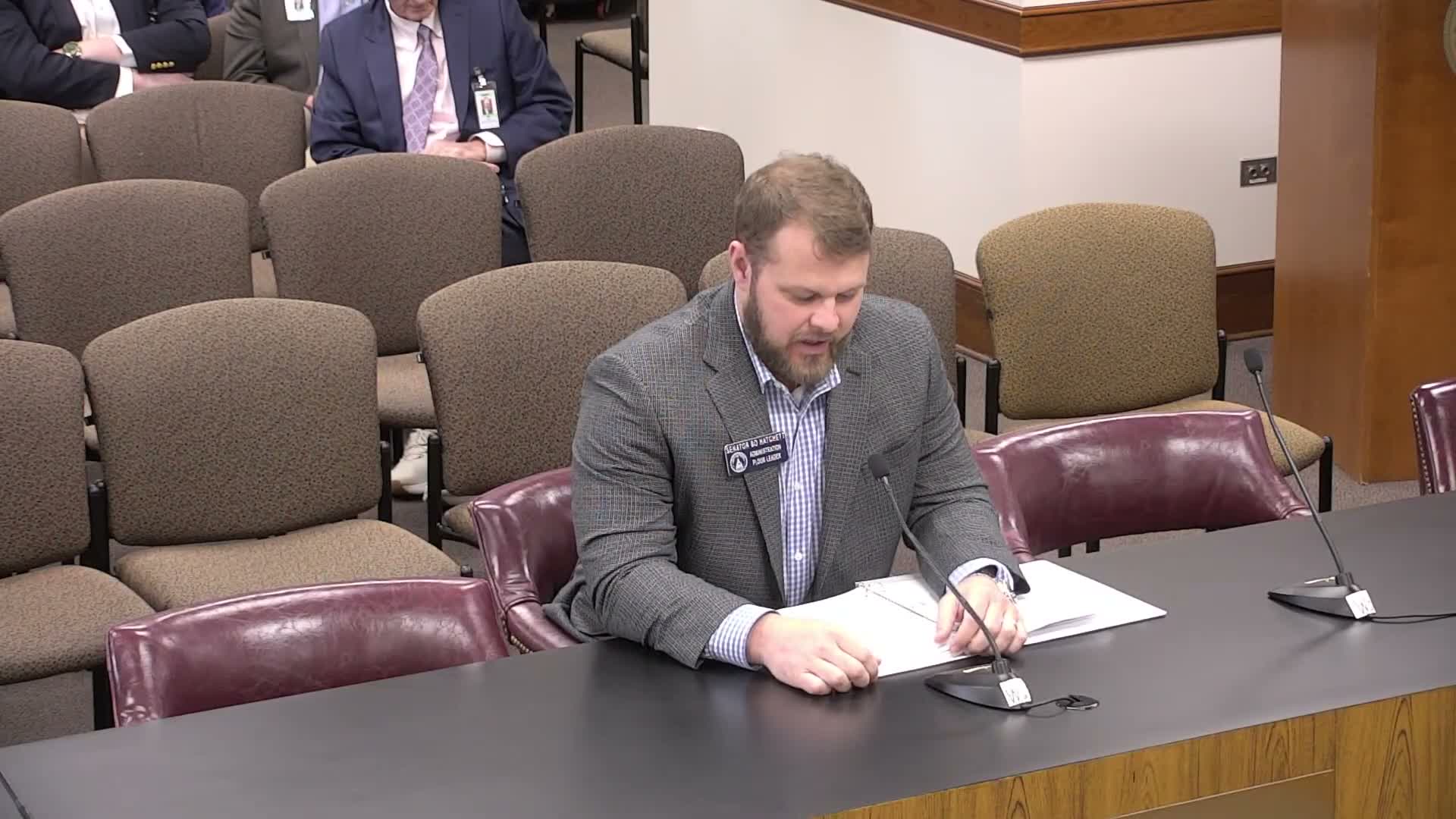
Summary
A Senate committee unanimously passed a substitute for Senate Bill 553 to move subjective board rules into statute for five trade divisions, requiring measurable experience, affidavits for verification and revised exam timing; proponents said it improves transparency while members pressed staff on verification and potential protectionism.
Senate committee members on Monday advanced a committee substitute for Senate Bill 553 aimed at codifying objective licensing requirements for five construction-trade divisions and reducing reliance on subjective board rules.
The measure, presented by Senator Hatchett on behalf of Governor Kemp, would set defined years of experience, require affidavits from licensed supervisors to verify work, identify approved educational programs, and change the exam process so applicants must pass exams before filing an application with the board. Hatchett told the committee the objective is to “streamline a very confusing and quite frankly outdated licensing process” so “anyone pursuing a trade can read the law and know exactly what they need to do to qualify for licensure.”
Supporters said the bill addresses two legal developments. Committee witnesses and the sponsor cited recent court decisions requiring clearer statutory standards and limiting broad delegations to boards; sponsor JC Martin described the measures as a response to nondelegation rulings and a companion to prior legislation including last year’s SB 635. The sponsor and staff said the goal is transparency and predictability, not protectionism.
Committee members focused questions on how experience would be verified and whether the bill unintentionally restricts entry into the trades. Senator Lucas asked who would verify the 2,000 hours of full-time experience; Amy Dorman of the governor’s office said the affidavits signed by an employer or licensed supervisor will be the primary verification method and can be submitted through an online portal: “So the affidavits would be what verifies the hours of work.” JC Martin added that U.S. Department of Labor apprenticeship programs will count toward required experience.
Committee members also pressed on local-government authority and homeowner exemptions. Staff clarified localities can adopt building codes and enforce permits but do not have the power to revoke a state license; the bill does not change the longstanding rule allowing homeowners to do work on their own homes without obtaining a contractor license.
The substitute makes several specific changes to experience requirements in the trade divisions discussed: it sets residential (restricted) electrical (class 1) experience at three years and unrestricted electrical (class 2) at four years, codifies journeyman plumber requirements (reduced to one year in code where previously set by board rule), and reduces master plumber class 1 from five to four years while keeping class 2 at five years. Staff said most existing licenses and certificates would remain valid under the new statutory structure.
Industry groups represented at the hearing — including the Mechanical Contractors Association, the Plumbers Association, the Atlanta Electrical Contractors Association, the Georgia Utility Contractors Association, the Conditioner Association of Georgia and the Independent Electrical Contractors — told the committee they worked closely with the governor’s staff and support the substitute. Lee Lemke, speaking for multiple contractor associations, said, “We are good with the bill as it is.”
Concerns persisted among some members about enforcement and whether affidavits could be policed for smaller or salaried employers who may not track hours as precisely as larger firms. Senator Brass summarized the tension, asking whether licensing intended to protect the public had become a mechanism that hinders workforce entry; the sponsor responded the bill aims to prevent boards from using subjective criteria to exclude applicants and to make qualifications objective and verifiable.
A committee member moved to pass the Senate substitute (LC560640ECS). The chair recorded the voice/hand vote as passing unanimously, 8 to nothing, and sent the substitute to the rules committee.
The committee adjourned; no further action was taken at that meeting.