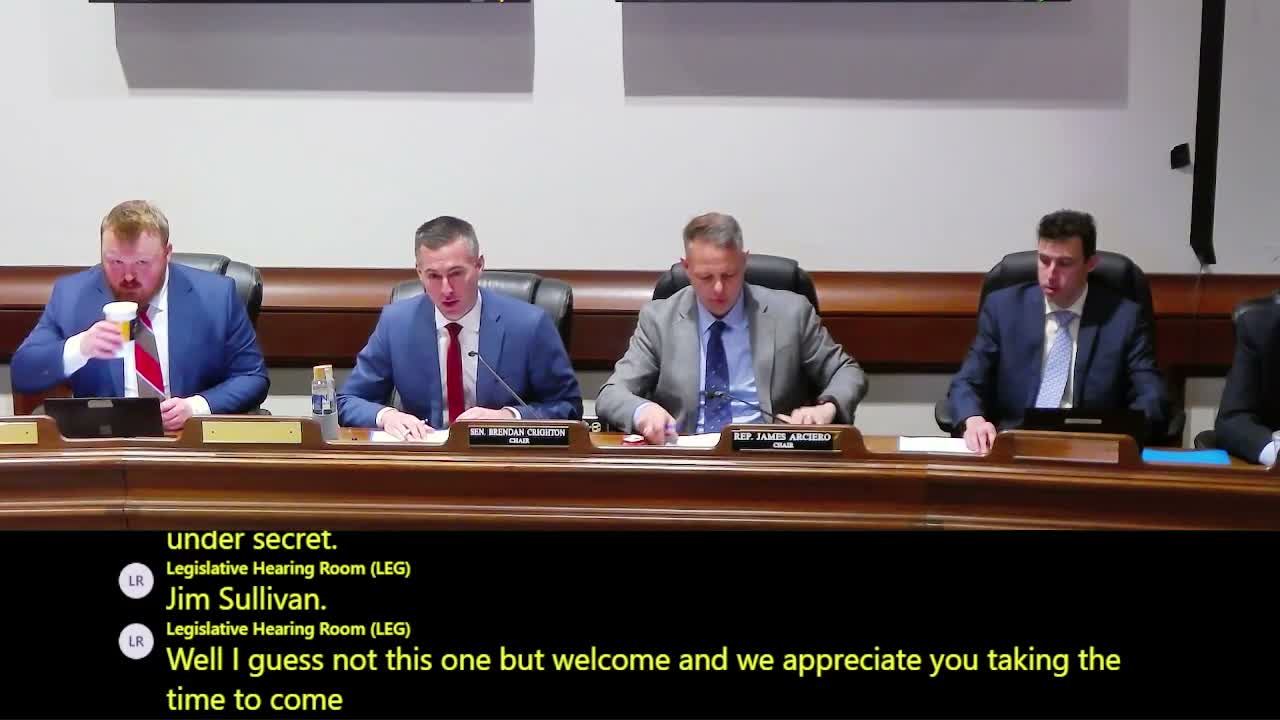
House panel hears administration, municipalities back multiyear Chapter 90 transportation bond bill
Loading...
Summary
Administration officials urged the committee to approve House Bill 4,987, a $5.5 billion transportation authorization that would lock in $300 million per year for Chapter 90 over four years and provide dedicated funds for MBTA modernization, bridges and housing‑supporting projects; municipal leaders stressed predictability for local planning while members pressed on revenue and federal grant risks.
Phil Ng, interim secretary of transportation and general manager of the MBTA, urged the Joint Transportation Committee to endorse House Bill 4,987 as a “generational investment” that would stabilize road and bridge funding for cities and towns across the Commonwealth.
“The Chapter 90 bill is a critical component in our vision for regional rail,” Ng said, describing recent municipal awards and the bill’s $200 million set‑aside for MBTA rail modernization and another $200 million to support transportation investments tied to new housing. He also noted a recently launched procurement for battery‑electric locomotives and a mix of Tier‑4 diesel and battery options to improve regional rail reliability.
The administration framed the measure as a broad financing package. Samantha Silverberg, undersecretary for transportation policy, said the bill complements an $8 billion, multi‑year strategy that blends fair‑share state revenue with federal grants. “Federal grants continue to be a major source of funding,” Silverberg said, citing recent Safe Streets and Roads and Federal Transit Administration awards that the administration said it used to leverage state matching funds.
Jonathan Gulliver, the undersecretary and highway administrator, laid out the bill’s programmatic structure: a four‑year Chapter 90 authorization totaling about $1.2 billion, $65 million for the municipal pavement program, $12 million for shared streets grants, $500 million for accelerated road and bridge improvements under the FAIR program, $2.3 billion in authority for federally eligible highway projects (including a $460 million state match), and $800 million for non‑federal highway projects. Gulliver said the bill also keeps a $100 million allocation determined strictly by local road miles to help rural communities.
Jennifer Sullivan, undersecretary for administration and finance, described the financing mix, including surtax or “fair share” revenue dedicated to the Commonwealth Transportation Fund (CTF) and bonding authority that would be used to finance the package. She and other administration witnesses emphasized that Chapter 90 authorizations are capital measures backed by CTF revenues (registry fees, gas tax and fair share revenue), which they said are more insulated from near‑term general fund pressures.
Committee members welcomed the predictability but pressed the administration on fiscal risks. One lawmaker warned that a ballot question to reduce the state income tax could shrink future revenues and asked whether a four‑year authorization was prudent. Sullivan responded that the Chapter 90 bonds would be financed by the CTF and are not drawn from the operating budget, while Silverberg and Gulliver added that predictable multi‑year funding helps municipalities plan and reduces long‑term costs by avoiding reactive, higher‑cost repairs.
Members also asked about exposure to changing federal grant rules. Administration witnesses said federal funding is competitive and some programs have tightened, but that MassDOT and MBTA continue to pursue grants aggressively and use state resources to maximize projects when federal awards are delayed or not obtained.
Municipal leaders who testified later urged the committee to approve the bill. Adam Shaptelain, executive director and CEO of the Massachusetts Municipal Association, said the measure’s multi‑year certainty is vital to 351 cities and towns and recommended a favorable report. Town officials provided local detail: Jeremy Marsett (Sherburne) said his town’s pavement management study recommends $1.3 million annually to maintain current conditions; Veronica Blanchard (Conway) described the high per‑mile costs for paving and for maintaining gravel roads and said it would take decades to repave all local roads without more state support; and Jeff Colby (Yarmouth public works director) said Yarmouth would need roughly $10 million to tackle its backlog.
Advocates and policy groups urged the committee to use the bond bill to also advance policy reforms. Tom Ryan of A Better City suggested pairing authorizations with procurement and electrification timelines and other policy actions the committee might pursue. Georgia Barlow of the Metropolitan Area Planning Council urged attention to complementary revenue tools and highlighted the bill’s $200 million for projects that unlock housing development and another $200 million for parkway resilience under DCR.
The hearing closed with brief audience input urging the committee to revisit the structure of local fees — including the TNC per‑ride fee that is set to sunset — as possible supplementary revenue tools.
The committee did not take a vote during the hearing; members said they will continue consideration as the bill moves through the legislative process.