Get Full Government Meeting Transcripts, Videos, & Alerts Forever!
Get email alerts on the Government Finance topic
No spam. Unsubscribe anytime.
Committee member urges automated audits to curb improper health-care payments; witnesses warn limits of current AI
Summary
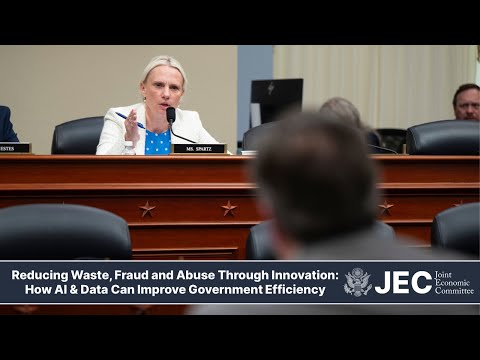
At a Joint Economic Committee exchange, a committee member argued for greater use of automated controls and continuous auditing to detect improper government health-care payments. Witnesses said automation can help but cautioned that current artificial intelligence cannot make fully deterministic decisions for final dispositions.
A committee member at the Joint Economic Committee pressed witnesses on expanding automated controls and continuous auditing to prevent improper government payments, saying, "All transaction that government disperse should be properly approved and authorized." The member cited private‑sector auditing experience and called for better matching of databases and automated checks to improve oversight of health‑care spending.
An agency official testifying in the hearing agreed that appropriate documentation and controls matter but cautioned about the limits of current artificial intelligence. The official said, "there the science right now does not support, artificial intelligence that is deterministic," and emphasized that automation’s usefulness depends on the specific technology and use case.
A medical witness also urged increased automation for fraud prevention. "I would say automation to eliminate improper payments," the witness said, arguing that reducing improper payments would save money or allow funds to be redirected to beneficiary services.
The committee member framed the exchange as part of a broader effort to ensure taxpayer dollars deliver value in health care and to reduce abuse of broad statutory authorities. The member argued that fraud and overbilling in programs such as Medicare and Medicaid had been treated as bipartisan problems in the past and expressed concern that the issue has become partisan.
Neither witness endorsed fully automated, unreviewed determinations. Instead, the agency official and the witness both described automation and continuous auditing as tools that can improve detection and control environments while cautioning that human oversight and careful implementation remain necessary.
The committee member concluded by urging simplification of billing processes and improved controls and then yielded back their time.