Get Full Government Meeting Transcripts, Videos, & Alerts Forever!
Get email alerts on the Improper Payments topic
No spam. Unsubscribe anytime.
Joint Economic Committee members weigh direct deposit and AI to curb stolen Treasury checks
Summary
At a committee hearing, lawmakers and witnesses discussed rising theft of Treasury checks, citing GAO estimates of large improper-payment totals and constituent losses. Proposals centered on moving recipients to direct deposit, tracking checks, and building validated datasets for AI-based fraud detection.
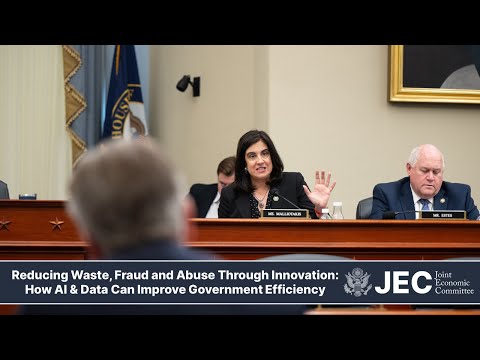
A congresswoman told a Joint Economic Committee hearing that her district has seen a wave of stolen Treasury checks and urged steps including broader use of direct deposit, tracking of checks and application of artificial intelligence to detect fraud.
She cited large figures she said were discussed earlier: "the GAO estimates a total of 162,000,000,000 in improper payments in fiscal year 20 25 and more than 2,800,000,000,000.0 since 2003," and said her district had "roughly 400 constituent cases of stolen federal checks that total $5,400,000." She pointed to a presidential executive order and recent House-passed legislation aimed at allowing recipients to get reissued payments via direct deposit and asked witnesses for practical solutions.
Mr. Chilson, invited to speak by the member, urged immediate expansion of electronic payments. "Taking the middleman... and doing direct deposit makes a ton of sense," he said, arguing that commercial payment firms already invest heavily in systems to detect when electronic transfers fail or are misdirected.
Dr. Thomas, a GAO-affiliated witness, said analytics and AI could help verify whether intended recipients actually receive payments but cautioned that the government has not yet validated technical approaches for stopping so-called check-washing. "We can't get into a habit of marking something that is not fraud and making a guess at it," he said, adding that two central barriers to deploying advanced AI are "the partitioning of data" across agencies and the lack of "foundational data that is validated" — a "gold standard dataset" that auditors and Inspectors General would certify.
When asked about Social Security Administration data-sharing authority that is set to expire next year, and about how much that authority has recovered, the member said she understood the figure to be about $31,000,000. Dr. Thomas said he would provide exact figures after the hearing.
The exchange left no formal actions on the record; witnesses offered follow-up commitments and stressed that solutions would require multiagency data-sharing agreements, validated datasets and reliance on commercial electronic-payment practices as near-term mitigations.