Get Full Government Meeting Transcripts, Videos, & Alerts Forever!
Get email alerts on the Oversight topic
No spam. Unsubscribe anytime.
Experts tell Joint Economic Committee that political friction and weak operations block fraud controls; OMB urges AI accountability
Summary
Experts at a Joint Economic Committee hearing told lawmakers that political resistance and operational shortcomings, not lack of recommendations, are the main barriers to tackling improper payments in federal programs; panelists said AI tools are underused and cited new OMB guidance that would place AI risk ownership with mission leads.
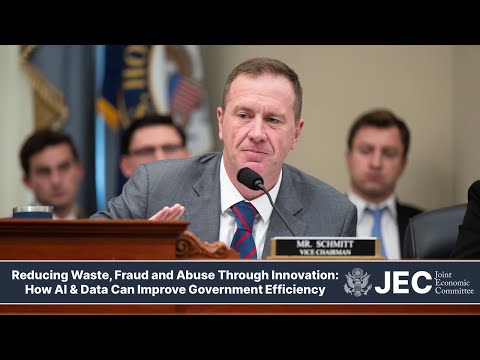
At a Joint Economic Committee hearing, witnesses and lawmakers wrestled with why longstanding recommendations to curb improper payments and fraud in federal benefit programs have not been put into practice and whether artificial intelligence can help.
A committee member pressed the panel on the "disconnect" between reports that identify improper payments and the failure to translate recommendations into agency action. The member said he wanted to use the hearing to understand "how we're at where we're at" and why controls are not effectively adopted.
Dr. Miller, an expert witness, told the committee two central barriers are at work. "One is, whether it's fraud or an improper payment, that's someone's revenue, and that person who has revenue doesn't like when you take their revenue away," he said, describing political resistance to enforcement. He added that agencies also often lack operational plans or fail to execute them: "We issue a nice report, write a nice paper, and then we don't get the agency wheels going to address it."
Dr. Miller gave a specific example: the lack of prepayment claims-editing for Medicare and Medicaid, a procedural gap he said would prevent many improper payments if implemented. "We should have prepayment claims editing in Medicare and Medicaid to prevent that from happening," he said.
On whether AI tools are in use to detect fraud, the committee member asked whether agencies are deploying such systems beyond high-profile, outside investigations. Panelists said deployment remains limited. One participant summarized the view that agency use of AI is not yet widespread or effective.
A second committee participant recommended that Congress increase transparency about outstanding recommendations and press agencies to explain what prevents implementation—whether it is staffing, funding, time or competing customer-service priorities. "What's prohibiting you from implementing it?" the participant asked, urging lawmakers to seek direct accountability.
An agency official pointed to recent Office of Management and Budget guidance issued the previous week on AI implementation. The official said the guidance recommends that "the responsibility for addressing and owning the risk be on the person who is responsible for the mission of the process that AI is being deployed for," arguing that naming a mission owner who must sign off would bring necessary scrutiny to new technologies. The official acknowledged uncertainty about how to retrofit that approach into existing agency practices.
No formal motions or votes were recorded in the transcript. The hearing focused on diagnosing obstacles and on oversight approaches—improved transparency, clearer lines of accountability inside agencies, and technical fixes such as prepayment claims-editing—rather than on immediate policy changes.
Lawmakers signaled interest in follow-up: they discussed potential oversight steps, including hearings and demands for agency explanations of resource and implementation gaps. The record ends with the panel noting the new OMB guidance as a potentially useful lever but without a consensus on next steps.