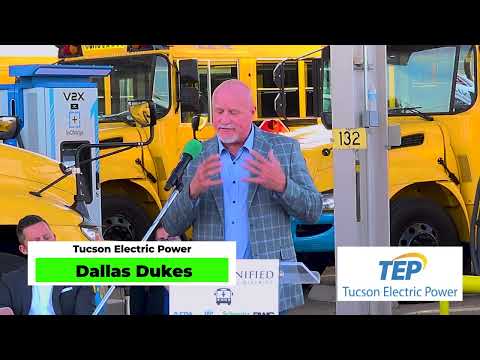
Tucson Unified District (4403) unveils 10-bus electric pilot and bidirectional charging system
Loading...
Summary
Tucson Unified District (4403) announced a pilot deploying 10 electric school buses and a bidirectional charging system; speakers said the trial will test range, maintenance costs and grid-relief capability, funded by a federal EPA program (unnamed), a TEP rebate and district funds.
Tucson Unified District (4403) announced the launch of a pilot program to put 10 electric school buses into service and celebrated the ribbon cutting for a bidirectional charging system the district and partners said is the first for an Arizona school district.
Superintendent said the delivery and deployment mark a milestone for the district and its fleet. “These are the best moments of the superintendency when the community comes together,” the Superintendent said, and noted the district will operate the 10 buses as a pilot to gather data on costs and performance.
A district official described the pilot as a chance to reduce the district’s environmental footprint while evaluating maintenance and operational costs. “It will also give us the opportunity to see how far these vehicles go on one single charge,” the Staff member said, describing range testing under local conditions.
A Presenter identified the manufacturer and provider for the buses, saying they are manufactured by IC Bus and provided and supported by RDBC Group. The Presenter also emphasized environmental benefits, asserting the buses will produce “0 emissions.” The article reports that claim as stated by the speaker; no independent emissions verification is provided in the transcript.
At the ribbon-cutting, a Presenter explained the bidirectional charging system and its potential grid benefits: “What that bidirectional technology does is it allows the district to be able to charge their buses just like normal, but also be able to send power back to the grid,” they said, and added that TEP and the district were able to use the system to add grid relief during high energy use.
Speakers cited funding sources for the pilot. A district official listed a federal EPA school-bus refund program (not named in the transcript), a TEP rebate and district funds as supporting the electric buses. The transcript does not give amounts or program names beyond the references above.
A current TUSD student who spoke during the event said, “I’m excited to see buses that are cleaner, safer, and better for our communities,” and added that electric buses can mitigate diesel-related air quality issues for students. The student also noted the buses will be identifiable by a blue bumper.
The district said it will use the pilot to perform a cost-benefit analysis and to test operational range and maintenance under local conditions. The transcript records no formal votes or binding decisions during the event; timing for fleet expansion or further procurement was not specified.