Get Full Government Meeting Transcripts, Videos, & Alerts Forever!
Get email alerts on the Solid Waste Rates topic
No spam. Unsubscribe anytime.
Enid staff warn solid-waste fund could run deficit; study proposes $2 monthly residential increase and automatic annual raises
Summary
Staff presented a consultant solid-waste rate study showing the fund may be depleted by 2032–33 under current rates and proposed raising the single-family Poly Cart fee from $16 to $18, increasing secondary-cart charges and considering automatic annual adjustments; no ordinance vote occurred tonight.
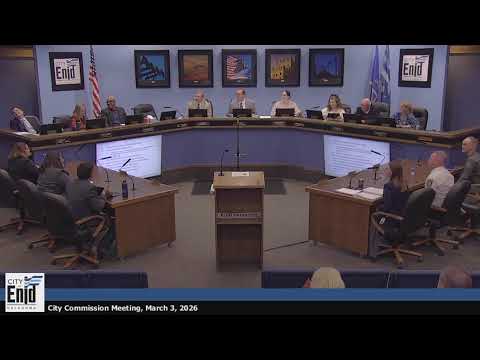
City staff and the utility director told the Enid City Commission on March 3 that a consultant model shows the city’s solid-waste fund could run a deficit in the early 2030s if rates remain unchanged.
Scott (city staff) introduced the study’s purpose and said the model accounts for fleet and equipment costs, landfill expenses and inflation. “The general fund had $14,000,000 transferred into it from the EMA,” Scott said, explaining the city relies on enterprise fund transfers. Brooke Brandenburg, director of Public Utilities, summarized the consultant’s findings and recommended options. “If we make no changes,” she said, the model’s solid line “is significantly lower than our commitments,” and the fund’s reserves would be depleted by about 2032–33.
Brandenburg described a package the consultants recommended and staff is considering: raise the monthly residential Poly Cart fee from $16 to $18, increase the secondary Poly Cart fee from $5.50 to $9 and adopt a 2% automatic annual adjustment. She also proposed amending city code to allow the city manager to set landfill and certain commercial rates administratively so the city can respond faster to changing costs.
Commissioners pressed staff about timing and details. One commissioner said the study’s consultant recommendation of 4.5% annual increases “is just barely making it” and urged caution; Brandon acknowledged staff is not yet recommending a specific ordinance and said the city will return with formal language. Scott and Brandenburg noted that the study includes an Excel forecasting tool staff can update and that some large equipment purchases (for example, a BOMAG unit costing near $984,000) drive timing of deficits.
Brandenburg said the recommended fee package would put the city on par with comparable communities and push the timing of a deficit further into the decade. She added staff will monitor cash reserves, capital needs and opportunities to expand service to adjacent territories to increase revenue. The commission did not vote on rate changes during the meeting; staff said they will return with proposed ordinance language for consideration.
What happens next: staff will prepare ordinance language and bring proposed rate changes and administrative-code revisions back to the commission for formal consideration.