
Concord Municipal Light Plant to move residents to time-of-day electricity rates starting April 1
Get AI-powered insights, summaries, and transcripts
Subscribe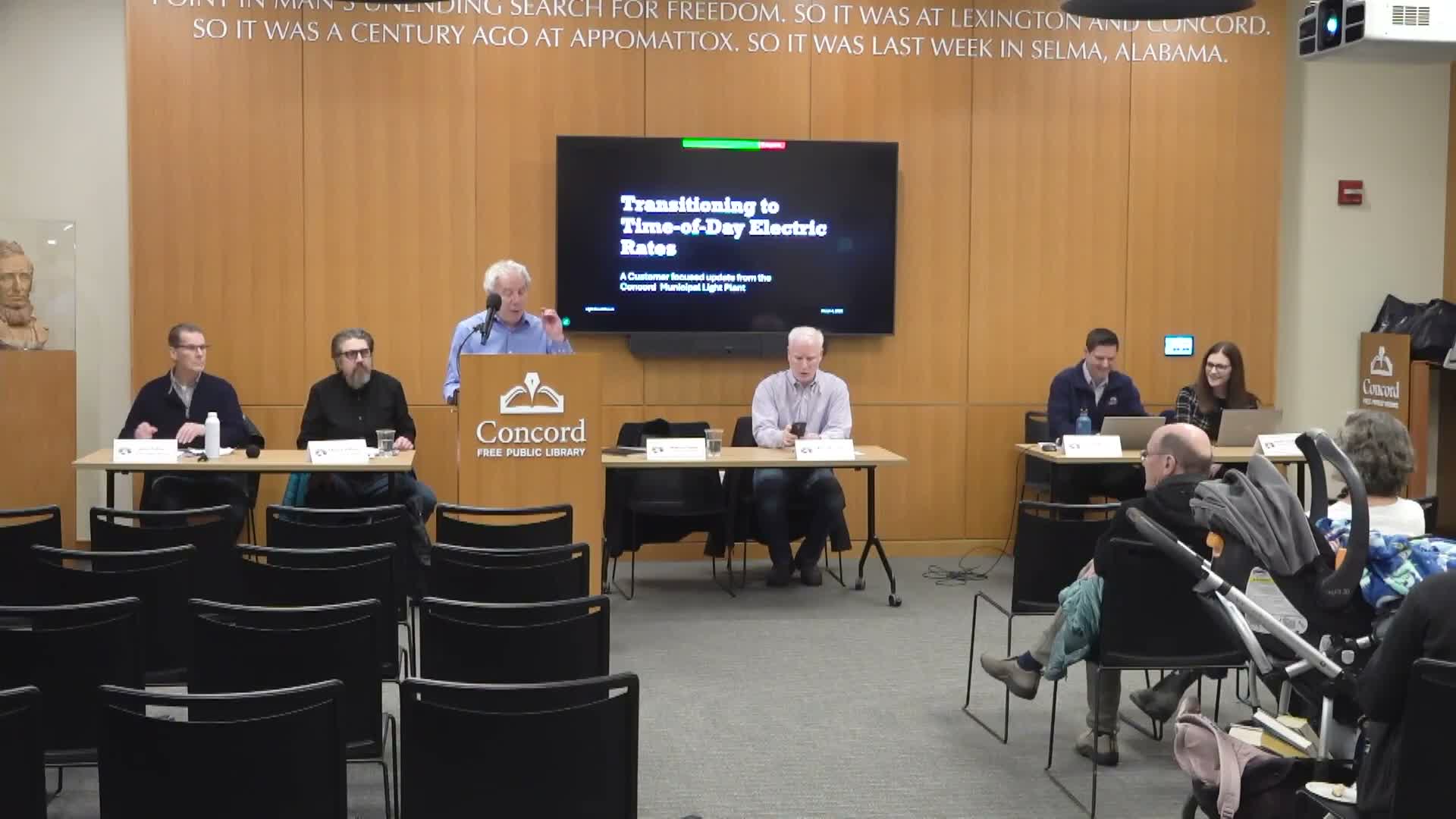
Summary
Concord Municipal Light Plant staff told residents the new time-of-day (TOD) residential rate goes into effect April 1, with the first TOD bills arriving in May; the board plans a phased, revenue-neutral rollout, an opt-out option and online tools to help customers shift usage and save.
The Concord Municipal Light Plant will switch residential customers to time-of-day (TOD) electricity rates on April 1, staff said at a public board meeting, a change the plant expects will better align charges with the cost of supplying power and help lower peak-driven transmission and capacity costs.
"This change to time of day rates has been in the works for a long time," Chair Warren Leon said, opening the meeting. Director Jason Bulger told attendees that customers will be automatically moved to TOD on April 1 and will see their first TOD bill in May, and that the new rate design is revenue-neutral—"we did not need to take in any more revenue," Bulger said.
Staff and board members described TOD as a way to send price signals to reduce demand during weekday peak hours (3–7 p.m.) and to reward use during super off-peak hours (1–5 a.m.). Board member Brian Folds said TOD can lower the Concord plant's costs for capacity and transmission, and therefore lower customer bills over time. "When we lower our peaks, we turn off those peaker plants that are quite polluting," Folds said, citing both cost and emissions goals.
The board said the program is being phased in to ease the transition. For 2026 the plant will implement about one-third of the cost-of-service differential (phase 1); staff estimated the phase‑1 on-peak price around 30¢ per kilowatt-hour with an estimated on-peak price near 48¢ in 2027 under the full cost-of-service design, while super off-peak prices in phase 1 were described around 20¢ and estimated to fall to about 17¢ in 2027.
Bulger said the plant's decision follows investments in advanced meters and a consultant cost-of-service study that identified peak demand as a key driver of costs. He noted the plant purchases power under long-term renewable and nuclear contracts and buys additional energy on the regional market when needed, and that transmission/network service (RNS) charges have risen substantially in recent years.
Staff emphasized practical customer supports. Board member Chris Schaffner described three resources: the existing Connected Homes (Connected Solutions) program for compatible smart thermostats, water heaters and eligible EV chargers; simple behavioral changes such as delaying dishwashers and dryers outside 3–7 p.m.; and online calculators and staff-run, personalized analyses available at concordma.gov/tod. "If you have a smart thermostat or a home EV charger, the system...allows the system to automatically make tiny adjustments so that you're not using electricity at peak times," Schaffner said.
On enrollment and flexibility, Bulger said customers will be automatically enrolled but may opt out at any time; however, customers can change their enrollment only once in any 12-month period because of administrative complexity. He also said the Connected Solutions scheduling can be overridden by a customer or vehicle app, but billing reflects the actual time the vehicle or device draws power.
Several residents asked about heat pumps and EV charging. Staff advised owners of heat pumps not to aggressively cycle temperatures to chase peak savings, saying average heat pump users may save slightly without changing behavior and that the plant has prepared fact sheets for specialized cases. On EVs, staff said automatic scheduling works when vehicles and chargers are eligible and enrolled, but customers can override schedules and will be billed for when charging actually occurs.
The board and staff framed TOD as a long-term rate approach to be reviewed annually and adjusted as needed; they noted a phased approach is intended to give customers time to adapt before larger price differentials take effect. Staff said examples from other utilities (including Groton, Mass., and larger systems such as Sacramento Municipal Utility District) informed outreach and design choices.
The meeting closed with a procedural motion: board member Chris Schaffner moved to adjourn, a second was recorded (speaker not specified in the transcript) and the board voted 4–0 to adjourn. Staff remained available for informal, one-on-one questions after the public meeting ended.