
Parametrics study urges pilot adaptive signals, safety and active‑transport improvements for Tiburon Boulevard
Get AI-powered insights, summaries, and transcripts
Subscribe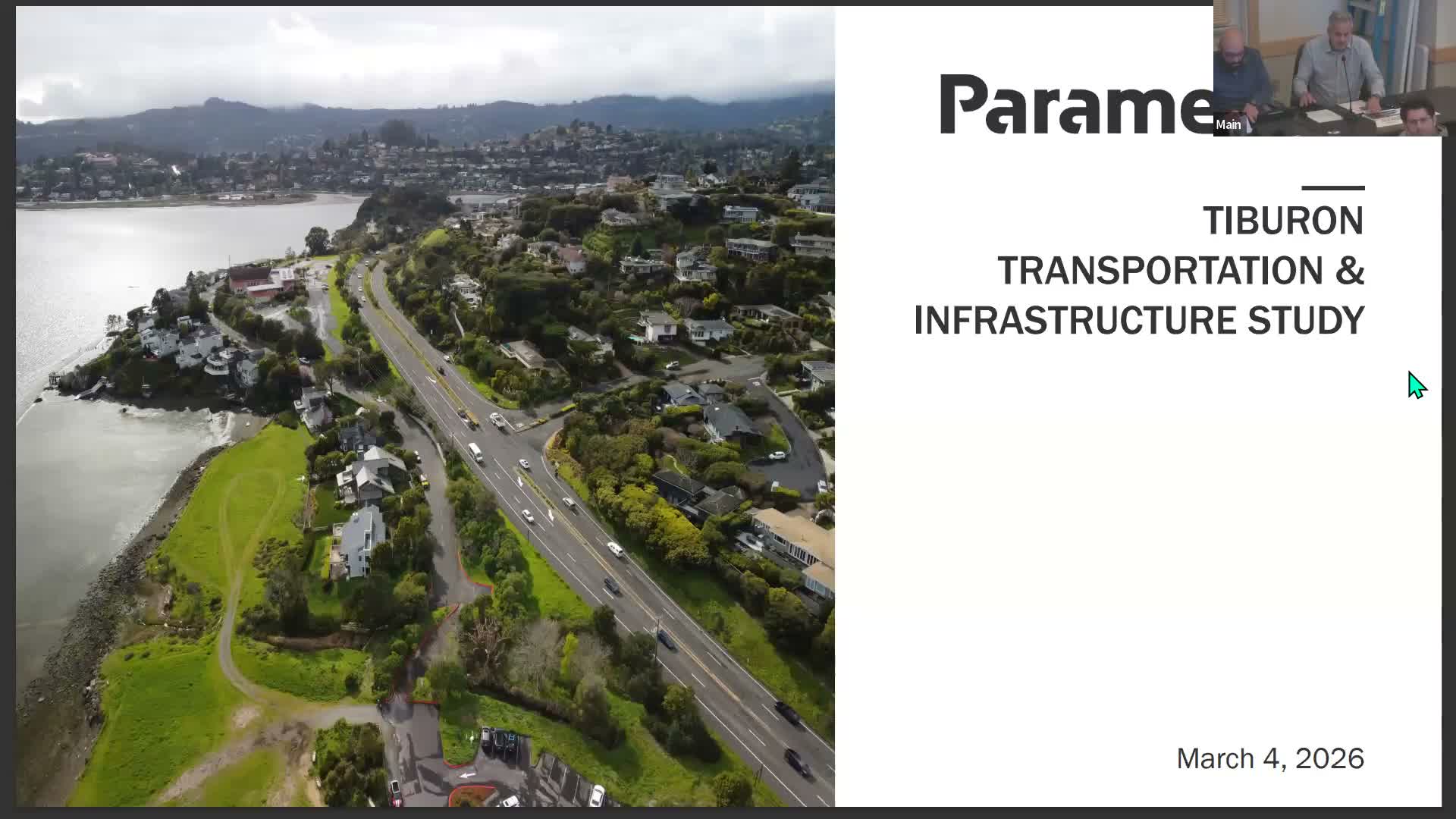
Summary
Parametrics presented a final draft transportation study recommending a pilot adaptive traffic signal program, targeted intersection capacity options (including Trestle Glen), school‑area safety measures and active‑transport projects; council asked the consultant for clearer travel‑time metrics and asked for further analysis before final acceptance.
Parametrics presented its final draft transportation and infrastructure study to the Tiburon Town Council on March 8, outlining short‑term operational measures and longer‑term capital concepts intended to reduce congestion and improve safety along Tiburon Boulevard and other town arterials.
David Priest of Parametrics said the study combined field counts, local crash data and public input. The project included an online survey with roughly 750 respondents, vehicle counts at three corridor locations (one site showed about 16,000 vehicles per day), and a five‑year crash review that found 31 reported crashes on Tiburon Boulevard from Jan. 1, 2020 through Dec. 31, 2024, with 37 percent of those crashes resulting in reported injury and five incidents involving pedestrians or bicyclists.
Key recommendations included piloting an adaptive traffic signal control system on the corridor (a coordinated, data‑driven system that adjusts signal timing in real time), targeted intersection improvements at the Trestle Glen bottleneck (options analyzed included a single‑lane roundabout, a multi‑lane roundabout or a short additional westbound lane), and a slate of pedestrian and bicycle improvements including sidewalk gap closures and potential undercrossing or overcrossing concepts at school locations. Parametrics also recommended maintaining and expanding the successful yellow school bus program and studying contractor‑traffic management to address peak direction construction vehicle flows.
Priest cautioned that adaptive signals are not a cure‑all for an oversaturated two‑lane corridor and stressed the need for Caltrans coordination because State Route 131 (Tiburon Boulevard) is under state jurisdiction. He also recommended a pilot approach to adaptive control coupled with improved communications infrastructure and sensors along the corridor.
Council members asked Parametrics to provide additional, quantitative travel‑time metrics showing how much time riders would save under different implementations ("beginner, mid, advanced" adaptive deployments) and asked spot analyses for Trestle Glen options. Parametrics said additional modeling and spot travel‑time analysis are feasible with remaining budget and asked for direction on which scenarios to quantify.
Public commenters largely supported a mix of measures: several residents urged a pilot adaptive signal program as a fast, relatively low‑cost test; others emphasized safety and continuity for bike and pedestrian facilities and supported Caltrans phase‑2 bicycle lane proposals; a handful of residents proposed larger capital options (roundabouts, undercrossings or a Del Mar tunnel) and asked for more study. Representatives from WTB TAM recommended prioritizing a continuous, separated active‑transport network to produce lasting mode shift.
Next steps: the council closed the public hearing and directed staff and Parametrics to return with a revised final report that includes clearer travel‑time estimates for the highest‑impact measures, a short analysis of the effect of capacity changes (including a requested high‑level look at wider cross‑section options), and expanded documentation on the trolley/tunnel proposals for future consideration.
Representative quote: "Adaptive control can help around the edges but it's not a panacea — the corridor is oversaturated," Parametrics said. "A pilot would let us see real effects and coordinate with Caltrans for a corridor approach."