Get Full Government Meeting Transcripts, Videos, & Alerts Forever!
Get email alerts on the Unpermitted Roadside Stands topic
No spam. Unsubscribe anytime.
Snohomish County officials cite health, safety and fairness concerns over unpermitted roadside food stands
Summary
Health officials told a county committee that unpermitted umbrella carts and canopy taco stands pose sanitation and safety risks, have surged in recent years and are difficult to police; the county will convene local partners in February while awaiting state legal guidance on disposal and seizure authorities.
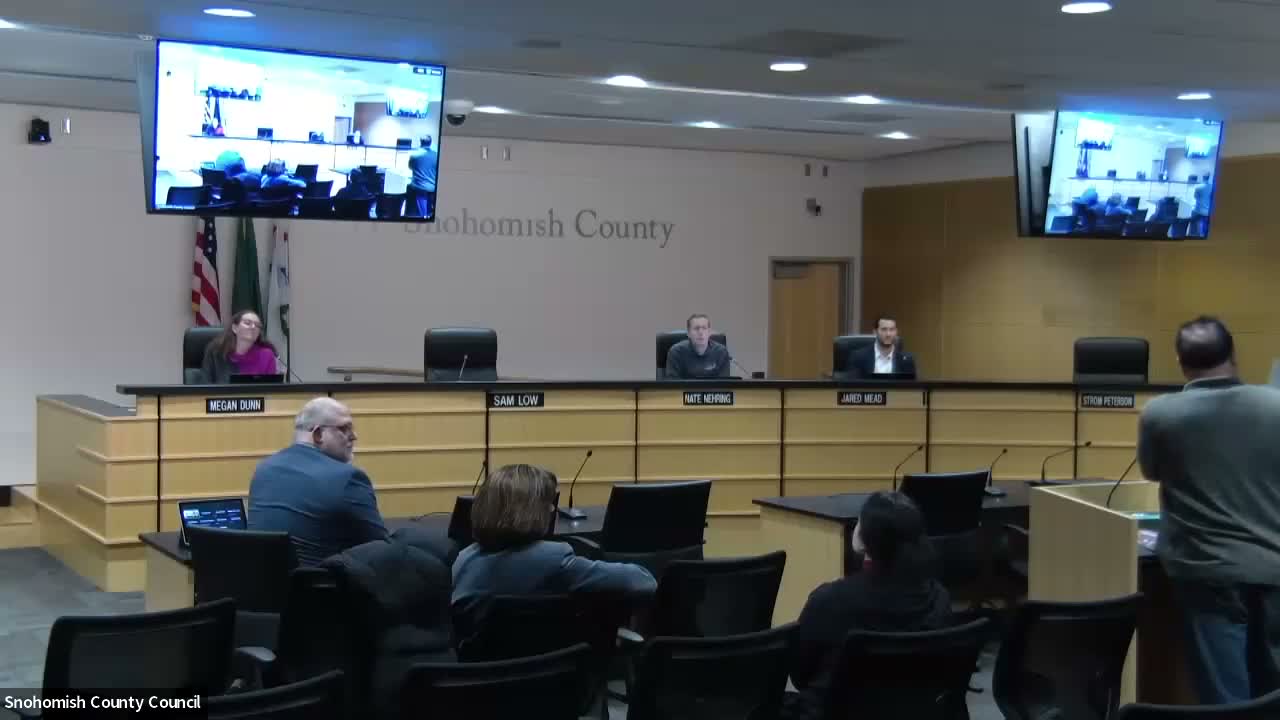
Tony Collinas, a health‑department presenter, told the Snohomish County Council Health and Community Services Committee on Jan. 27 that unpermitted umbrella carts and 10‑by‑10 canopy stands selling tacos and other foods create “a primary risk… around lack of sanitation,” with no handwashing, limited cold storage and cross‑contamination hazards.
Collinas said the county issues roughly 3,600 routine food permits and about 1,200 temporary event permits; inspectors handled more than 1,000 complaints last year across routine and temporary operations and have closed more than 40 unpermitted stands since May 2025. He described repeated night‑time reopenings of closed stands and said inspectors often pair after‑hours responses with law enforcement for staff safety.
Why it matters: Council members and members of the public said the stands create public‑health and traffic‑safety risks, including exposed propane tanks and blocked sidewalks, and undercut licensed businesses that pay fees and meet safety standards. Council members asked county staff whether local code changes or law‑enforcement tools could be used sooner if the state does not act.
The health department said enforcement is constrained by current state retail‑food code and by limits on inspectors’ authority. “Our inspectors are not law‑enforcement officers… we can’t request ID,” Health Department Director Kim Van Pelt told the committee, noting the department received a prior PA advisory that left authority to seize food or equipment unclear.
The department outlined a two‑track approach: it is participating in a statewide Department of Health work group that is exploring legal paths — including whether food served in unpermitted operations may be discarded — and it plans to convene local partners for two two‑hour meetings in February to review authority, best practices and local coordination. Collinas listed potential tactics under consideration: license‑plate tracking of vehicles tied to canopy stands, focusing enforcement on centralized kitchens that supply multiple stands, hauling and storing confiscated equipment, and expanded public education about how to identify permitted operators.
Council members pressed for quicker action at the local level if the state takes too long. Chair Mead said he will ask the sheriff’s office whether deputies can be more consistently deployed to request identification or take other enforcement steps when health inspectors encounter uncooperative operators. Several council members said they will pursue potential code changes or PA review to create clearer local authority if state guidance is delayed.
Public commenters who attended the meeting urged aggressive enforcement. One commenter said he is "not anti‑immigrant" but wants legal vendors protected from unfair competition by unpermitted street vendors; another identified herself as Rosario and said the activity has hurt her husband’s legally permitted taco stand.
What comes next: The health department has drafted invitations for a local convening of cities, law enforcement, the food‑truck association and business groups in February to discuss enforcement options. The county will continue closure postings on its public notification page, continue partnering with law enforcement for after‑hours responses and weigh code‑change options pending state guidance and PA clarification.
Ending: County staff asked the committee for direction and said they will return with updates after the February convenings; council members said they plan to follow up with the sheriff’s office and the county prosecutor’s office on enforcement options.