
Cowlitz County commissioners debate cuts, direct public-safety sales-tax proposal to voters 2–1
Get AI-powered insights, summaries, and transcripts
Subscribe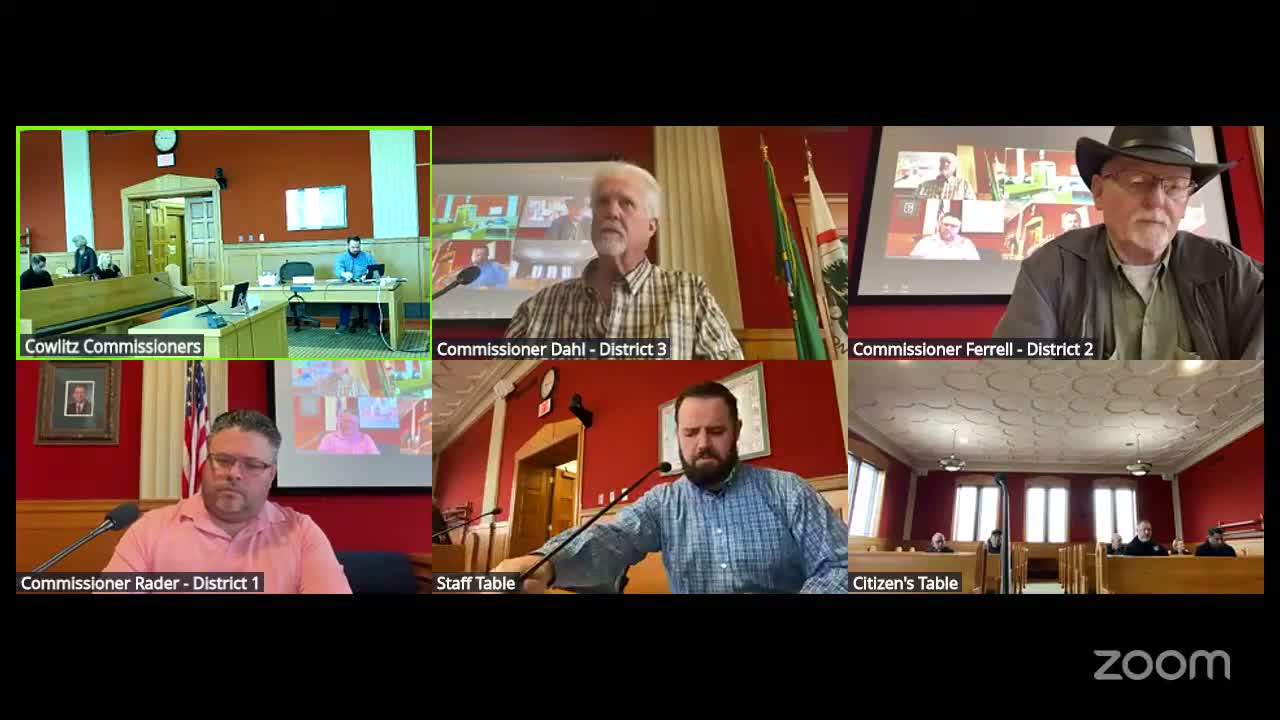
Summary
Facing a multimillion-dollar shortfall in 2027, commissioners discussed property-tax capacity, a behavioral‑health tax, a juvenile-detention tax and two versions of public‑safety sales tax; the board recorded a direction to advance a voted public‑safety sales-tax proposal to the ballot with a 2–1 split.
Cowlitz County commissioners on Monday weighed how to close a projected operating gap of roughly $10.3 million for 2027, considering a mix of revenue options and spending reductions before directing staff to pursue a voted public-safety sales-tax measure.
County staff summarized the situation, saying the board had approved 2026 revenues of $61,000,000 and expenditures of $74,000,000 and projected 2027 revenues of $69,300,000 against $79,500,000 in expenses, leaving a structural shortfall. The staff presentation listed several revenue options: taking the full 1% property-tax capacity and banking new-construction value; reintroducing a behavioral-health tax (estimated collection about $3.3 million); a voter-approved juvenile-detention sales tax (about $3.3 million at a one‑tenth percent rate); a public-safety enhancement sales tax the board can enact without a vote (one‑tenth percent); and a larger, voted public-safety sales tax of up to three‑tenths percent that requires sharing some revenue with cities.
Commissioner Dahl told colleagues he was uncomfortable shifting costs to taxpayers without contractually binding reductions elsewhere, saying the county must "live within what the people give us" and pressing for concrete expense cuts before pursuing new taxes. Another commissioner said the county faces a juggling act of state-imposed, unfunded mandates and agreed a mix of targeted revenue measures and cuts would probably be necessary. Department heads in the room warned that budget-driven cuts would reduce services and could force reduced hours or closed days at some county offices.
After discussion about timing and the May 1 deadline to put measures on an August ballot, the board recorded what staff described for the record as one no and two yeses regarding moving a voted public‑safety sales-tax proposal toward a public vote. The county said it would return with more detailed revenue estimates and options in coming weeks.
Why it matters: Commissioners face a tradeoff between asking voters to raise local taxes for public-safety and facility needs or imposing deep spending cuts that officials say would affect services countywide. The board’s decision to advance a voted measure (2–1) means voters could see a public-safety sales-tax question on a near-term ballot if the board finalizes that direction and meets ballot deadlines.
What happens next: Staff will refine revenue estimates and return to the board with detailed scenarios; if the board proceeds, the county must complete ballot paperwork by May 1 to appear in August.