Tempe consultants present preliminary Downtown Historic Core Plan, seek public feedback
Loading...
Summary
City of Tempe staff and consultants presented preliminary guidelines to balance preservation and downtown growth, including draft height zones, incentives for adaptive reuse, and public-realm priorities; consultants emphasized the draft status and scheduled more stakeholder outreach and a planned City Council review in July 2026.
City of Tempe historic preservation staff and consultants presented an early draft of a Downtown Historic Core Plan and invited public feedback at a virtual meeting. Zach Lechner, the City of Tempe Historic Preservation Officer, opened the session and said the materials are preliminary and subject to change.
Rick Barrett of MIG and Corky Poster, a subconsultant, summarized the plan’s goals and an engagement timeline. Barrett said the plan implements General Plan policy HP 7 and aims to balance preservation with downtown growth by establishing a planning framework, design guidelines and implementation tools. ‘‘We began this project in 2025 with analysis and community engagement,’’ Barrett said, describing workshops, commission briefings and a community survey used to date.
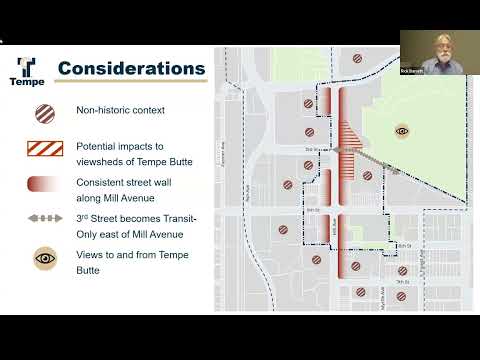
Consultants highlighted recurring public priorities: protecting views to Tempe Butte, preserving Mill Avenue’s low-scale fabric, supporting resident-serving businesses, and improving the public realm with shade, walkability and gathering spaces. Recommendations presented include drafting Downtown Tempe historic core design guidelines, exploring transfer-of-development-rights (TDR) mechanisms, and identifying growth areas outside the core for higher-intensity housing and employment.
On specific design guidance, consultants discussed protecting the Mill Avenue street wall, encouraging active ground-floor uses, and proposing height guidance that consultants described as a starting point: base heights of roughly 28–36 feet with a maximum of about 65 feet at the frontage and higher massing set back behind primary blocks (consultants mentioned the possibility of taller structures farther from the street). Corky Poster said the intent is compatibility, not mimicry: ‘‘we're not looking for mimicry in new development’’ but for designs that respect historic massing and pedestrian scale.
The plan also recommends civic anchors (for example near 5th and Mill and Mill and Rio Salado), a cultural spine with street-level art and wayfinding, incentives for façade improvements and tenant support, and sustainability measures such as shaded frontages, low-impact stormwater systems and tree canopy extensions. Consultants said they are exploring preservation incentives including grants, tax incentives, preservation easements and TDR to support rehabilitation.
Consultants stressed participation opportunities: a survey (posted on the project website) that closes March 18, an in-person open house at the Hayden House, additional stakeholder meetings and planned presentations to the Historic Preservation Commission and Development Review Commission preceding a targeted City Council review in July 2026. Barrett said the final report will include catalytic sites, financing options and metrics to monitor implementation.
The presentation closed with a public Q&A in which staff reiterated the draft nature of the work and encouraged community comments to shape the May draft and the final plan ahead of council consideration.