
Indio council extends 60‑day moratorium while drafting tighter rules for fueling stations
Get AI-powered insights, summaries, and transcripts
Subscribe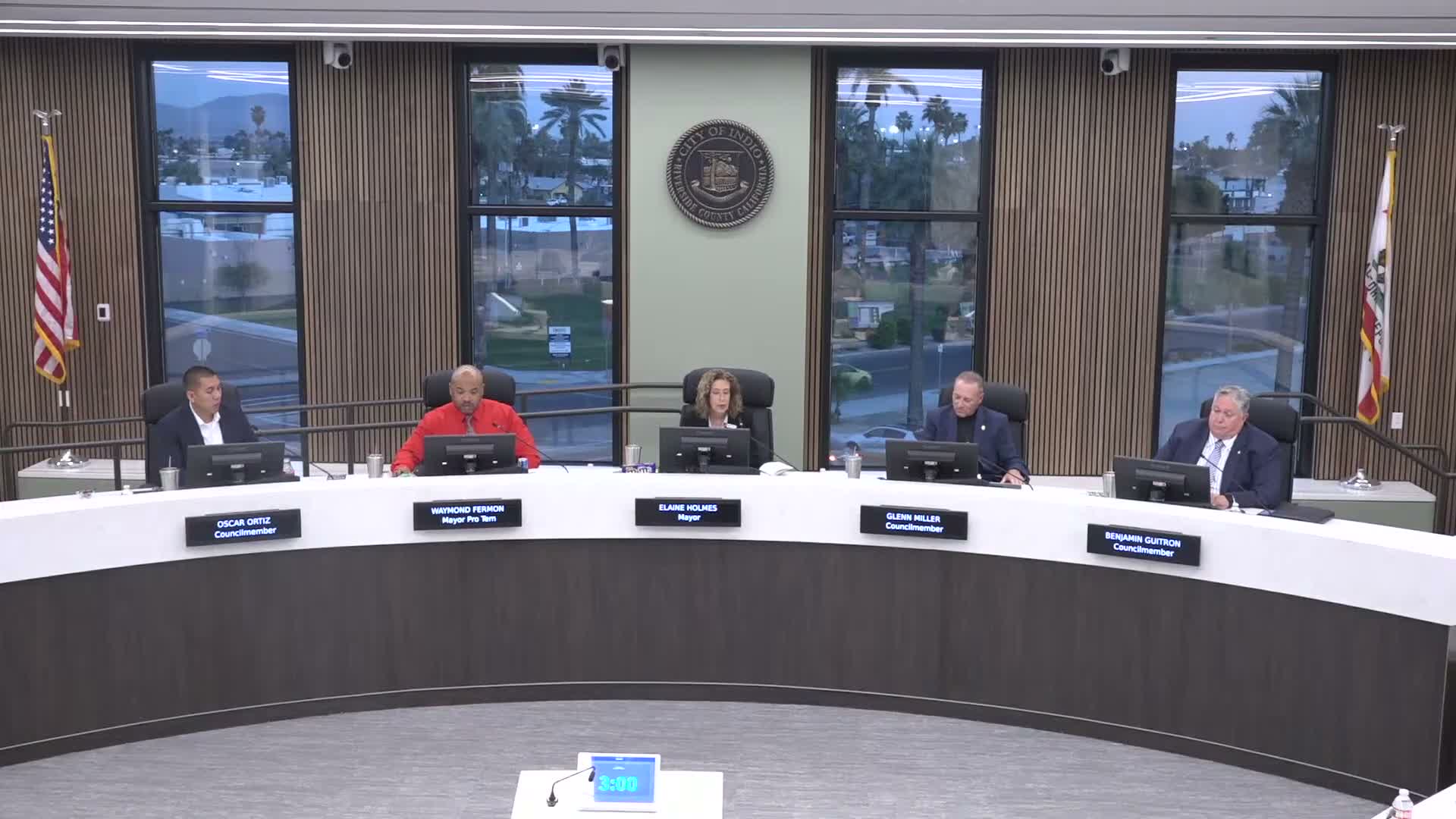
Summary
The Indio City Council voted to extend a 60‑day moratorium on establishment or expansion of fueling stations to give staff time to refine an ordinance with location, landscaping, design and EV‑charging requirements; council members asked staff to consider operational standards for existing stations and to provide a tax‑revenue breakdown.
The Indio City Council on March 4 approved a 60‑day extension of a moratorium on the establishment or expansion of fueling stations while staff refines a draft ordinance that would tighten location, landscaping, design and operational standards.
Brian Halverson, Indio’s director of community development, told the council the city is an entitlement jurisdiction for HUD‑style grants and staff work had identified an estimated $18,000,000 of unmet fuel demand — a figure council members asked staff to unpack with a tax‑revenue breakdown. Halverson summarized proposed changes that include increasing landscape coverage on site plans from roughly 10% to 20%, requiring a regional tree palette and a recorded landscape‑maintenance plan, minimum EV charging (at least one charger for a station), limits on convenience‑store size (a 4,000‑square‑foot typical cap unless a conditional use permit allows more) and a requirement that at least 5% of gross retail area be devoted to fresh food in some proposals.
“The extension would get us to June 18 and allow us to take council input to planning commission and back,” Halverson said, framing the moratorium request as a short pause for additional outreach and edits.
Council members said they supported raising design standards but pressed staff to make operational rules enforceable for existing stations as well as new ones. Council member Miller urged a mechanism to verify landscape maintenance, signage and upkeep; another member recommended that any planning‑commission exceptions return to council for final approval. “If they make an exception, it should automatically come back to the city council so that we have it,” one council member said.
Public commenters largely favored the extension and urged broader study. Jacqueline Lopez, speaking from a land‑use and planning perspective, said the draft lacked an analysis showing how many parcels would remain eligible for new stations after the proposed buffers and corridor restrictions and urged the council to adopt spacing standards to prevent clustering. “Without that analysis, it is difficult to determine whether the proposed ordinance actually limits additional stations or allows new stations to be developed in multiple locations,” she said.
Steven Figueroa of the Inland Empire Latino Coalition urged a longer pause to study public‑safety and health impacts, and to examine whether stations would become outlets for alcohol or other products that could harm youth. Several speakers asked that staff consider requirements for functioning restrooms, lighting, cameras, hours of operation and community reinvestment commitments from station operators.
Council member Gautron moved to extend the moratorium for 60 days; the motion was seconded by Mayor Pro Tem Wayman Furman and approved by the council. The transcript does not include a roll‑call tally in the minutes; staff said the extension would move the moratorium expiration to June 18, 2026 and allow the city to take a revised ordinance first to the planning commission before returning it to council for formal adoption.
Next steps: staff will incorporate council direction on operational standards, spacing/exception processes and avenues for public safety and health review, provide the requested economic/tax breakdown tied to the $18 million figure, and return the refined ordinance to the planning commission and council for formal action.