Get Full Government Meeting Transcripts, Videos, & Alerts Forever!
Get email alerts on the Sb1123 topic
No spam. Unsubscribe anytime.
Commission orders SB 1123 scoping study after hourlong public comments and debate
Summary
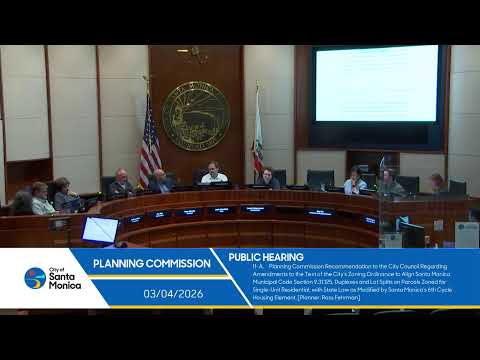
Staff presented a scoping session on SB 1123 (starter home act); commissioners and dozens of public speakers debated whether to go beyond state law, how to define "family housing," parking/driveway impacts, and whether public land or subsidies are better tools; commission directed staff to form a technical working group, broaden outreach and return with parcel‑level analyses.
City planning staff presented an initial scoping session on SB 1123 (the Starter Home Act) at the Santa Monica Planning Commission meeting on March 4, outlining eligibility rules, design constraints and possible local options, and the commission directed staff to develop a formal technical study with expanded outreach.
Staff framed SB 1123 as an extension of the state's efforts to expand ownership opportunities on smaller parcels. Key points in the presentation included the minimum resulting parcel size (the state baseline is 1,200 square feet unless a local agency adopts a different minimum), limits on average net habitable floor area (a city cannot allow an average net habitable area to exceed 1,750 square feet), FAR and parking parameters, prohibition in high or very high fire severity zones and the need for tribal consultation timelines. Staff also reviewed the AB 130 remainder‑parcel rule (which lets applicants retain an existing building as a "remainder parcel" while subdividing), and explained where local objective standards can still apply (height floors not to be reduced below underlying zoning, limited ability to require side/rear setbacks greater than four feet, and ADU counting rules).
Public comment was extensive: dozens of speakers (particularly from Sunset Park and Pico) urged the commission not to adopt rules that go beyond state law, warned of concentrated impacts on vulnerable neighborhoods, and requested robust outreach and study. Neighbors raised concerns about parking, multiple curb cuts on corner lots, loss of trees/solar, and neighborhood character. Several developers and housing advocates urged calibrated local flexibility (for example, allowing a third story on sloped parcels, or limited changes to setbacks) to make for‑sale projects feasible and produce more homeownership opportunities.
Commission discussion centered on two linked questions: whether SB 1123 alone will produce affordable homeownership in Santa Monica and, if not, what additional local tools (code changes, incentives, public land or Measure GS revenues) the city should pursue. Commissioners asked staff to evaluate feasibility (construction costs, insurance, market demand), the equity distribution of potential new units, how ADUs and inclusionary rules might be used, and options to discourage undesirable outcomes (for example, many separate driveways on corner lots). Several commissioners emphasized timing and alignment with the city's upcoming LUCE/general plan and the 2029 housing element cycle; others urged moving sooner to identify workable incentives.
After discussion the commission voted to direct staff to prepare a formal SB 1123 study package: produce parcel‑level maps, run neighborhood‑level capacity and equity analyses (Pico, Wilmot, Sunset Park, North of Montana, etc.), develop technical working‑group composition (staff, commissioners, developers, architects, affordable‑housing providers and resident representatives), and expand outreach to renters groups, safe‑streets/mobility stakeholders, and neighborhood organizations. The commission appointed a small commissioner subgroup to participate in the technical working group.
Staff will return with a proposed study schedule and materials for a dedicated study session; commissioners requested that staff also evaluate the use of public land and Measure GS resources as potential ways to produce deed‑restricted ownership options if market‑based SB 1123 outcomes look unlikely.