
Seaside council weighs commercial vacancy tax options amid concerns about water limits and administrative costs
Get AI-powered insights, summaries, and transcripts
Subscribe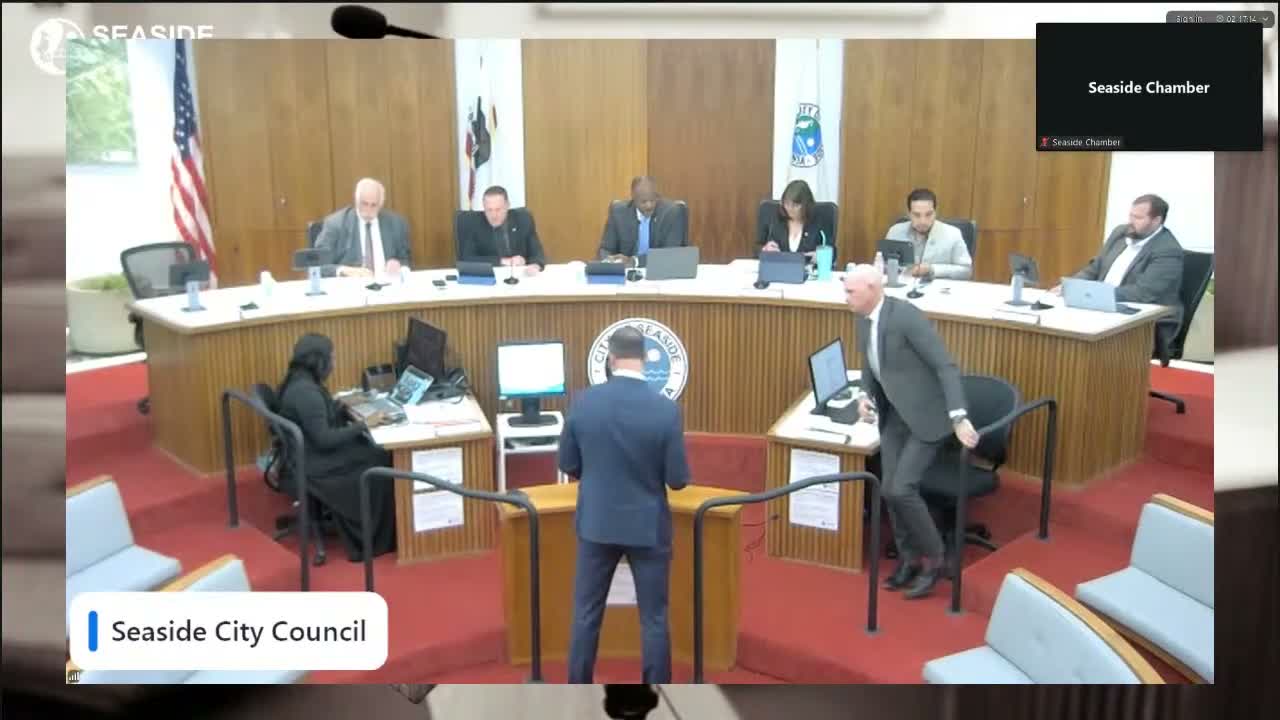
Summary
Staff presented a report on commercial vacancy taxes used in other California cities; council and residents raised concerns about Seaside's water limitations, potential administrative costs and legal risks, and suggested alternatives such as business districts and targeted economic incentives.
City Manager Greg McDaniel presented a staff report on March 5 summarizing the mechanics, legal considerations and administrative burden of commercial vacancy taxes, noting that few California cities have implemented them and that San Francisco and Oakland are the primary examples.
McDaniel explained common structural elements of vacancy taxes — vacancy thresholds, escalation schedules, exemptions for construction or redevelopment, and enforcement mechanisms — and said revenue purposes affect the vote threshold, citing Proposition 218 and Proposition 13 constraints. “San Francisco provides the primary example,” he said, and noted Oakland’s broader approach as a second case study.
Council and public commenters raised multiple concerns specific to Seaside. Several residents and council members emphasized that local water availability constrains the city’s ability to attract and enable new businesses, so penalizing vacant properties risks charging owners for conditions the city cannot control. One speaker noted the city currently has only a handful of vacant commercial parcels and questioned whether revenue would justify the ballot and administrative costs.
City staff cautioned that implementation of a vacancy tax requires significant compliance systems, annual declarations, audits and appeals processing; one commenter cited a different local registry that had required two staff and about $400,000 per year in administrative costs. The city attorney and city manager discussed litigation risk and the need to design exemptions for projects subject to construction delays or redevelopment timelines.
Alternatives surfaced in the discussion: councilmembers proposed exploring business-district models that allow local districts to assess fees for marketing and activation, and staff said they would bring additional economic-development incentive options to a future CJAP (economic development) review. Council did not direct staff to put a vacancy tax on the ballot; the discussion concluded with plans to return with more targeted proposals and a business-district report requested by council.
What’s next: Staff will present potential economic-incentive options and a business-district briefing in coming weeks; councilmembers will pursue further due diligence before deciding whether to pursue a vacancy tax referendum or other tools.