
Monterey One Water outlines $500 million capital plan, signals potential 8% rate increase
Get AI-powered insights, summaries, and transcripts
Subscribe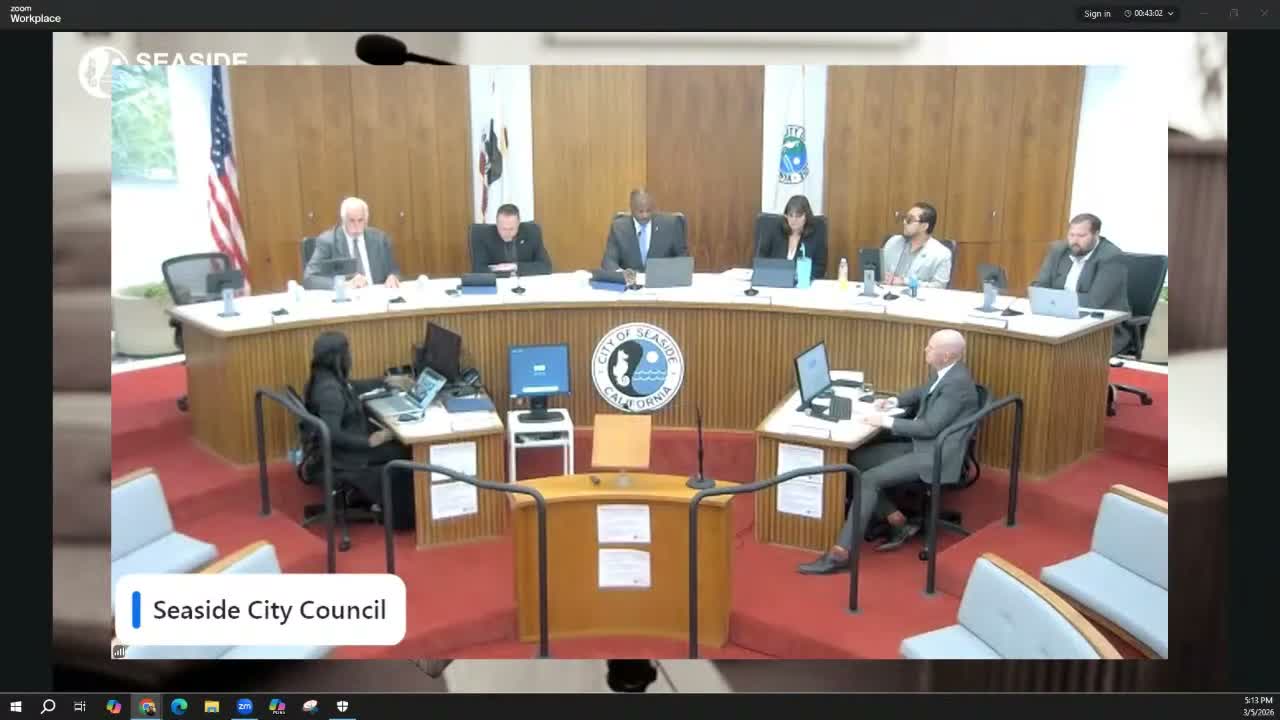
Summary
Monterey One Water officials told Seaside council the utility faces roughly $500 million in capital needs over five years and will begin Proposition 218 rate-notice steps; preliminary modeling estimates an about 8% increase in year one that would lift the typical single-family sewer bill from about $54 to roughly $58.32 per month, subject to board decisions and financing.
Paul Sciuto, executive officer of Monterey One Water, told the Seaside City Council on March 5 that the regional wastewater provider faces major capital and operating pressures and will ask its board for direction on a Proposition 218 rate notice in the coming months.
“We’re going to the board in March … requesting a Proposition 218 rate increase,” Sciuto said, explaining the agency manages roughly $1 billion in treatment and pump-station assets and currently treats about 17 million gallons per day of wastewater with a 30 million-gallon-per-day capacity. He said staff are preliminarily modeling about $500 million in capital work over the next five years and that preliminary numbers indicate an approximately 8% increase in the first year if the board moves in that direction.
Sciuto translated the preliminary model to a household impact: “Right now [a single-family dwelling] is about $54 per month. An 8% increase would bump it up to $58.32 per month,” he said, noting the final amount will depend on the board’s policy direction and financing decisions.
Why it matters: Monterey One Water said capital investments will prioritize pump-station upgrades, ongoing treatment-plant maintenance and electrical reliability, and a treatment-plant master plan to map 35 years of future needs. The agency also highlighted energy costs — Sciuto cited roughly $9.2 million annually for power and more than $8 million for chemicals — and said energy projects and grant funding are part of the strategy to hold down long-term bills.
Council members focused questions on rate structure and equity. Councilmember Miller asked whether the current single-family rate treats a one-bedroom the same as a five-bathroom house; Sciuto confirmed the utility currently uses a flat single-family rate and said the board rejected property-tax funding and fixture-count approaches in past discussions. He described a possible low-volume exception: “If you live by yourself and can demonstrate low water usage, there could be a discount,” he said, characterizing it as an exception rather than a broad restructuring.
Sciuto also briefed council on how the agency funds projects: a mix of enterprise funds, low-interest federal loans (LIFIA), bonds and grant funding. He said the expansion project to increase indirect potable reuse capacity cost about $63 million, with roughly $42 million in state and federal support and $21 million financed through low-interest loans.
What’s next: Monterey One Water will present formal rate proposals and Proposition 218 notices to its board later this spring. The agency plans public information sessions, a 45-day public comment period after a formal notice, and a board decision expected in June on whether to proceed and by how much.
Council response: City and council members thanked the presenter and requested follow-up information on potential equity protections, alternatives to a flat structure, and outreach plans for Seaside residents.