
State officials warn HR 1 could cut SNAP benefits and shift billions to California
Get AI-powered insights, summaries, and transcripts
Subscribe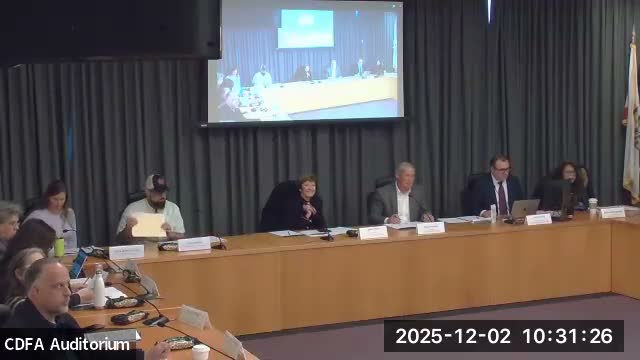
Summary
State and CDSS officials told the California State Board of Food and Agriculture that House Resolution 1 (HR 1) will reduce SNAP funding, widen work requirements and shift billions in administrative and benefit costs to California, potentially affecting hundreds of thousands of residents and counties— budgets.
Alexis Fernandez Garcia, deputy director of the Division of Family Engagement and Empowerment at the California Department of Social Services, told the board that House Resolution 1 (HR 1) will substantially change CalFresh eligibility and funding.
"We estimate that as a result of HR 1, SNAP funding for benefits will be cut by nearly $3,700,000,000 annually," Alexis said during a detailed presentation on federal provisions and state impacts. She warned that multiple provisions already in effect and others planned for implementation next year will reduce benefit eligibility and purchasing power for many Californians.
Why it matters: CalFresh serves about 5.5 million Californians each month, and CDSS said roughly 55% of participating households include children. Panelists warned that changed federal rules will not only reduce benefits for individuals but reshape state and county budgets because administrative and some benefit costs will be shifted to the states.
Alexis walked the board through the most consequential provisions: a mandated cost-neutral Thrifty Food Plan that will erode benefit purchasing power over time; elimination of ability to count basic internet costs as a deductible expense; lost federal funding for nutrition-education programs (about $178 million); tightened energy-assistance deductions that will remove eligibility for some households; expanded work requirements that raise the upper age from 54 to 64 and narrow child exemptions; and reduced eligibility for many lawfully present noncitizens. "This is going to result in unprecedented change to the program," Alexis said.
The state also faces large new fiscal risk. Beginning in fiscal year 2027, the federal share for administrative costs will fall from 50% to 25%, increasing the state—s share by an estimated $701 million and shifting roughly $211 million to counties. HR 1 also ties benefit cost-sharing to a state—s payment error rate; Alexis said California—s most recent error rate would place it in the highest cost-share bracket and could add nearly $2 billion in annual liability under certain scenarios.
Board members pressed CDSS on how the department is preparing. Alexis said federal guidance has arrived piecemeal and the department is still absorbing rules, working with county partners and updating systems. "We are in full preparation mode," she said, noting the agency is prioritizing accuracy improvements and outreach to maintain benefit access.
The board took one procedural action earlier in the meeting when it approved the October 21 minutes by voice vote.
What comes next: CDSS said some HR 1 provisions are already implemented, others remain under planning; counties and the state will continue to assess waiver thresholds, implementation timelines, and potential legislative responses to mitigate projected fiscal impacts.