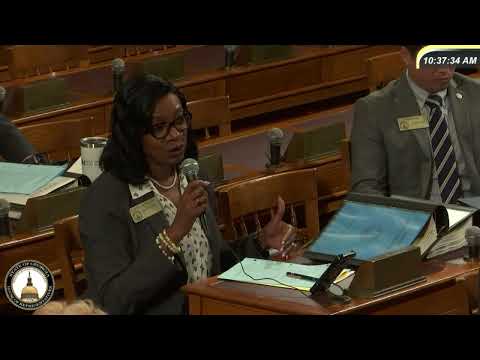
Rep. Ridley defends bill that would limit local firearms ordinances, add enforcement options
Loading...
Summary
Representative Ridley presented HB 1454, a three-part bill addressing carry-permit privacy, a five-acre rule for discharging firearms on private property, and requirements and enforcement for sale of unclaimed police firearms; members pressed him on public-safety and legal implications but the committee did not take final action.
Representative Ridley introduced House Bill 1454 to the Rules Committee on March 8, describing three main provisions: (1) treat carry-permit records held by probate courts as non-sharable databases and create penalties for unlawful sharing; (2) state that property owners with five acres or more may discharge firearms on their land without being subject to local ordinances enacted after that activity began; and (3) require sale or disposition of unclaimed firearms by political subdivisions within 12 months and authorize enforcement when jurisdictions do not comply.
Why it matters: the bill touches on competing concerns — private-property rights and local home-rule authority on one hand, and public-safety, noise and law-enforcement discretion on the other. Committee members sought concrete assurances about how the five-acre rule would operate near schools and whether time-of-day and noise ordinances would still apply.
Representative Ridley told the panel the five-acre provision is intended to protect private-property rights broadly. "If you got 5 acres or more and you shoot guns on it, that you can't have a the city or the county can't put an ordinance in to prevent you from doing that," he said when introducing the measure. He also defended a provision aimed at enforcing current law on disposal of unclaimed firearms, saying some jurisdictions "have not been doing that" and recounting cases of firearms not being returned to owners. At one point the author said, "We've got some that's got 3,500 to 4,000 guns right now," to illustrate a perceived problem with unclaimed inventories.
Opponents and questioners pressed multiple points. Representative Evans asked whether the bill effectively creates a private right of action permitting private citizens to sue jurisdictions that fail to sell firearms quickly enough; Evans said such a mechanism risks clogging courts with lawsuits by individuals seeking to buy a particular gun. "We're now gonna give this private citizen the right to go into court and clog our already overburdened judges with lawsuits to say, 'I wanna buy that gun,'" Evans said. Secretary Kelly clarified the author's intent, describing the remedy as a mandamus action to compel compliance with state law and noting that the bill would allow plaintiffs who are forced to sue to recover reasonable attorney fees.
Members also asked about public-safety safeguards. Leader Hughley asked how the bill protects the public if allowing firearm discharge anywhere on a five-acre parcel leads to stray bullets; Ridley replied that civil and criminal liability for causing injury would remain unchanged and that existing ordinances already apply where in force. Pro Tem Jones asked explicitly whether the bill would supersede existing city ordinances; Ridley said preexisting ordinances would remain effective and agreed to provide follow-up clarification.
No final committee vote on HB 1454 was recorded in the transcript. Committee members asked the author to follow up offline with clarifying language on the five-acre scope, the interplay with existing noise and time-of-day restrictions, and the practical mechanics of the mandated sale and mandamus enforcement. The committee proceeded with other calendar business.
Provenance: the HB 1454 presentation and detailed Q&A run from the author’s introduction at SEG 366 through the chair’s encouragement of offline follow-up at SEG 671.
Next steps: author to provide clarifying amendments and staff briefings; committee did not adopt or reject HB 1454 during this meeting.