
State fish and wildlife official says golden mussels detected in Delta; agencies form task force to limit spread and protect infrastructure
Get AI-powered insights, summaries, and transcripts
Subscribe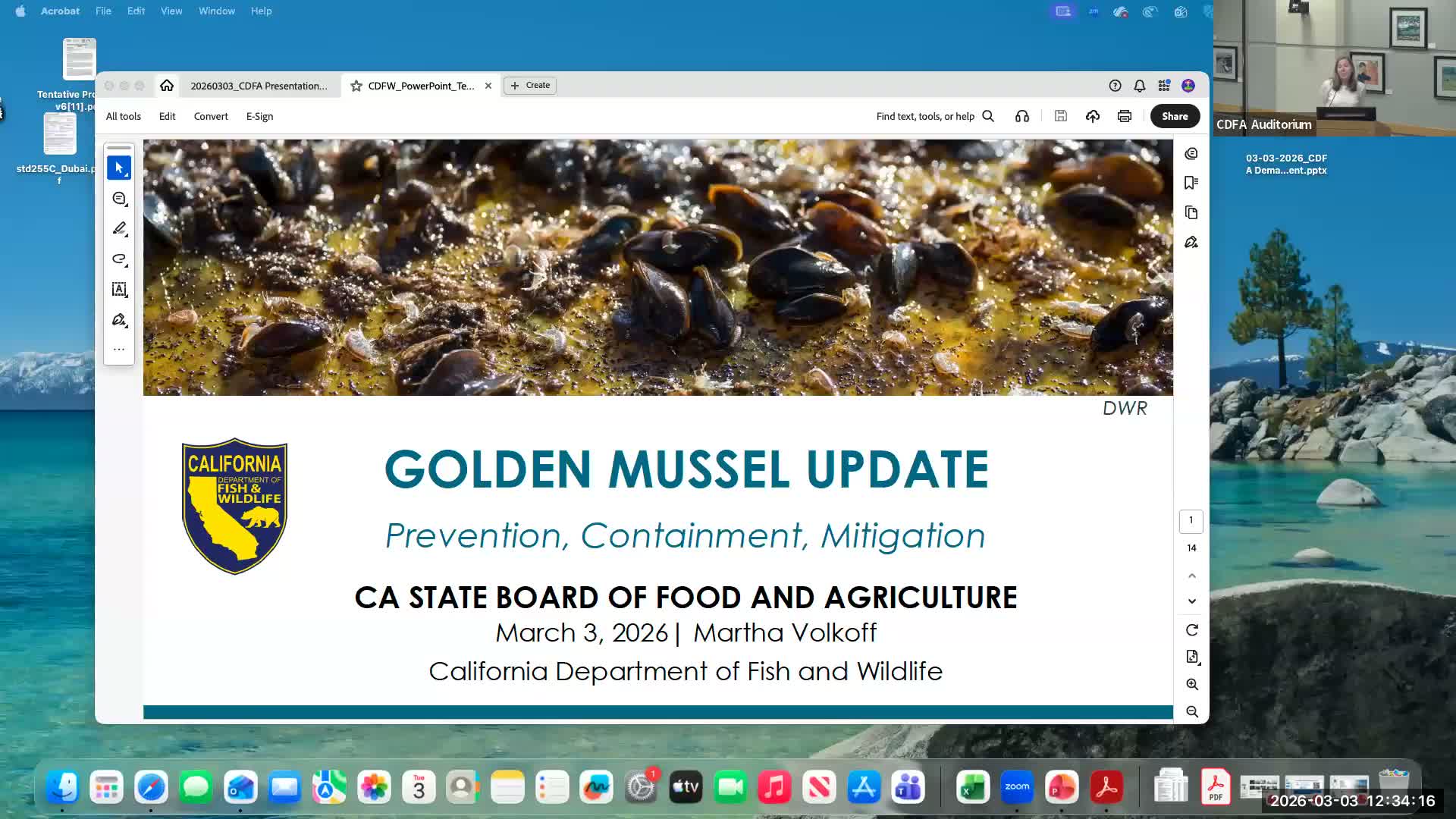
Summary
The Department of Fish and Wildlife reported the first North American detections of golden mussel in October 2024 at the Port of Stockton; the agency and partners have convened a task force focused on monitoring, facility mitigation and preventing overland spread via boats and equipment.
The Department of Fish and Wildlife briefed the board on the emergence of golden mussels in Delta waters and the near‑term operational impacts on state and federal infrastructure. Martha Volkoff, an environmental program manager in CDFW’s fisheries branch, said the species—native to China and Southeast Asia—was first detected in October 2024 in the Port of Stockton and that monitoring equipment and fish‑screen infrastructure have experienced heavy biofouling.
Volkoff described the mussel’s life cycle and resilience: broadcast spawning with a planktonic larval stage that can last two to four weeks, and adult mussels that can detach and translocate. She noted golden mussels tolerate lower calcium waters, increasing the number of California water bodies at risk compared with previously established quagga or zebra mussels.
Early detections have been concentrated along the Delta flow path and on state and federal project deliveries, she said; there were no confirmed detections outside that flow path at the time of the briefing. CDFW and partner agencies created a Golden Mussel Task Force and produced a response framework focused on monitoring, science and capacity building; large‑scale eradication in the Delta is not considered feasible at present. The state has taken immediate legal and policy steps: CDFA performed a pest rating and CDFW proposed changes to Fish and Game code sections to add invasive mussels to restricted/injurious species lists.
Volkoff and staff discussed practical responses for managers of infested facilities, including facility mitigation working groups, increased inspection and decontamination coordination, and experimental studies into salinity and other treatments. She warned that overland transport on recreational and commercial vessels is a high risk and urged stronger interception and decontamination at launch sites. “This species is native to China and Southeast Asia,” she said, noting that its biology and observed movement mean water managers must adapt operations and infrastructure to the new challenge.
Board members asked about ecological impacts on native mussels, desiccation vulnerability, and facility retrofits; CDFW said impacts to native species and ecosystem composition are possible over time, and that containment and targeted mitigation at facilities are the most realistic near‑term strategies.