
Sacramento City Unified board gets stark solvency update; staff directed to pursue OPEB and Medi‑Cal offsets as layoffs loom
Get AI-powered insights, summaries, and transcripts
Subscribe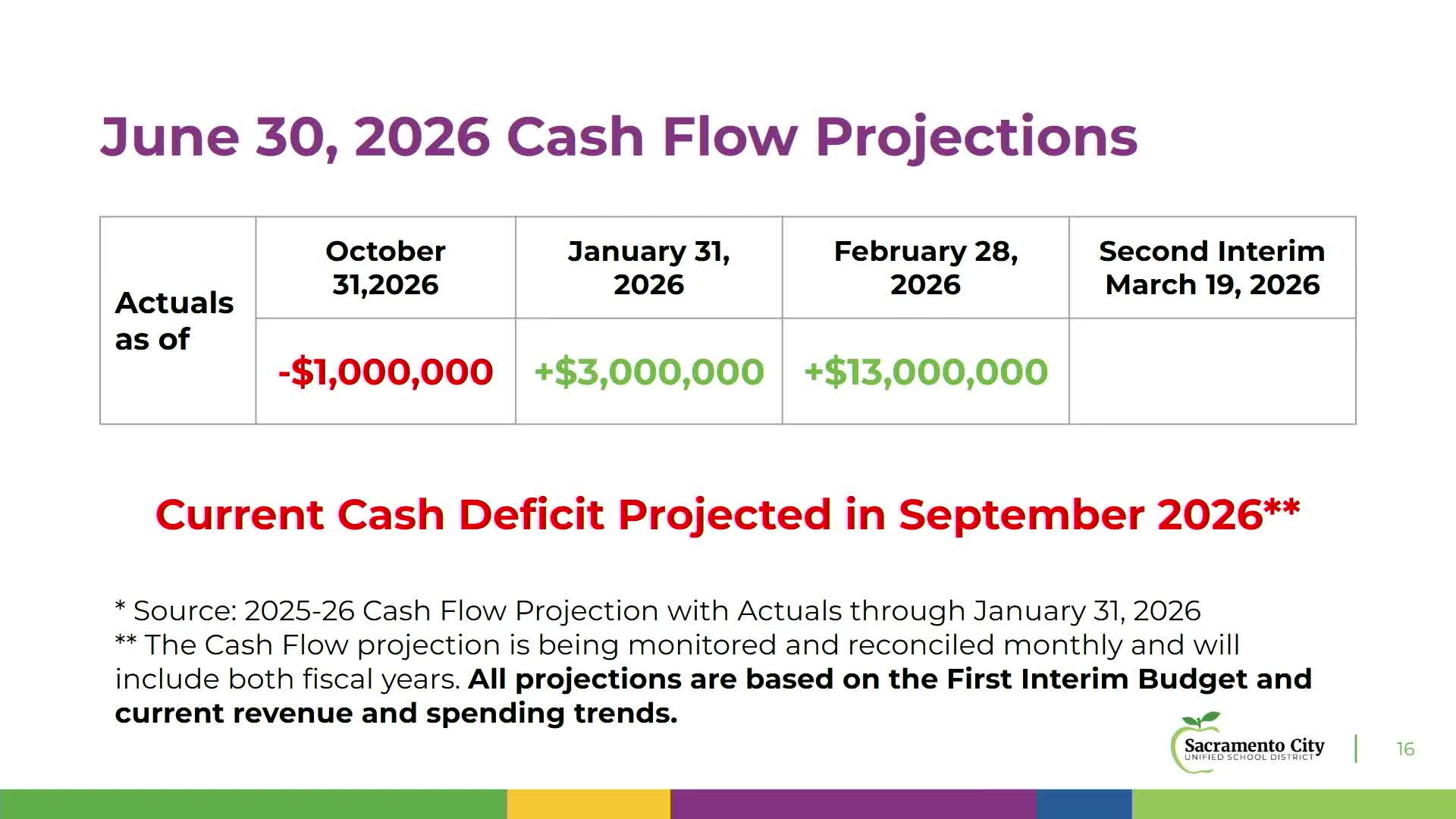
Summary
District staff told the Sacramento City Unified School District board that a structural deficit and projected cash shortfall could deplete reserves by September 2026; the board gave direction to staff to pursue OPEB and Medi‑Cal offsets and begin labor conversations while public commenters urged protecting English learners, special education and site safety roles.
Sacramento City Unified School District staff on Wednesday told the board that the district faces a multiyear structural deficit and a near-term cash shortfall that could exhaust reserves by September 2026 without further action. The presentation identified about $63.34 million in one-time savings or cost avoidance in 2025–26 but said those measures leave a remaining gap of roughly $70.7 million on a multiyear projection; staff said deployment of OPEB strategies and Medi‑Cal reimbursements could reduce the gap to about $36 million.
The update, presented by district finance and cabinet staff, outlined the difference between recurring savings and one-time cost avoidances, noted an $18 million upward revision to special-education costs for 2025–26, and placed the districton a trajectory that will require personnel and program decisions. A staff presenter said the districtis currently projecting a $13,000,000 shortfall in the near term and that second-interim figures will be updated in two weeks.
Why it matters: Board members and families said the choices will directly affect students who rely on counselors, assistants and specialized services. Public commenters urged the board to prioritize classroom instruction, nutrition, safety and wraparound mental‑health services while searching for long-term stability.
Board direction and procedural steps
After the presentation, the board discussed decision points including certification of the 2025–26 budget, issuing additional preliminary layoff notices for site staff funded through LCFF, and launch of 2026–27 strategies (fiscal restructuring, furlough days, and facilities optimization). The board asked staff to proceed with work to pursue OPEB and Medi‑Cal offsets and to begin formal conversations with labor partners about potential cost‑saving options; the transcript records board membersoffering nonbinding head nod agreement rather than a formal roll-call vote.
Members emphasized timing: the chair said May 7 is the last regular-meeting date for major board decisions tied to layoff timelines, and staff said preliminary layoff notices would be issued with final notices targeted for mid‑May under the personnel timeline described in the presentation.
Public comment and priorities raised
Community speakers — including Lucero Soto of Sacramento Act, parents who represent English-learner families, a long‑time district librarian and a TK enrollment technician — warned that cuts to site staff and specialists would harm English learners, students with disabilities and program access. Tasha Weatherall, district librarian since 1999, said she would prefer pay reductions or furlough days over mass layoffs: “I would rather take a pay cut or take furlough days than to lose my job,” she said. Asia Yang, an enrollment-center office technician, described operating the TK lottery and warned that eliminating the TK specialist position would delay placement and harm families trying to enroll their children.
Staff and board next steps
Staff previewed a public fiscal dashboard that will post the next day and allow the board and community to drill into contracts, vendor spending and classroom-level allocations. The board scheduled a facilities-optimization briefing for April 23 to begin exploring long-term site use and consolidation planning; staff emphasized that any footprint changes would not be implemented immediately but would require community engagement and at least a year of planning.
The board also moved and seconded a procedural motion to extend the meeting; the chair called for a voice vote and members responded in the affirmative. As of the end of the item the board had given staff direction to continue pursuing OPEB and Medi‑Cal strategies and to begin labor discussions; staff said the second-interim update and related budget actions would return to the board in two weeks and that May 7 remains a key procedural deadline for any final decisions related to layoffs.