
Police say every officer will complete 40-hour crisis-intervention training this year; county funding helps schedule classes
Get AI-powered insights, summaries, and transcripts
Subscribe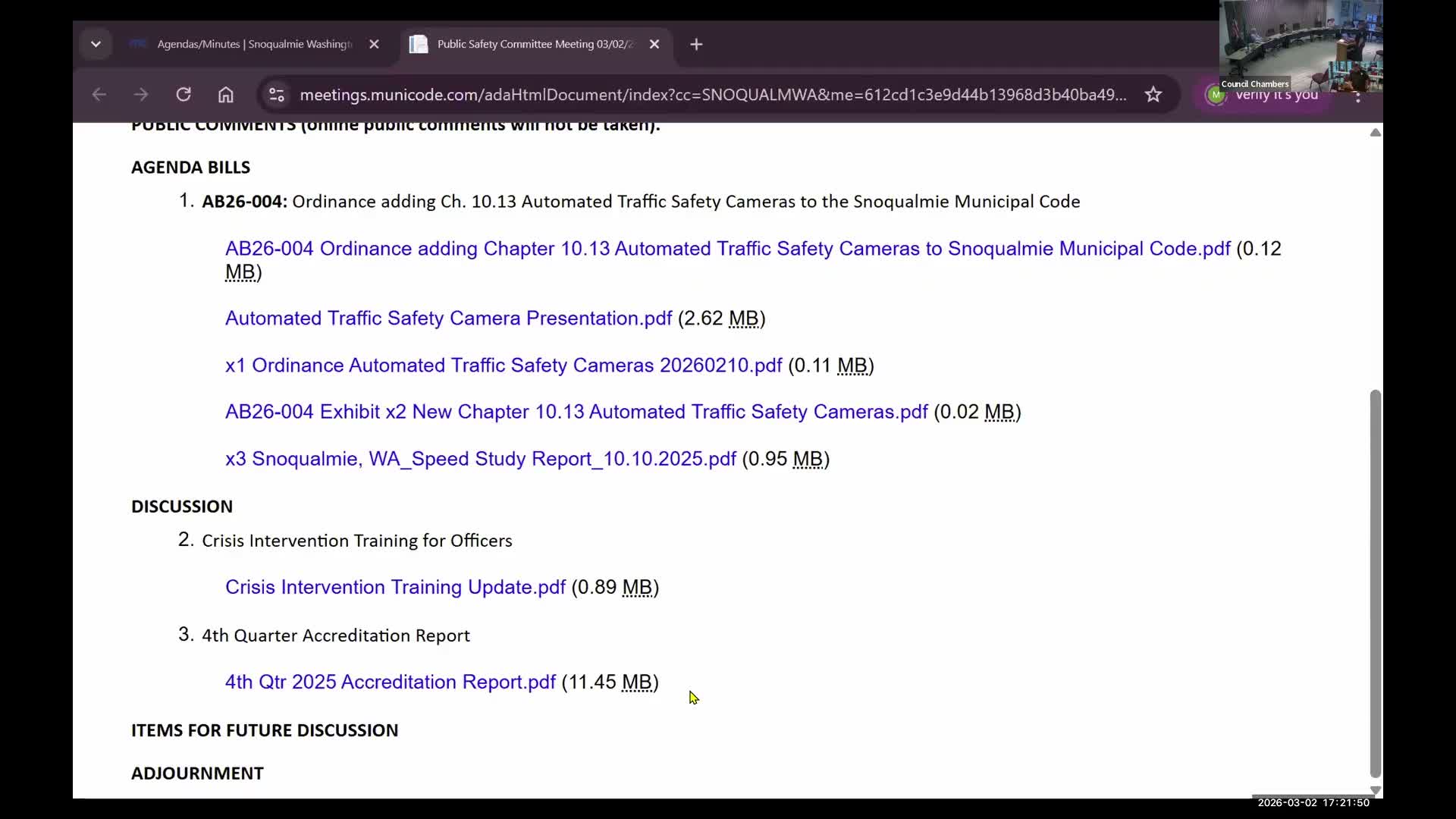
Summary
Snoqualmie's police leaders told the Public Safety Committee they aim to have all officers complete a 40-hour crisis-intervention training course by the end of the year, using King County-funded classes to reduce local costs; the department reported crisis-related calls were a small share of total call volume.
Snoqualmiepolice briefed the Public Safety Committee on March 2 on crisis-intervention training and plans to expand officer participation in 40-hour crisis-intervention courses.
Police told the committee that Washington state requires annual training for officers (24 hours) and additional multi-day crisis-intervention training on a three-year cycle. Department leaders said the goal is for every officer to complete a 40-hour CIT course by the end of the year, scheduling classes and using King County-funded sessions to limit overtime exposure. Staff said partial overtime reimbursement from the academy helps offset backfill costs.
Officials gave context on call volumes and crisis contacts. For 2025, the department reported roughly 6,284 total calls for service with about 79 crisis-related calls and 19 involuntary commitments, representing about 1.26% of total call volume in 2025. The chief described continued reliance on county and regional partners (Eastside Fire & Rescue mobile integrated health, King County mobile scribe team, Crisis Connections, area hospitals) when a local mental-health professional is not available.
Councilmember Catherine Cotton asked whether the crisis numbers covered Snoqualmie only; staff confirmed the statistics were for Snoqualmie alone. Cotton said that given current training and partner resources, the city could defer hiring another full-time mental-health professional for now and use funds for other priorities.
The department also discussed staffing targets (an 18-position structure including command and patrol roles) and said it will monitor call volumes, scheduling and reimbursement as it implements broader officer participation in CIT classes. Committee members did not take a formal vote; staff will continue to schedule classes and report back as officers complete training.