McHenry County panel debates raising impervious-area exemption, advances plan for a ‘simplified method’ tool
Loading...
Summary
County staff presented analyses showing why keeping a half-acre trigger may be safer than a blanket 1-acre exemption and proposed a GIS-based "simplified method" to let landowners estimate runoff without routine engineering. The committee asked staff to refine curve-number tables and bring a draft tool back for review.
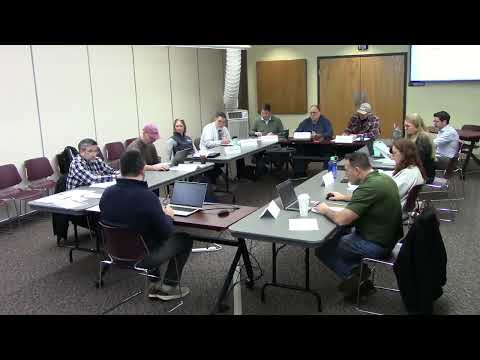
Staff member (S1) presented a draft approach to McHenry County’s stormwater ordinance on March 5, proposing a county "simplified method" and asking whether the current half-acre exemption for impervious-area review should be raised to 1 acre for large agricultural parcels.
The staff member framed the discussion around two example analyses — a 2-acre tributary example and a 77-acre parcel — and said the simplified method would let users derive a time of concentration and a rational-method C value from conservative curve-number choices. "The half acre is probably best," the staff member said, arguing that a blanket 1-acre exemption could capture more storm durations and trigger additional flood-risk analysis.
Committee members pressed technical points about converting TR-55 curve numbers into rational-method C-values and whether those conversions are consistent across soil types and data sources. "I would say we just stick with one method or the other," a committee member (S7) said, urging the group to avoid inconsistent cross-method conversions. Another committee member (S5) cautioned that "going to the 1 acre is too risky to use as a blanket exemption," highlighting concerns that a higher threshold could increase downstream flood risk in some locales.
Staff described numerical thresholds derived from the examples: roughly 1 cubic foot per second (CFS) as a practical difference for pipe-controlled outfalls and about 2.25 CFS for swales, figures that staff equated with a downstream rise of about a tenth of a foot. Under the draft approach staff also modeled a release-rate framework that applies a proportional reduction to allowable flows (examples used a 0.85 scaling factor) and suggested capping very low allowable rates (illustrative caps discussed included 0.15 CFS/acre). Staff emphasized that enforcement officers would retain discretion to require additional, site-specific hydrograph or off-site analysis where watershed conditions or known flood studies indicate greater risk.
To reduce review burdens for routine projects, staff proposed a GIS-based tool that would let a property owner or reviewer click a parcel, accept a conservative land-cover choice (for example, "ag," "lawn," or "paved"), and receive a derived curve number and time-of-concentration for use in a rational-method calculation. Until GIS functions are available, staff offered to run short in-person sessions to help applicants complete the simplified calculations. "We'd like the tool to resemble StreamStats — you put a pin in a map and it helps generate tributary area and TC," the staff member said.
The committee agreed the simplified method could lower costs and speed approvals for many owners, particularly on large agricultural parcels, but members also insisted on conservative defaults and a defensible conversion/lookup table so applicants and reviewers cannot exploit unfavorable parameter choices. Staff committed to drafting a McHenry County curve-number table, preparing the spreadsheet/tool prototype, and returning with more technical material and appendix language at a future meeting (staff signaled the May meeting as an expected milestone).
No formal ordinance adoption occurred at the March 5 meeting; the committee approved routine agenda matters (minutes and schedule changes) and directed staff to continue technical development and to coordinate watershed mapping to identify areas needing stricter scrutiny. The committee adjourned following announcements about upcoming green-infrastructure training and a regional water forum.