Get Full Government Meeting Transcripts, Videos, & Alerts Forever!
Get email alerts on the Pensions topic
No spam. Unsubscribe anytime.
IMRF counselor Jessica Turner outlines pension rules, benefits and how members can apply
Summary
Jessica Turner of the Illinois Municipal Retirement Fund explained benefit protections, tiers, service-credit rules, voluntary additional contributions, tax and refund rules, and offered practical steps for members to register for online access and apply for retirement; she answered member questions about slides, timing and insurance coordination.
Jessica Turner, an education counselor with the Illinois Municipal Retirement Fund (IMRF), gave a presentation for members explaining how IMRF benefits are calculated, how to enroll and how to prepare for retirement.
Turner emphasized that IMRF is a defined-benefit plan established by the Illinois General Assembly in 1941 and that members’ benefits are protected under the Illinois pension code. "Your benefits are protected, by the Illinois pension code. So that means that your benefits cannot be diminished," Turner said. She summarized IMRF’s growth from five employers and $5,000 in assets at inception to more than 3,000 employers and roughly $53 billion in assets today and noted IMRF does not receive state funding.
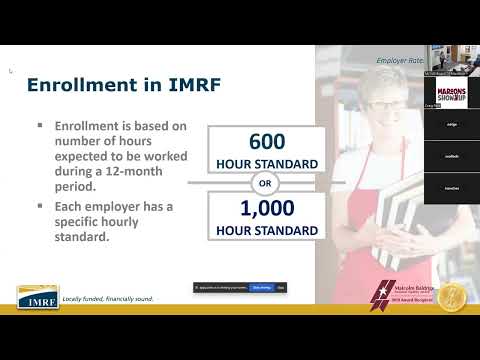
Turner walked through core rules that determine eligibility and benefit size. Regular members currently contribute 4.5% of gross wages; a typical pension dollar came from member contributions (about 11 cents), employer contributions (about 22 cents) and IMRF investment earnings (about 67 cents). IMRF uses an "hourly standard" to determine enrollment (schools typically use 600 hours). Tier classifications depend on hire date: Tier 1 covers those first participating before Jan. 1, 2011; Tier 2 covers those on or after that date. Vesting requires eight years for Tier 1 and ten years for Tier 2, and unreduced retirement ages differ by tier.
Turner explained how service credit is earned (a full month’s credit for any month with a paycheck), how unused sick days may convert to service credit at retirement (every 20 days equals one month), and a 60-day timing rule that a pension must be effective within 60 days of IMRF employment termination for sick-time credit to count. She described reciprocity with other systems (state employees, state teachers and state university systems), cautioning that differing vesting rules across systems can affect eligibility for a combined retirement.
On benefit calculation Turner said IMRF averages the last 10 years: Tier 1 uses the highest 48 consecutive months; Tier 2 uses the highest 96 consecutive months. Accrual rates she cited were 1 2/3% per year for the first 15 years, then 2% per year thereafter. Turner also laid out survivor and death benefits: for vested members beneficiaries may elect a refund or an annuity; surviving spouse pensions are 50% for Tier 1 and 66 2/3% for Tier 2 plus a $3,000 lump-sum death benefit.
Turner described the Voluntary Additional Contribution (VAC) program — an after-tax option allowing members to contribute between 1% and 10% to an individual account that earns interest. She noted VAC interest is credited annually on Dec. 31 based on the Jan. 1 balance and gave hypothetical examples of long-term savings and the additional monthly annuity those contributions can buy. She warned that VAC refunds require full-account withdrawal and that the taxable portion of a refund is subject to a 20% federal withholding; if the member is under 59 and does not roll over the funds they may face an additional early-withdrawal tax.
Turner also outlined wage-reporting and pensionable-earnings caps: she cited a 2026 wage cap of $360,000 for certain Tier 1 members and said she expected the Tier 2 cap for 2026 to be about $129,192.26; wages above the caps remain reportable but contributions are not withheld on the excess. She announced recent service improvements — including a new self-service phone option for payment verification, form requests and claim-status checks — and explained IMRF does not offer health insurance directly but works with a broker (referred to during the session as Doyle Row) that offers vision, dental, prescription and long-term-care options and can collect premiums via pension deduction.
During Q&A attendees asked Turner to share the slides; she said she would email them to Joan for distribution and offered to e-mail or schedule phone follow-ups for individual account questions. Members also asked how far in advance to contact IMRF before retirement; Turner recommended beginning the process about six months out and noted IMRF accepts pension applications generally 30–90 days before the member’s last day. A question about whether brokered insurance coordinates with Medicare drew Turner’s recommendation that members contact the broker directly for details.
The presentation closed with Turner encouraging members to sign up for online member access to run pension estimates, verify beneficiary information and review documents, and to contact IMRF by email if they prefer a phone appointment. She invited attendees to complete a feedback survey and said she would send the presentation materials.