
Lyon County approves Winston Solar PUD after months of revisions, with road‑improvement commitments
Get AI-powered insights, summaries, and transcripts
Sign Up Free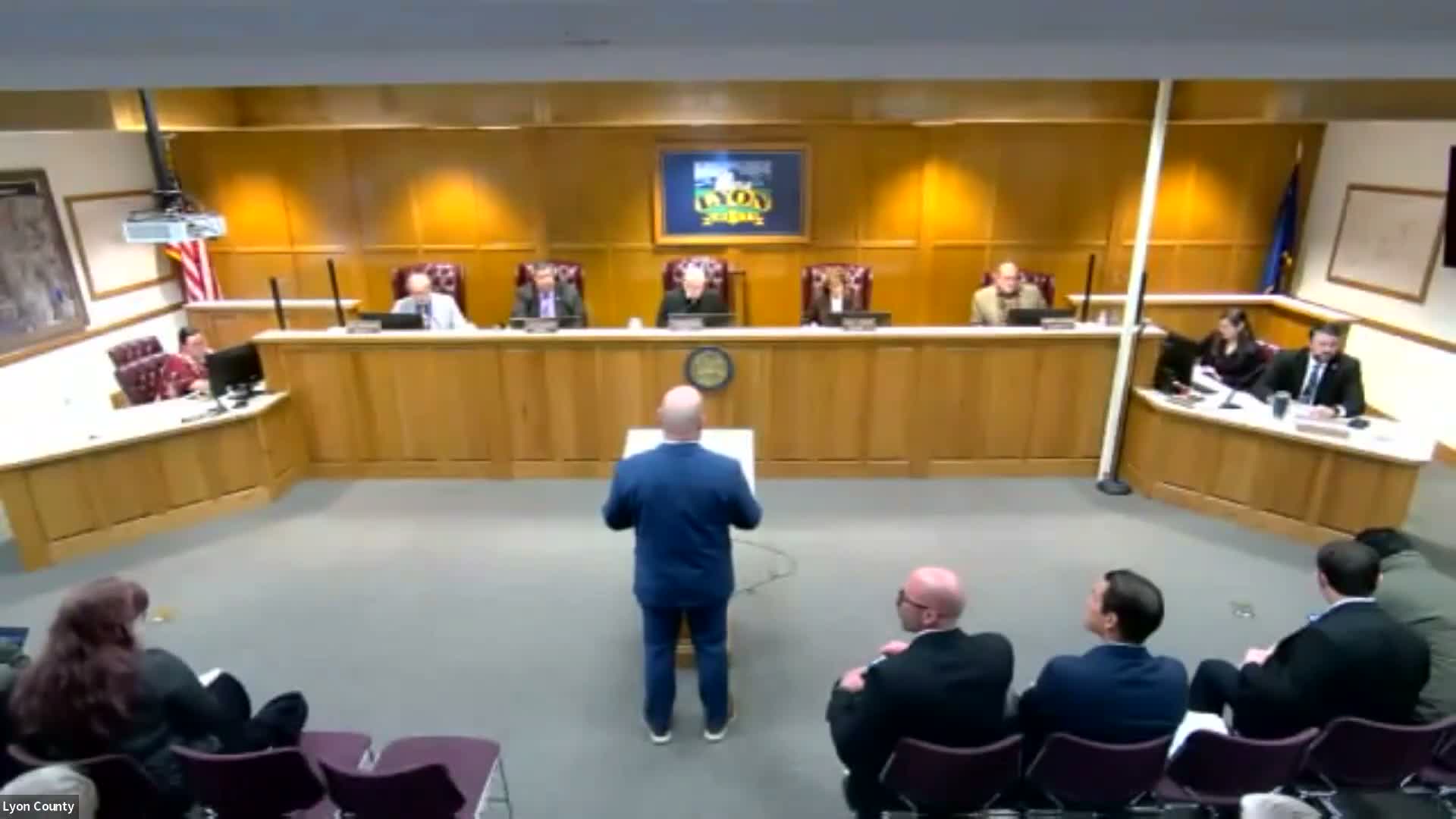
Summary
After public testimony that split residents and supporters, Lyon County commissioners approved a tentative planned‑unit development for the 400‑megawatt Winston Solar Project with a reduced setback and conditions requiring traffic improvements and a landscape buffer.
The Lyon County Board of Commissioners voted March 5 to tentatively approve a planned‑unit development for the Winston Solar Project, a proposed 400‑megawatt photovoltaic array with a battery energy storage system and supporting substations. Staff, the applicant and dozens of residents spent the morning and afternoon at a public hearing that exposed deep differences over visual impacts, traffic and wildlife.
Louis Cariola, senior planner, told the board staff had previously recommended denial when the applicant proposed a 300‑foot setback from US‑95A; after two months of coordination the applicant increased that buffer to about 1,320 feet and proposed a 30‑foot landscape strip along the highway. Cariola said NDOT had reviewed the project’s traffic impact study and provided required comments; staff and the applicant agreed those recommendations should be conditions of any approval.
Devin Buto, vice president of development for the project representative, said the company had worked with county staff to respond to concerns and would pay its agreed pro‑rata share of traffic improvements at Sierra Way and other affected intersections. "We are absolutely committed to working with other stakeholders to pay our fair share," he told the board, adding the project team had offered a $2 million upfront contribution toward Sierra Way improvements and would participate in a cumulative‑impact agreement.
Residents urged both approval and denial. Matthew Winterhawk, who had earlier urged the county to study contamination and fire funding disparities, said at the hearing the project could bring jobs and school revenue but asked for rigorous environmental controls and traffic mitigation. Opponents warned about wildlife impacts, potential water use and the visual change to Mason Valley; speakers also asked for stronger protections against battery fires and clearer decommissioning and recycling plans for panels.
After debate the board rejected an initial motion to approve the project without further setback changes. A subsequent motion to approve the tentative PUD with a 25% reduction in the code setback (a 1,980‑foot setback from US‑95A rather than the half‑mile standard) and conditions requiring a landscape buffer, NDOT‑recommended road improvements, and a traffic‑improvement reimbursement mechanism passed on a recorded vote. The board recorded agreement that final approvals (final PUD and permit issuance) would require the applicant to secure NDOT sign‑offs and execute development agreements specifying construction timing and funding for road work.
The approval is tentative: the final PUD process will examine detailed building, operational and monitoring plans and require the applicant to meet the conditions the board attached before construction permits are issued. The county’s staff report and the applicant’s revised materials will be used as the baseline for the final review.
The board also encouraged continued local outreach; the applicant said it would keep working with landowners, NDOT and irrigation districts to address ditch setbacks and cultural resources.
Next steps: the applicant must satisfy the staff‑and‑NDOT conditions and return with a final PUD and the development‑agreement language that spells out timing, funding triggers and construction sequencing for the roadway improvements.