
Data storytelling training urges tribes to pair numbers with human stories
Get AI-powered insights, summaries, and transcripts
Subscribe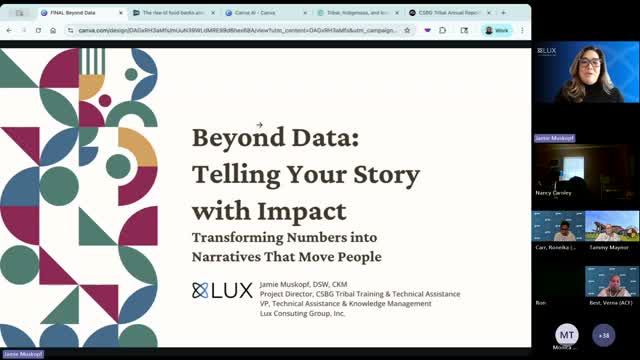
Summary
A data storytelling session urged tribal administrators to convert CSBG numbers into narratives that explain why outcomes matter, using visuals, maps and quick templates; presenters demonstrated Canva and an AI tool for audio summaries while cautioning on privacy and AI voice use.
At the ACF tribal annual meeting, a training session led by Jamie Muscough (Lux/Luxe Consulting Group) urged grant administrators to pair program metrics with meaningful narratives so federal reviewers and local audiences can see why the numbers matter.
Jamie opened by framing data storytelling as an element of data sovereignty: "Data tells us what happened, but stories tell us why it matters," she said, and she encouraged attendees to add simple context (who, why, how) to numeric entries in the annual report.
Practical framework: Jamie outlined four pillars — audience, message, visuals, medium — and asked participants to pick one data point from their reports and reframe it for different audiences (for example, to Congress, local membership, or a community bulletin). She recommended mixing quantitative metrics (counts, percentages, before/after comparisons) with de‑identified qualitative elements (short quotes or testimonials) to create a compelling, defensible narrative.
Tools demonstrated: The session showed low‑cost production tools. Jamie highlighted Canva for infographics and quick web pages and demonstrated an AI tool (NotebookLM) that can generate audio and short video summaries from written reports. She cautioned that the AI demo produced synthetic voices that "sound like real people," calling that effect "terrifying" and advising presenters to prioritize actual community voices when possible.
Privacy and ethics: Trainers repeated the earlier guidance to avoid PII. They recommended collecting consent for quotes and using de‑identified descriptors ("a tribal elder" or "a program participant") rather than names; they also encouraged use of aggregate survey results instead of single-person data where privacy is a concern.
Takeaways: The session stressed building simple routines — a short checklist for events to collect a quote, a photo (with consent), and a key metric — so storytelling does not become a last‑minute burden. Jamie recommended teams choose 1–2 priority initiatives each year to document thoroughly and use visuals and short multimedia assets to reach specific audiences.