
Committee trims DOER'9s grid-resilience ask to $750,000 one-time after questions about match and continuity
Get AI-powered insights, summaries, and transcripts
Subscribe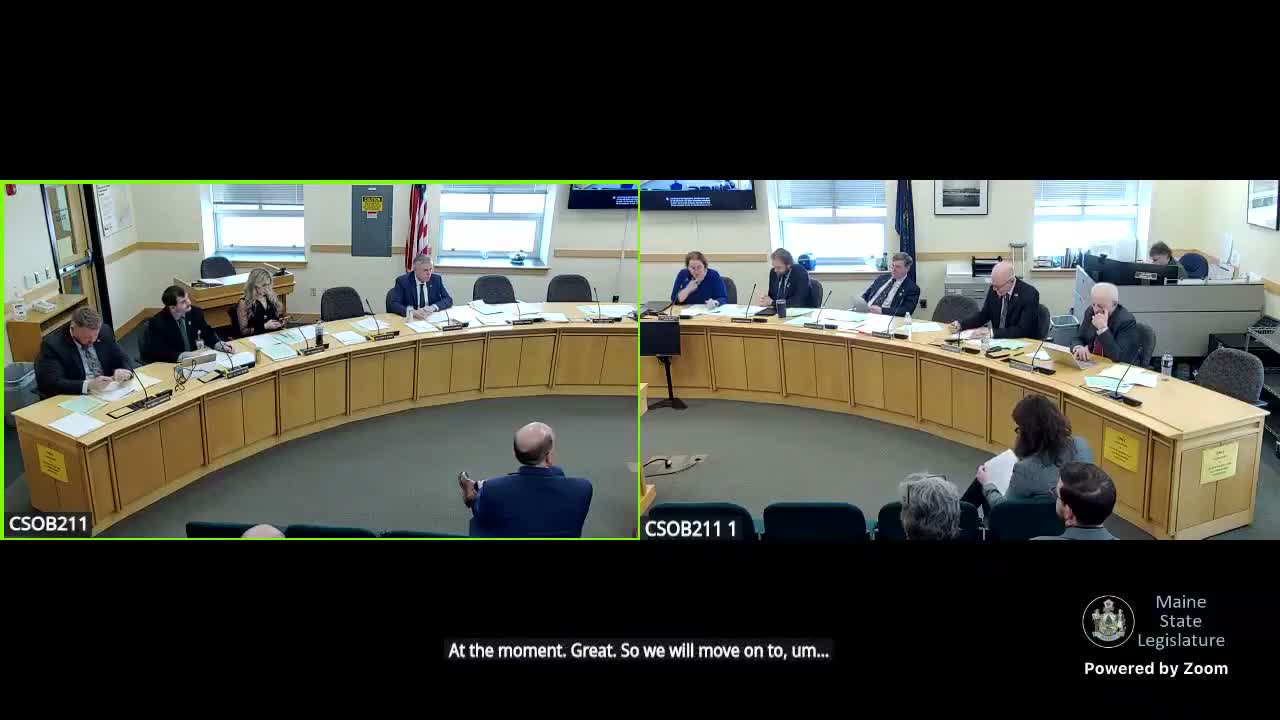
Summary
The Energy, Utilities and Technology Committee voted to replace a $3 million-per-year request for a grid-resilience matching fund with a one-time $750,000 appropriation to be available for federal match. Lawmakers said uncertainty over federal funding and concerns about ongoing general-fund commitments prompted the change.
The Maine House Energy, Utilities and Technology Committee narrowed a Department of Energy Resources request for an annual $3 million general-fund appropriation for a grid-resilience grant program to a one-time $750,000 appropriation after extended questioning about cost match, program eligibility and ongoing budget commitments.
Chair Melanie Sachs opened the discussion by describing reference 208 as a request to provide state funding to meet the anticipated cost-match for a federal grid-resilience program. Acting DOER Commissioner Dan Burgess and the department'9s planning policy manager, Ethan Tremblay, told the committee the federal program (IIJA section 40101(d)) is a five-year formula grant and that Maine expects additional federal dollars to be available; Tremblay said the department was "envisioning using this $3,000,000 fund to assist with that cost match, but also help us to expand the program." (Ethan Tremblay)
Members pressed the department on how the federal cost-match works and whether ratepayer or other restricted funds could satisfy the state portion. Tremblay explained that past state matches were general funds, that the federal program has multiple cost-match tiers (the state portion historically was about 15% and subrecipients provided either 33% or 100% depending on size), and that using ratepayer-restricted accounts would be administratively difficult.
Representative Sophie Warren proposed a narrower alternative: provide only the amount necessary to meet the expected state match to draw down the federal allocation and require any unused or later-obtained federal funds to revert to the general fund. Committee staff suggested $750,000 as a reasonable one-time amount to meet the near-term matching need. Fiscal staff advised that the cleanest drafting approach was a one-time appropriation in this supplemental budget rather than an unallocated, multi-year placeholder.
After a caucus, the committee accepted the amendment: instead of adding $3 million annually to the baseline, it directed a one-time $750,000 appropriation for fiscal year 2026-27 that may be carried forward into fiscal year 2027-28 but lapses thereafter. Committee leadership said the change reflected the combination of program oversubscription and federal funding timing uncertainty, while still preserving capacity to support smaller utilities'9 projects that the program targets.
The committee recorded its procedural votes as part of the LD 2212 work session and will include this recommendation in its report to the Appropriations and Financial Affairs Committee.
The department emphasized it still seeks federal funds (Tremblay said the state expects to seek roughly $4.4 million from the federal program) and that the state appropriation would help leverage and expand resilience projects, especially for smaller municipal utilities.
Next steps: AFA will consider the EUT recommendations under the 5 p.m. filing deadline; DOER and committee staff can be expected to return with any drafting language needed to implement the one-time appropriation and carryforward authority.