
Nebraska Judiciary Committee hears debate on AM 23‑13 to LB 1096; sponsors and industry disagree on mandatory penalties
Get AI-powered insights, summaries, and transcripts
Subscribe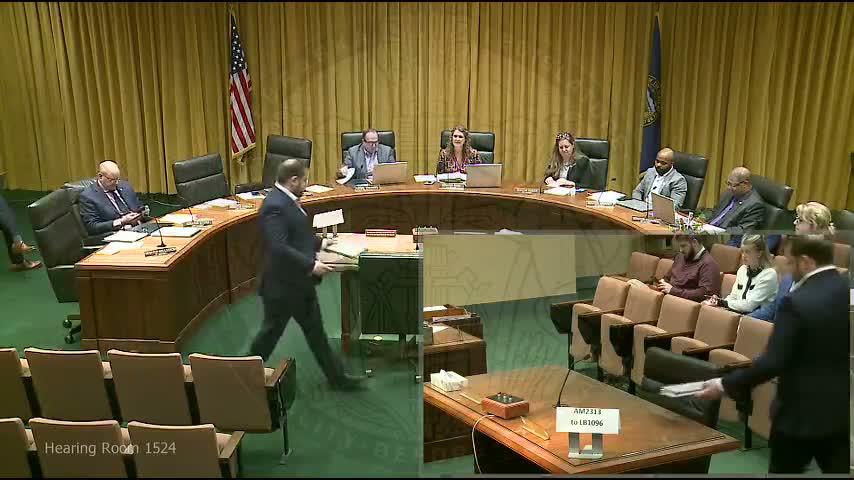
Summary
Senators, industry groups and state agencies debated AM 23‑13 to LB 1096, which narrows covered critical infrastructure, preserves criminal bans on importing high‑risk agricultural pathogens, and would bar state incentives for entities tied to foreign adversaries. Opponents urged restoring regulatory discretion and aligning state deadlines with federal replacement programs.
The Judiciary Committee heard testimony on AM 23‑13 to LB 1096, an amendment that targets foreign‑adversary access to high‑risk agricultural agents and certain critical infrastructure and would prohibit state tax incentives for entities controlled by foreign adversaries. Senator Elliot Bostart introduced the amendment, saying it “takes a more focused and targeted approach to protecting Nebraska's critical infrastructure” and preserves existing agricultural bioterrorism prohibitions.
Supporters including the governor's policy office, the Nebraska Department of Agriculture and the Greater Omaha Chamber framed the amendment as a measured clarification. Kenny Zoeller, director of the governor’s policy research office, said the governor supports language that clarifies last year’s LB 644 definitions and helps the state “find those set companies that are using that technology.” Jessica Schellburn, deputy director of the Nebraska Department of Agriculture, told the committee the bill “would allow the department to use existing authority to issue permits or authorization for the importation of these pathogens or pests,” and said the changes strengthen preventive tools already used in coordination with federal APHIS procedures.
Industry representatives and telecommunications providers opposed parts of AM 23‑13, focusing on Section 12’s mandatory penalty language and on fixed state deadlines that may conflict with federal replacement programs. Tip O’Neill, president of the Nebraska Telecommunications Association, said the mandatory‑penalty approach is problematic because it “removes judgment and mandates punishment regardless of circumstances,” arguing that clerical errors or carriers working under federally granted extensions could be subject to daily fines. Jeremy Crandall of CTIA warned that federal programs and enforcement (FCC and federal remediation efforts) are already active on equipment removal; he said existing Nebraska law remains more restrictive than current federal requirements and cautioned about duplication and potential conflict.
John Becker, speaking for a regional carrier, urged alignment with the FCC’s rip‑and‑replace program and told senators that imposing a state civil penalty “of up to $10,000 a day beginning on 11/01/2026” could divert funds from equipment replacement and slow progress amid supply‑chain and labor constraints. Several committee members pressed the sponsor about replacing discretionary “may” language with mandatory “shall” language in Section 12; Senator Rick Holcroft asked why discretion would be removed, and Bostart responded that the statute already provides meaningful discretion, including the ability to impose lower penalty amounts despite a $10,000 per‑day cap.
Committee members also asked whether the amendment aligns with the incentive definitions adopted in LB 644 and whether state timelines could be made to track federal deadlines; Bostart said he would work to align definitions and was open to adjusting timing language (for example, to change Nov. 1 to Nov. 8) while avoiding unlawful delegations of legislative authority. Multiple testifiers asked the committee to preserve mechanisms that allow the Public Service Commission and the Attorney General to exercise judgment rather than impose automatic fines for administrative or federally‑covered compliance issues.
The committee received mixed testimony from business groups urging continued negotiation and compromise; Matt Williams of the Nebraska Chamber asked senators to advance the amendment while keeping stakeholders engaged to reach a Nebraska‑specific solution.
The hearing concluded with Senator Bostart saying additional language would be provided to address concerns raised during testimony. No vote was taken at the conclusion of the hearing; the sponsor indicated he would circulate revisions and continue discussions with industry and agencies.