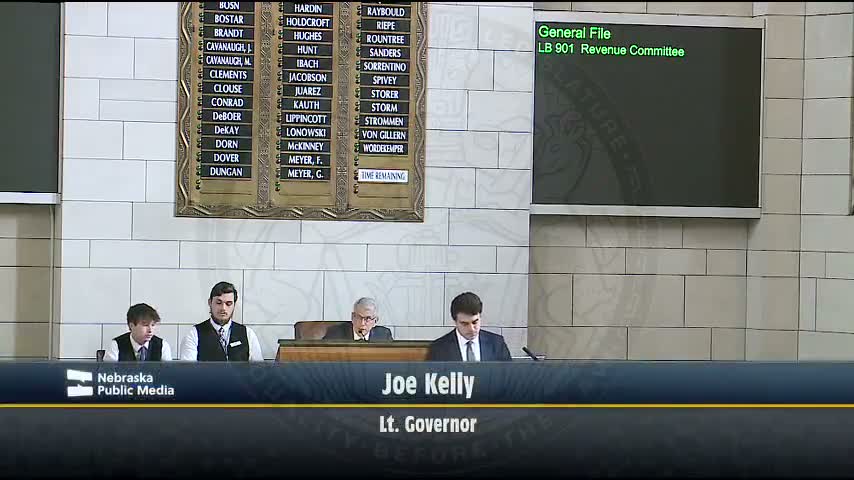
Revenue committee advances LB901 package folding tax-rollbacks, domestic-violence credits and games-of-skill reforms
Loading...
Summary
The Nebraska Legislature advanced LB901, a revenue-package shell that combines four bills to raise an estimated $26 million by rolling back a limited data-center exemption, expanding Department of Revenue fee and collection authority, increasing taxes and regulation for 'games of skill' devices, and creating $3 million in refundable, transferable tax credits for domestic-violence service providers.
Senators advanced LB901 to E & R on a voice and recorded vote after hours of debate over revenue, regulatory design and how new funds would be distributed.
Senator von Gillen, the revenue committee chair, opened the floor saying the committee amendment AM24-69 combines four bills and the package is expected to be revenue positive, roughly $26 million for fiscal year 2026–27. "Taken as a whole, the committee AM should have a direct positive general fund impact of around 22 to $25,000,000 for fiscal years 26-27," he said in his opening remarks.
The package folds four measures: one that repeals certain sales-and-use tax exemptions applied to manufactured components tied to data centers; one that expands allowable functions and fee authority for the Department of Revenue (DOR); LB890, which raises registration/inspection and decal fees and an occupation tax on mechanical amusement devices; and LB1131, which creates a domestic-violence and human-trafficking service providers tax-credit program.
Senator Klaus detailed the fee increases for mechanical amusement devices: the one-time application/inspection fee moves from $500 to $650, the annual decal fee from $250 to $350, and an occupation tax for devices such as pinball or pool tables from $35 to $70. He said portions of those fees will be deposited into the DOR enforcement fund and to the general fund depending on statutory splits.
Senator Spivey, a lead sponsor on the games-of-skill changes, said the amendment also tightens oversight and safety requirements — requiring a physically present attendant for device locations, banning solely remote supervision, and strengthening advertising and packaging rules. "Today there are more than 6,000 cash devices across Nebraska, located in 91 of 93 counties," she said, adding the amendment raises the effective tax on net operating revenue of those devices from about 6.5% to 11.5% and reallocates the new revenue among several accounts.
The package includes a revenue mechanism for supporting domestic-violence service providers. Senator Bostar described a $3 million program of certificated, refundable, transferable tax credits administered by DOR that can be redeemed by nonprofits or sold in the secondary market. "These organizations are often the first and sometimes the only place victims can turn for safety, shelter, legal advocacy and crisis intervention," he said, noting the distribution formula mirrors current DHHS allocations and includes set shares for tribal governments and statewide coalitions.
Members pressed sponsors for fiscal detail and legal clarity. Senator Raybould and others asked for a spreadsheet outlining the projected sources and sums; von Gillen offered to provide that summary once amendments stabilize. Sponsor von Gillen and others said roughly $6 million comes from the data-center exemption rollback (of which $3 million would be directed to the DV credits, producing an estimated $3 million spillover to the general fund), roughly $3 million to $4 million from DOR fee collection changes, and a smaller net from the games-of-skill adjustments after distributions.
Debate highlighted tradeoffs. Senator DeBoer recounted an emergency domestic-violence incident to underscore service gaps and asked whether cuts in other areas would hurt victims; Senator Jacobson noted federal EMTALA rules require hospitals to treat emergent patients regardless of ability to pay but cautioned about uncompensated-care costs to providers. Sponsors said they had sought industry input on the games-of-skill changes and that some compromises—such as allowing a fifth device outside qualifying census tracts—were negotiated.
On the floor, senators adopted FA1028 to preserve an existing property tax credit fund allocation that would have been affected by the redistributions, then approved AM24-69 and AM24-06 in recorded votes. The clerk recorded adoption of AM24-69 and final adoption of the committee amendment; LB901 then advanced to E & R for engrossing.
Next steps: the bill will be engrossed with the agreed amendments and return to the floor for further consideration. Sponsors said they will supply additional fiscal worksheets before select-file debate so members can review the updated projections and distribution language.