Get AI Briefings, Transcripts & Alerts on Local & National Government Meetings — Forever.
House Appropriations opens FY27 budget hearings; officials flag revenue shifts and $1 billion in efficiency savings
Loading...
Summary
The House Appropriations Committee launched a series of FY27 budget hearings reviewing the executive budget (HB 1). Presenters warned of declining revenues tied to tax dedication changes and conservative REC forecasts while the inspector general described nearly $1 billion in recurring savings identified across state programs.
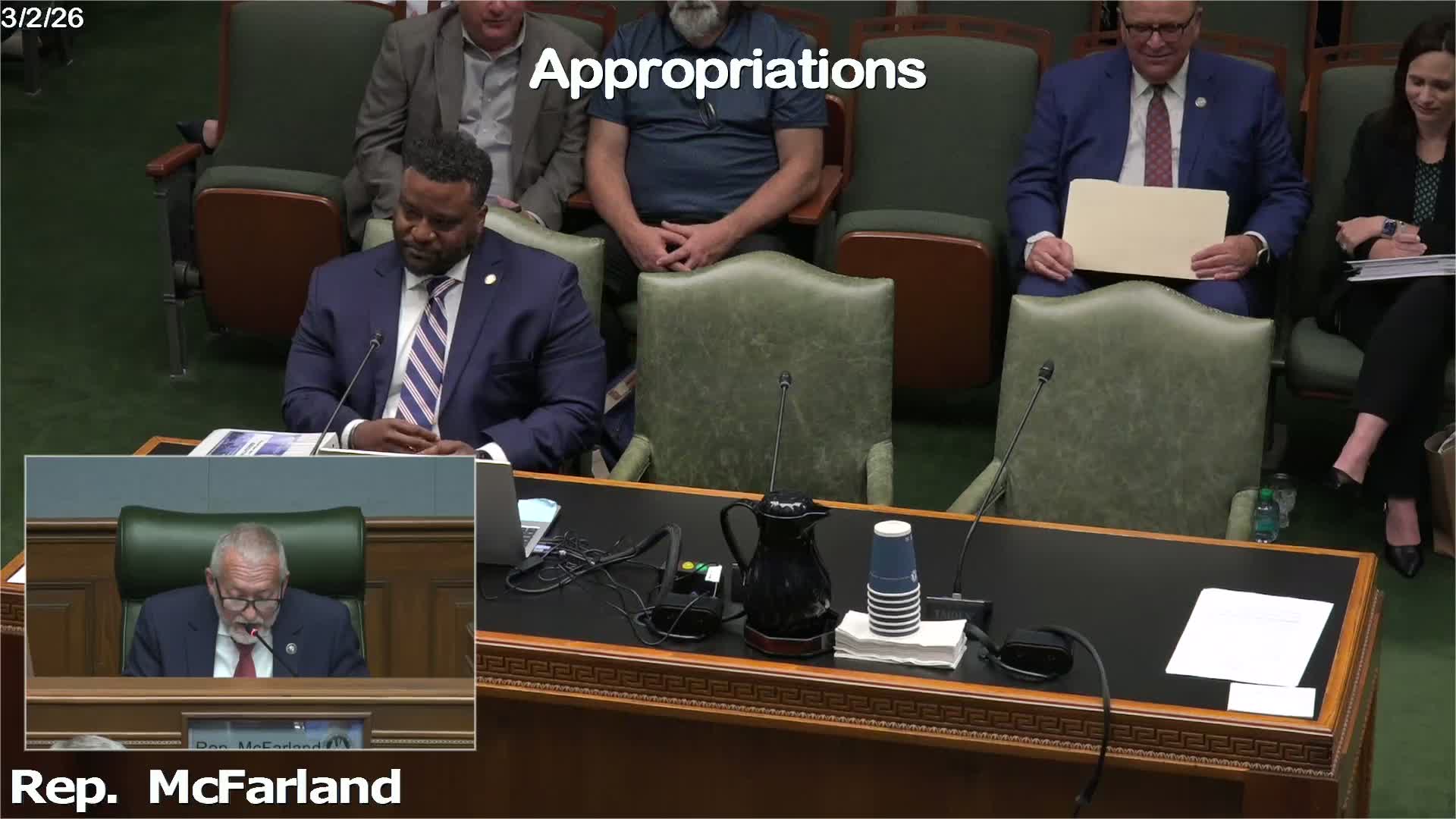
Chairman McFarland opened the House Appropriations Committee’s series of hearings on the fiscal year 2027 executive budget, asking members to limit questions to budget-related issues and noting the committee will use the presentations as the basis for the original HB 1.
Asharra Robinson of the House Fiscal Division led an overview of the executive budget and revenue charts, saying the FY27 statewide recommendation totals roughly $5.05 billion in recommended appropriations and pointing members to the division’s online materials and budget tracker.
State economist Manfred Dix told members the Revenue Estimating Conference (REC) is the authoritative forum for forecasts and described the REC’s intentionally conservative approach. Dix highlighted a change in the dedication of motor vehicle sales tax toward the Transportation Trust Fund that will reduce State General Fund receipts beginning July 1, 2027, and cautioned that corporate tax collections are difficult to predict in the near term. ‘‘Corporations pay whenever they want, whenever they want,’’ Dix said, stressing uncertainty around the short‑run effects of recent state tax reform and federal depreciation provisions on corporate collections.
Members pressed presenters on what is driving projected declines in revenue. Several legislators asked whether the elimination of the corporate franchise tax or the motor vehicle sales tax dedication is the main driver; staff and Dix said the dedication shift is a material reallocation and that corporate collection behavior and recent federal changes are additional factors that warrant monitoring.
Taylor Barad, commissioner of the Division of Administration, described the administration’s third standstill budget cycle and said a multi-agency efficiency exercise and an earlier executive order produced about $125–130 million in recurring and one‑time savings that were applied to the current budget recommendations. Barad also highlighted persistent cost pressures in social services and corrections, including unpredictable medical and overtime costs for facilities and populations not covered by Medicaid.
Colleen Gill, the state budget director, said the HB 1 preamble contains no substantive policy changes this year and cited only technical updates, including small civil service rule alignments. Alan Boxberger of the Legislative Fiscal Office reviewed the printed ‘green book’ and ancillary materials that provide details on enhancements, reductions and means-of-finance substitutions.
Major General Michael Greer, speaking after the recent transfer of the Governor’s Office of Homeland Security and Emergency Preparedness into the Department of Military Affairs, described operations and readiness, detailed youth and workforce programs supported by federal grants, and asked for continued legislative support as the department assumes GOSEP’s logistical and budget responsibilities.
Paige Filyaw and CPRA representatives summarized a FY27 recommendation aligned to the agency’s master plan, noting statutory dedications and interagency transfers dominate CPRA’s funding and that some out‑year authority was stepped down to match project timing.
Inspector General Angel Davis outlined an efficiency initiative moved into the Inspector General’s Office that she said identified nearly $1 billion in recurring savings across state programs, with much of that first tranche tied to Medicaid and SNAP eligibility corrections. The IG requested roughly $3 million for short‑term consulting contracts to help implement and automate recommended eligibility and eligibility‑verification changes; members asked about contract duration and the plan to recover or realize recurring savings.
House fiscal staff also reviewed recommendations for the Office of State Public Defender, the Louisiana Commission on Law Enforcement, the Louisiana Stadium and Exposition District (which does not require State General Fund), the Office of Elderly Affairs, and the ancillary appropriations that fund OGB, ORM and OTS. Ancillary appropriations were presented as largely fee‑for‑service and interagency transfers with OGB and OTS accounting for large shares of the total authority.
The committee closed after members asked follow-up questions about OTS modernization projects, a DMV replacement timeline, and parish‑level impacts for council on aging formula changes. The chair reminded members of upcoming dates for follow‑up and public testimony and adjourned the meeting.
What’s next: the committee reserved March 23 for follow‑up items and March 24 for public testimony; members signaled they will monitor REC updates and early receipts to assess the impacts of recent tax changes and federal provisions on FY27 revenues.