Committee hears competing testimony on phasing out lead in ammunition and fishing tackle
Loading...
Summary
An informational hearing featured wildlife veterinarians and conservation groups urging a phase-out of lead ammunition and industry and sports representatives warning of cost and participation impacts for youth clay-target programs; the committee requested follow-up data and encouraged stakeholder talks.
The Senate Environment, Climate and Legacy Committee held an informational hearing on proposals to phase out lead in hunting ammunition and fishing tackle, invited by the sponsor of Senate File 1595.
Senator McCune introduced the hearing saying the goal is to push industry and stakeholders toward a phase-out that protects human health and wildlife while keeping sports affordable. ‘‘Ultimately, we want to move to a place where we don't have lead in our ammunition or our tackle,’’ the sponsor said.
Voices calling for restrictions included ecologists, DNR retirees and wildlife veterinarians. Willis Mattson (Isaac Walton League volunteer) testified: “We know there's no safe level of lead,” and said shooting ranges and gut piles intentionally release lead that can bioaccumulate. Dr. Patrick Redig (Raptor Center) described a long-term pattern of bald eagles admitted with lead poisoning tied to the fall deer season and said roughly 150,000–200,000 deer taken annually create gut piles that attract scavengers. Dr. Julia Ponder, also of the Raptor Center, urged legislative leadership and recommended scaling up voluntary programs and incentives where appropriate.
Industry and shooting-sports representatives urged caution. Nifi Cole of the National Shooting Sports Foundation said available data do not justify a ban and promoted best-management practices for minimizing secondary ingestion of lead. Andrew Try of the USA Clay Target League warned that non‑toxic shotgun ammunition is currently more expensive and, if scarcity and price persist, could raise participation costs for thousands of Minnesota students; he estimated a typical student shoots two boxes of 25 shells per session (current box prices roughly $8–$9; non‑toxic $15–$20 when available).
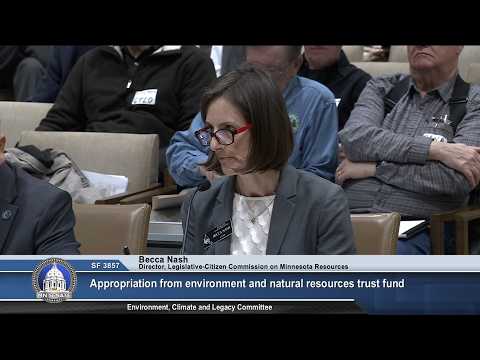
Committee members pressed for more data. Senator Green and others asked the University of Minnesota and LCCMR for a finer breakdown of salary and budget categories for university‑linked LCCMR projects; university representatives committed to follow up. LCCMR director Becca Nash said project work plans posted online include proposed salary, FTE and line-item information and offered assistance gathering summaries.
No legislative action was taken during the informational hearing. The sponsor said the purpose was to bring stakeholders together to begin setting dates for a phase‑out and to identify necessary supports and incentives.