
Committee advances LCCMR $103M package with community grants and conflict-of-interest changes
Get AI-powered insights, summaries, and transcripts
Subscribe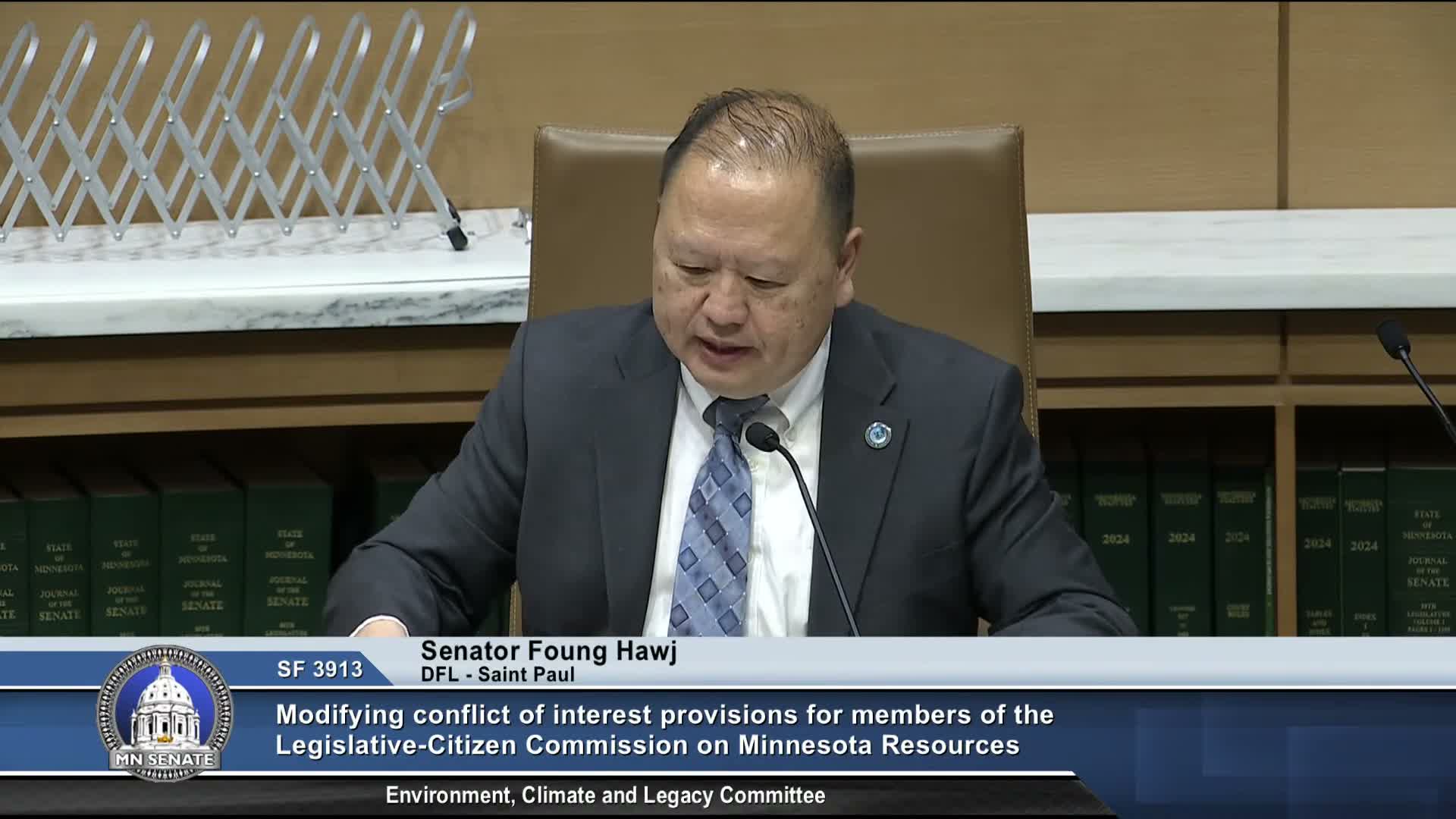
Summary
The Senate Environment, Climate and Legacy Committee recommended passage of Senate File 3857, the LCCMR annual recommendations (109 projects, roughly $103 million), adopting amendments to add a 1.5% community grants allocation and revise conflict-of-interest language; members pressed the University of Minnesota for detailed salary breakout of funded projects.
The Senate Committee on Environment, Climate and Legacy voted to recommend passage of Senate File 3857, the Legislative-Citizen Commission on Minnesota Resources (LCCMR) annual recommendations, as amended and re-refer the bill to the Finance Committee.
The package contains recommendations for 109 projects totaling roughly $103 million to protect and enhance Minnesota’s air, water, land, fish and wildlife. LCCMR director Becca Nash told the committee the fund is financed primarily by lottery proceeds and investment earnings and that the commission’s recommendations follow a multistage competitive RFP and external peer review process.
Committee members adopted three substantive amendments before forwarding the bill. Chair Hur’s A‑1 amendment added the 1.5% community grant portion of the Environment and Natural Resources Trust Fund to the bill; environmental groups including Environmental Initiative testified in favor. “I’m pleased to support Chair Hur’s A‑1 amendment,” said Mike Harley, executive director of Environmental Initiative.
Senator Green offered A‑2 to revise LCCMR conflict-of-interest language. Counsel and LCCMR staff explained existing rules requiring members to declare conflicts and refrain from participation; Mr. Stanley noted that language protecting against voting on matters where a member has a direct or indirect personal financial interest would remain. The committee adopted A‑2.
Chair Hur also added A‑3 (the DNR land-acquisition amendment discussed earlier in session). DNR assistant commissioner Bob Meyer had earlier testified that the department now uses a strategic land asset management program that vets acquisitions and that the LCCMR voted 16–1 to recommend the policy change.
The meeting included a sharp exchange over the bill’s distribution to higher-education institutions. Senator Drazkowski proposed an A‑4 amendment labeling parts of the bill a “slush fund” for universities; University of Minnesota government-relations representative Andrew Chelseff and faculty supporters rejected the characterization and the sponsor withdrew the amendment after LCCMR and university staff agreed to provide a tabular breakdown of how grant dollars are spent (including salary and FTE details) for the 33 university projects that together account for about $22.17 million in recommended funding.
Senator Hird moved the committee recommendation that the amended Senate File 3857 be recommended to pass and re-referred to the Committee on Finance; the motion passed by voice vote.
The committee discussion also flagged a minor inconsistency in the record: LCCMR staff referenced both $103,326,000 and $103,288,000 as the total recommended funding during the walkthrough. LCCMR staff said detailed work plans (posted online) show project-level budgets and that they will provide requested summaries to legislators.
The committee’s action sends the LCCMR package to Finance, where lawmakers will consider funding and possible further amendments.