
Senate Taxes Committee votes 5–4 to advance $40M emergency rental aid drawn from Tyler settlement funds
Get AI-powered insights, summaries, and transcripts
Subscribe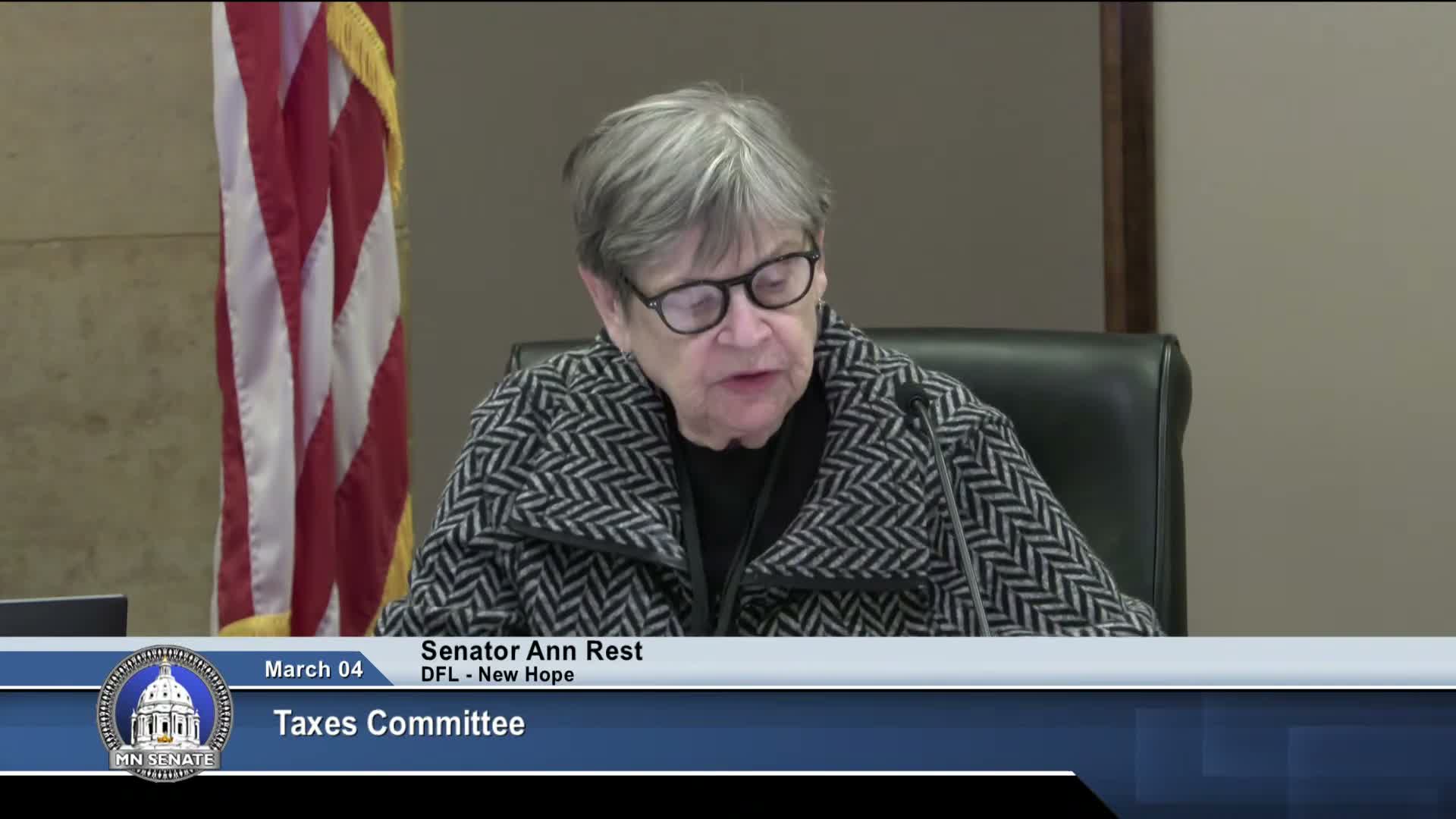
Summary
The Minnesota Senate Taxes Committee on March 4 advanced Senate File 3596 as amended, a bill that would appropriate $40 million in one-time emergency rental assistance distributed to counties and tribal governments and strengthened reporting to the legislative auditor. The committee adopted several amendments including tribal data proxies and child prioritization, and rejected proposals to convert the funds into property-tax refunds or broad local aid.
The Minnesota Senate Taxes Committee on Wednesday advanced Senate File 3596 as amended, approving a one-time $40 million appropriation for emergency rental assistance to be distributed to counties and federally recognized tribal governments.
Senator Port, the bill’s author, told the committee that "Minnesota saw more than 25,000 evictions in 2025, the highest number in state history," and framed the measure as a targeted, short-term response to rising housing insecurity. The A11 amendment that became the committee bill sets program definitions, permits counties, groups of counties, cities, tribal governments or authorized community nonprofits to administer assistance, and requires the commissioner of revenue to calculate and certify aid allocations for each jurisdiction.
The DE specifies a total FY2026 appropriation of $40,000,000, divided into $35,200,000 for counties and $4,800,000 for tribal governments. The bill includes data-privacy protections for applicants and a reporting requirement: counties and tribal governments must submit distribution information and the legislative auditor will receive reports on program administration and outcomes.
Staff modeling presented to the committee included a data workaround for tribal areas without median-rent figures. For the Prairie Island Indian Community, staff said a county-average proxy (Dakota and Goodhue counties) would yield a median gross rent of $1,257 and a projected maximum per eligible household of $6,285 if the A17 amendment is adopted.
The committee also added A16 to expand reporting. Miss Bursch (committee staff) summarized that A16 requires reports to be broken down by each entity administering assistance (for example, cities or nonprofits acting on behalf of counties), report how many recipient households include at least one minor, and provide minimum, median and maximum assistance amounts. The amendment also directs reports to the legislative auditor.
Opponents focused on eligibility and funding choices. Senator Drazkowski urged colleagues to reject the bill, saying it "simply redistributes wealth to illegal aliens to people who decide not to work," and asked whether undocumented people could receive funds. Senator Port replied that the draft contains no documentation test and emphasized that the program targets people experiencing "financial hardship," highlighting a recent 60–80% increase in calls for rental help to 211 and legal-aid lines.
The committee debated the source of funds at length. A18 clarifies the use of so-called Tyler settlement money: state staff explained that a $109 million transfer to a claims administrator followed chapter 113 (the 2024 Tyler legislation), and current estimates indicate $35–$45 million of that appropriation will return to the state. Mister Nelman (state official) testified that the amendment cancels $40 million (the midpoint of the current estimate) and directs the administrator to return unused funds to the state on a schedule (roughly June 20, 2026) that permits fiscal accounting to support the appropriation.
Several alternative amendments failed. Senator Drazkowski’s A19 would have repurposed the $40 million as a property-tax refund and was defeated on a roll call (4 ayes, 5 nays). A22 (a one-time county rebate) and A23 (splitting the $40 million into $20 million supplemental city aid and $20 million supplemental county aid) also failed on roll call.
Votes at a glance: the committee adopted the A11 delete-all amendment by voice vote; it approved A15 (prioritizing households with children), A16 (expanded reporting), and A17 (tribal data proxy) by voice votes; A19, A22 and A23 were defeated on roll calls; the committee recommended Senate File 3596 as amended be passed and referred it to the Committee on Judiciary and Public Safety on a 5–4 roll-call vote.
Clerk roll call on final passage recorded five ayes and four nays; the committee report will move the amended bill to Judiciary and Public Safety for the next procedural step.
Supporters said the targeted assistance could reach households at imminent risk of eviction without increasing taxes; opponents argued the funds should be used differently and pressed questions about eligibility and fiscal process. The committee left in place strong reporting and auditing language intended to provide the Legislature with oversight of distribution and program outcomes.
The committee adjourned after announcing it would reconvene the next day on a different bill. The bill now moves to the Judiciary and Public Safety Committee for further consideration.