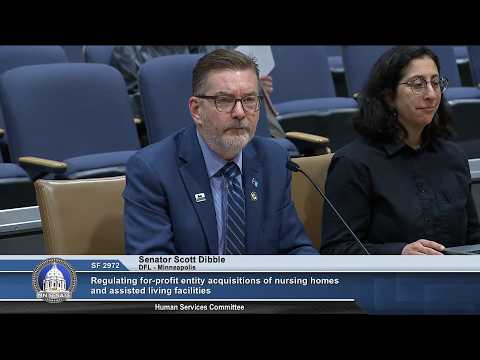
Sen. Dibble amendment wins committee backing; bill tightens owner disclosure, staffing and prohibited practices in long-term care
Loading...
Summary
The Minnesota Senate Human Services Committee adopted an A3 amendment to Sen. Dibble's SF 2972 and recommended the bill, as amended, to pass and be re-referred to Judiciary and Public Safety. The measure requires expanded ownership disclosures for nonprofit-to-for-profit transfers, prohibits asset-stripping and self-dealing, and establishes minimum staffing and 24-hour RN presence with waiver options.
The Minnesota Senate Committee on Human Services voted to adopt an amendment and recommended passage of Senate File 2972, Sen. Dibble's bill that would tighten oversight of ownership changes and set enforceable staffing protections for nursing facilities and assisted-living settings.
Sen. Dibble, the bill sponsor, said the measure builds on work from last year and responds to patterns documented in state investigations and industry reporting. "We're looking for clear prohibitions on business practices that have been shown to reduce care quality and harm residents," he told the committee, listing practices the bill would prohibit: self-dealing, asset stripping, excessive related-party transactions, declines in CMS ratings and failure to reinvest public funds in direct resident care.
Key elements in the adopted A3 amendment and bill text include advance notice and detailed disclosure requirements for nonprofit-to-for-profit ownership transfers, an affidavit demonstrating an acquirer's fitness to operate (financial capacity, legal history and commitment to resident protections), and a new prohibition on certain business practices such as diverting real-estate ownership from the operating budget.
The bill also adds enforceable staffing protections: a requirement for 24-hour on-site registered nurse presence in specified high-acuity settings, minimum staffing ratios tied to resident needs, competency-based staffing aligned with care plans, and a formal waiver process for facilities demonstrating hardship. Sen. Dibble framed staffing rules as essential to preventing preventable harm: "If we do not require round-the-clock professional nursing presence in high-acuity elder care settings, we are knowingly accepting preventable harm."
Supporters included the Office of Ombudsman for Long Term Care and the Minnesota Nurses Association. Deborah McCarthy described repeated staffing churn and rate increases in a memory-care facility where she said services decreased while a corporate investor reported a 14% shareholder return. Ben Valeo of the Minnesota Nurses Association urged stronger staffing ratios and protections for nurses who face safety and licensing risk when facilities are understaffed.
Industry witnesses including representatives of the Long Term Care Imperative acknowledged the need to address documented harms but warned the committee that some provisions could raise costs, reduce bed capacity and exacerbate staffing shortages if implemented without funding or careful design. They cited state data on facilities' financial reserves and estimated increases in Medicaid costs if the federal-proposed staffing model were imposed without adjustments.
After questions on financial impacts and rural capacity, the committee adopted the A3 amendment by voice vote and then voted to recommend SF 2972 as amended to pass and be re-referred to the Committee on Judiciary and Public Safety. Chair Hoffman said the motion carried on a voice vote; the committee did not record a roll-call tally in the transcript.
Next steps: SF 2972 as amended will move to the Judiciary and Public Safety Committee for further consideration.