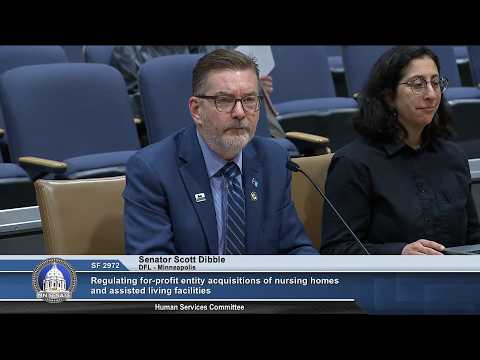
Sen. Mann's bill would require owners to honor resident contracts and explain big fee hikes; committee lays it over

Minnesota Senate Committee on Human Services · March 5, 2026

Get AI-powered insights, summaries, and transcripts

Subscribe
AI-Generated Content: All content on this page was generated by AI to highlight key points from the meeting. For complete details and context, we recommend watching the full video. so we can fix them.

Summary

The Minnesota Senate Human Services Committee heard Sen. Mann's SF 3844, which would require new owners of nursing and assisted-living facilities to honor existing resident contracts, require documentation for fee increases above CPI-U, forbid requiring guardians for admission and add AED and response-time documentation requirements. After testimony from families, ombudsmen and providers, the committee laid the bill over for further work.

The Minnesota Senate Committee on Human Services on Monday heard testimony on Senate File 3844, authored by Sen. Mann, a bill that would require buyers of nursing homes and assisted-living facilities to honor existing resident contracts and to justify any housing or service charge increases above the Consumer Price Index for All Urban Consumers (CPI-U).

Sen. Mann told the panel the bill is a "person-centered" measure aimed at protecting residents as private-equity and other investors increasingly acquire care facilities. "If a facility changes ownership, the new license must honor the current contracts until they expire," she said, and companies that impose large price hikes would have to provide documentation and justification for those increases.

The bill also would prohibit facilities from requiring a resident to obtain a guardian as a condition of admission, require an automatic external defibrillator (AED) at the facility with staff training, and strengthen documentation about resident needs and staff response times.

Parice Rudina of the Office of Ombudsman for Long Term Care, testifying for the Consumer Advocates Coalition, told senators that residents and families often discover the true costs and services only after moving in and urged increased transparency for consumers. "Finding compliance information is difficult, so having this already public information available will better support residents and families in locating their new home," Rudina said.

Family testimony underscored the consumer-advocacy arguments. Cheryl Pray described repeated billing errors at her mother's assisted-living facility: an initial set of charges for December and January showed $19,287, and after multiple challenges the invoice was corrected to reveal $1,333 in overcharges. "Billing is complicated," she quoted a facility executive as saying. "Respectfully, it is not," she told the committee.

Provider representatives from the Long Term Care Imperative said they are willing to keep working with advocates but raised operational concerns about several provisions. Erin Hubert said sections of the bill that limit when a facility may seek guardianship and that require call-log audit trails and response-time reporting could prevent facilities from obtaining needed clinical or financial supports in some cases and add manual burdens at a time of workforce strain. Kyle Burnt said AED-training requirements could impose certification and liability costs not contemplated in the draft.

Several senators tested the boundaries of the bill's fee transparency provisions. Sen. Erin McQuaid pointed to a packet of fee examples from the ombudsman's office that included line items such as fall fees, small fees for retrieving eyeglasses and charges for sending paper mail; she said the proposals in the bill are aimed at forcing explanations for sudden or repeated increases well beyond CPI-U.

Committee members repeatedly returned to the question of whether the bill's restrictions might amount to "rent control." Supporters, including Sen. Mann and Sen. McQuaid, said the measure requires explanation—rather than a cap that automatically prevents any increase—when prices rise faster than CPI-U. Opponents, including industry witnesses, warned that poorly designed limits could make it harder for providers to secure financing for capital needs.

The panel did not vote on SF 3844. Chair Hoffman said the committee would "lay over" the bill for further negotiation and possible inclusion in an omnibus package. "We appreciate the willingness of the imperative to continue discussing these issues so we can identify helpful solutions to these challenges," Rudina said as the committee concluded.

Next steps: Committee staff and stakeholders will continue negotiations; the bill was not advanced at today's meeting.