Get Full Government Meeting Transcripts, Videos, & Alerts Forever!
Get email alerts on the Judiciary Budget And Policy topic
No spam. Unsubscribe anytime.
Judicial branch urges security funding, seeks paid‑leave coverage and court‑rule changes; committee adopts author amendment and rejects arbitration rollback
Summary
The judicial branch asked the Senate Judiciary and Public Safety Committee for supplemental funding for courthouse and judicial‑home security, proposed employer‑share funding for Minnesota’s paid leave, and advanced several policy changes — including jury‑pool research access, a move to post court notices online, and raising the mandatory no‑fault arbitration threshold. The committee adopted the author’s A1 amendment, rejected an amendment to keep arbitration at $10,000 and laid the bill over for further budget consideration.
The Minnesota judicial branch told the Senate Judiciary and Public Safety Committee on March 4 that rising threats to judges and courthouse facilities require new spending and staffing, and that the branch needs help covering the employer share of the new Minnesota Paid Leave program.
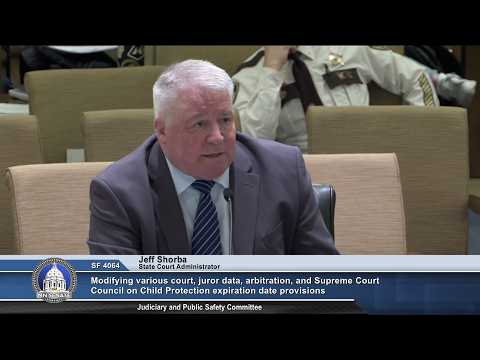
"Our judicial council put safety and security at the top of our priorities," Jeff Shore, state court administrator, told the committee. Shore outlined a five‑part security package — including personal data‑removal services, reimbursement for home security, two new security‑experienced staff positions, state‑patrol protection for the chief justice (about $100,000 a year) and a $1,000,000 one‑time courthouse security grant program with a required 50% local match.
Why it matters: Judicial officials said threats to judges and staff have jumped substantially and include doxxing, home‑surveillance drones and direct threats to families. Chief Judge Michael Fritz of the Seventh Judicial District told lawmakers the branch logged 211 incident reports in 2024 and 310 in 2025 — "nearly six incident reports per week" — and described several instances in which litigants obtained judges’ private contact information or used drones to surveil judges’ homes.
"When threats come in, you ask: is this serious? What should I do? Do I need to tell my family?" Fritz said, urging two experienced law‑enforcement hires to help intake and threat assessment.
Budget and paid leave: Shore estimated the security package would add roughly $1.3 million a year in 2028–29. The branch also asked the committee to fund its employer share of the new Minnesota Paid Leave program, which Shore said was not covered in the prior budget and is currently being paid out of other judicial functions. He gave a working cost estimate of about $644,027 in the near term, rising toward about $1.2 million in 2028.
Policy package: The judicial presenters also outlined seven policy proposals bundled in Senate File 4064. Key items include temporary access to driver‑license and Department of Revenue records for a jury‑pool research project, increasing the mandatory no‑fault arbitration filing threshold from $10,000 to $20,000, allowing district courts to publish required notices on the Minnesota Judicial Branch website as an alternative to publication in a qualified newspaper, streamlining conciliation court notice service for claims under $2,500, enabling administrative renewal of restitution judgments, clarifying notice requirements in some divorce cases, and extending a child‑protection council deadline to June 2027.
Pressing concerns and testimony: The newspaper sector objected to the court‑notice change. Sarah Strong of the Minnesota Newspaper Association told the committee that, while notice habits have changed, newspapers (and their websites) still reach many Minnesotans and that shifting judicial notice duties exclusively to the courts could raise due‑process and outage risks. "Eighty‑six percent of Minnesota adults read their local print or digital newspapers each month," Strong said, and warned that a court website outage would leave parties without access to notices.
Arbitration debate and floor amendments: The arbitration proposal drew the most sustained, partisan debate. Senator Seaburger offered an A2 amendment to retain the $10,000 mandatory no‑fault arbitration threshold, arguing from three decades of practice that expanding arbitration risks increasing costs and potential abuses. Lindsay Carpenter, a member of the Supreme Court’s no‑fault standing committee, testified that a balanced committee of plaintiff and defense attorneys had recommended raising the limit to $20,000 to reflect inflation and to align with small‑claims and filing practices.
The committee voted on A2 and the result was tied 5–5; the A2 amendment therefore failed to prevail. Earlier, the committee adopted the bill’s A1 author's amendment to put the bill into the author's preferred shape.
Committee action and next steps: Chair Lats said the committee would lay Senate File 4064 over for possible inclusion in the budget process and to allow further work on data‑classification and technical language. The presenters agreed to provide follow‑up numbers about Minnesota Management and Budget’s experience with the paid‑leave program. No final appropriations were made; the bill was held for further committee and budget consideration.
What’s next: The committee laid the bill over for future consideration as part of the broader budget process. Presenters said they will return with any requested analysis and details about costs and data safeguards.
Sources: Testimony from Jeff Shore (state court administrator) and Chief Judge Michael Fritz; testimony and questions from committee members; written materials provided by the judicial branch and the Minnesota District Judges Association.