DEED tells Senate committee Minnesota UI trust fund has largely recovered; fraud rate at about 1.5%
Loading...
Summary
DEED officials told the Senate Committee on Economic Development that Minnesota's unemployment insurance program remains operationally strong, with technology upgrades and audits keeping fraud and error rates low (about 1.5% fraud). Officials outlined trust‑fund mechanics, employer tax structures and pandemic borrowing repayment.
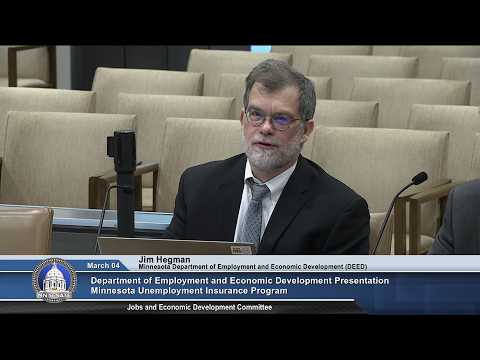
Deputy Commissioner Evan Rowe and Unemployment Insurance Director Jim Hegman told the Senate Committee on Economic Development on March 4 that Minnesota’s unemployment insurance (UI) program is functioning without major operational failures and that integrity controls have kept fraud and improper‑payment measures relatively low.
Hegman told senators the program is eligibility‑based and temporary — “up to 26 under normal circumstances,” he said — and that the typical weekly benefit replaces roughly half a worker’s pre‑unemployment wages up to a current maximum of $914.
Why it matters: UI benefits are paid from a federal‑held Minnesota trust fund that smooths seasonal and economic swings. State tax rules, an employer experience rating and occasional additional assessments are designed to replenish the fund when payouts rise; during the pandemic the Legislature paid down roughly $2.3 billion to reduce federal borrowing and restore the trust fund toward a pre‑pandemic level Hegman described as about $1.5 billion.
Hegman and Rowe described how benefits are funded and how the system responds to downturns: employers pay a base tax (Hegman described the base as about “4‑tenths of 1%”) plus an experience‑rating component that can vary by employer (Hegman cited a cap near 8.9%). Reimbursing employers (government entities and some nonprofits) instead repay benefits as they are paid. Hegman said the tax structure and experience rating typically take time to respond to rising payouts, which is one reason the trust fund exists.
On program performance and integrity, DEED staff pointed to ongoing audits and automated checks. Hegman said Minnesota participates in routine reviews by federal and state auditors and that DEED’s internal controls and employer reporting help detect problems. “We watch every single request for benefits, and we watch every single banking transaction that takes place, and we have tools available to us to intervene,” Hegman said.
When senators asked about measurement, DEED cited the federal Benefit Accuracy Measure and related metrics. Hegman told the committee the program’s fraud rate is near 1.5 percent and that most of that measured error is driven by unreported earnings or applicant mistakes rather than imposters or account hijackers. “The 1.5% that you’re seeing is primarily…unreported earnings,” Hegman said, adding that imposters or hijackers have been “relatively low” and that many attempts are stopped before payments leave DEED’s systems.
Senators pressed DEED about identity‑theft cases, timeliness of detection and recovery of overpayments. DEED officials said their strongest tool for detecting unreported earnings is a quarterly wage‑detail cross‑match with employer wage files; many non‑fraud overpayments are recovered through offsets against future benefits, and larger fraud collections can involve tax‑refund intercepts, liens or garnishments but require confirming the debt. DEED said it did not have a full collection‑rate number at the hearing and offered to follow up with detailed figures.
DEED also described technology investments that undergird its ability to scale. The agency migrated its UI system to the cloud in 2021, added multilingual access (Hegman said the application process is available in English, Somali and Spanish) and has pursued incremental updates rather than large, risky overhauls. Officials said paid‑leave implementation was supported by cloning the UI tax system so employers would see minimal change while keeping UI and paid‑leave taxes separate.
On oversight, DEED reported a recent USDOL review and earlier Office of Legislative Auditor work with generally positive findings; DEED said it did not anticipate adverse findings from the recent USDOL visit. The department also said it has returned to regular employer audits (roughly 1,400 audits per year) after pandemic slowdowns.
The committee did not take final action on UI policy at the hearing. DEED officials offered to provide follow‑up data on overpayment collections and other detailed metrics requested by senators. The committee adjourned with plans to resume business Monday.