
Contentious Bogalusa oversight hearing centers on fiscal administrator's conduct and audit delays
Get AI-powered insights, summaries, and transcripts
Subscribe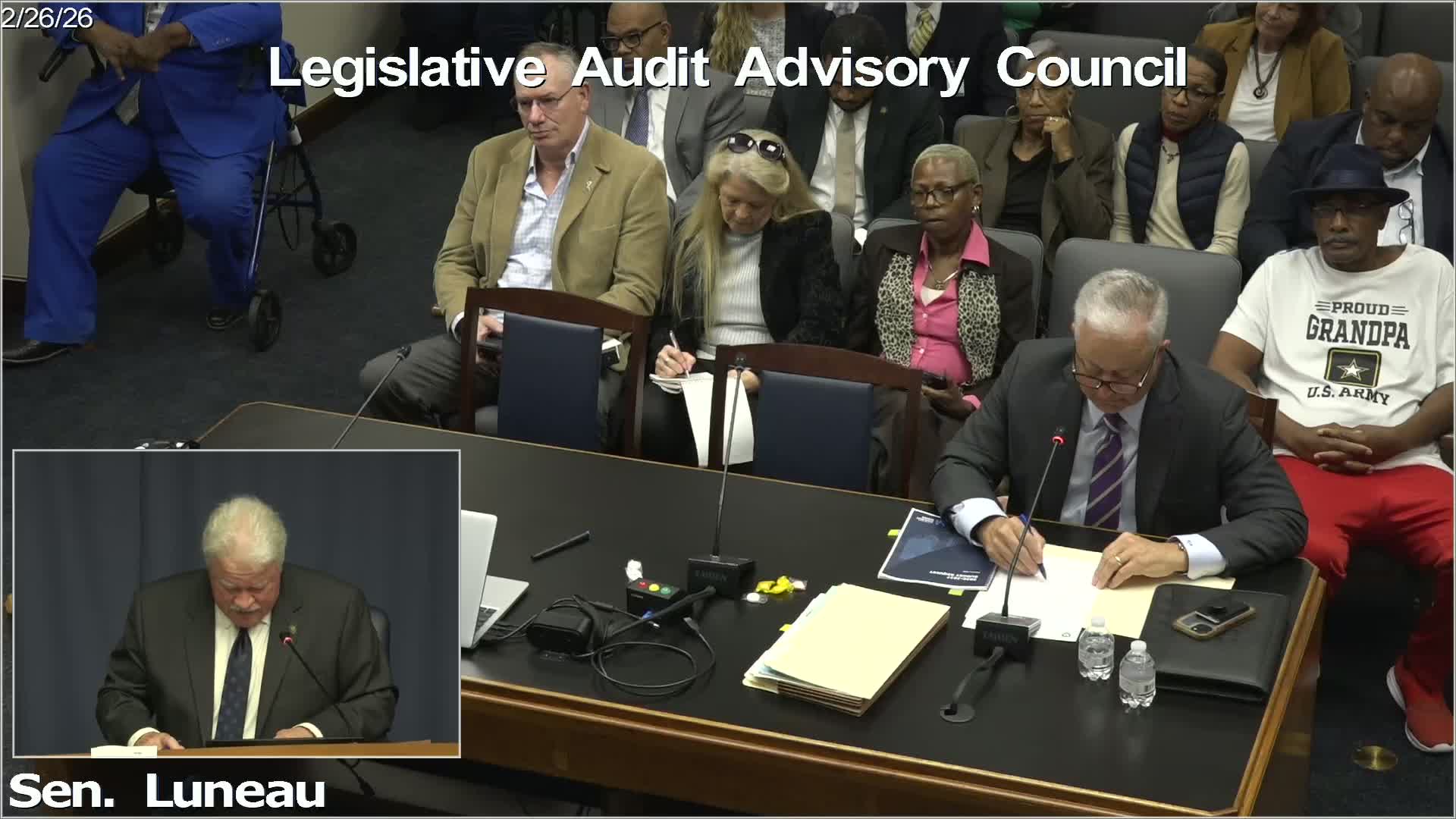
Summary
At a Feb. 26 Legislative Audit Advisory Committee meeting, fiscal administrator Bob Nielsen gave a financial update on Bogalusa; the presentation and a lengthy public comment period featured competing claims about missing funds, personnel changes and whether the city is in a fiscal crisis. Lawmakers urged cooperation while auditing work continues.
Chairman Senator Luno convened the Legislative Audit Advisory Committee on Feb. 26 to hear a report from Bob Nielsen, the court‑appointed fiscal administrator for the City of Bogalusa, and extended public comment on the city's financial condition.
Nielsen told the committee the city's current cash position is "approximately $4,900,000, with $1,700,000 in unrestricted funds and $3,900,000 in restricted funds," and reported current open payables of about $190,000 and outstanding payroll‑tax liabilities approaching $1,000,000 that the city is negotiating with the IRS. He described steps he said are underway to stabilize operations: engaging an external payroll provider, issuing $1,700,000 in bonds for a sewer treatment plant project, installing roughly 1,100 water meters to improve revenue capture and using an outside Office of Debt Recovery contractor to collect past‑due utility accounts.
The update prompted an extended public‑comment section in which residents, community leaders and the mayor offered sharply different accounts of the city's recent past and present. Faith Barrow, a longtime resident, urged removal of the fiscal administrator; Joe Miller and other speakers described personal property removals and friction between the administrator and elected officials. Daryl Smith and one commenter said the 2022 audit shows large figures described in the report as fraud or misappropriation and called for formal criminal investigation; Smith said the audit cited roughly $1,440,000 in alleged misappropriation. John Sanders, who identified himself as the airport manager, disputed some of Nielsen's claims about airport operations and revenue.
Mayor Trung told the committee, "Bogalusa is not in a financial crisis," and said he has repeatedly requested documents and access to the city's accounting system (Tyler). He said the city had 119 employees when the administrator took over and 149 now, and questioned how Nielsen's office reconciles those hiring figures with claims of payroll reductions. The mayor also told the committee he plans to provide an employee roster and Department of Health noncompliance notices to legislators for review.
Nielsen denied some of the more pointed allegations directed at his conduct. He said audits for 2023 are beginning and estimated completion of both the 2023 and 2024 audits within about nine months, while acknowledging the bookkeeping and historical coding errors have slowed the process. He attributed many extension requests around the state to a delayed federal compliance supplement and to staffing and turnover issues at audited entities.
Committee members repeatedly urged cooperation between the fiscal administrator, the mayor and the city council and discouraged repeating material the committee had already heard. The chair said the committee has an advisory role and does not have authority to remove the administrator; members pressed for documentary follow‑up and asked Nielsen to provide audit records when available. No formal action to change the fiscal administrator's appointment was taken during the meeting.
Next steps: the auditor's office and the fiscal administrator said they will continue the audits and provide requested documents to the committee; Nielsen estimated the 2023 and 2024 audits could be completed in about nine months, after which the state auditor's office will further scrutinize the records.