Get Full Government Meeting Transcripts, Videos, & Alerts Forever!
Get email alerts on the Fraud Prevention topic
No spam. Unsubscribe anytime.
Isanti County health staff outline fraud-prevention program, report $560,168 saved in FY2025
Summary
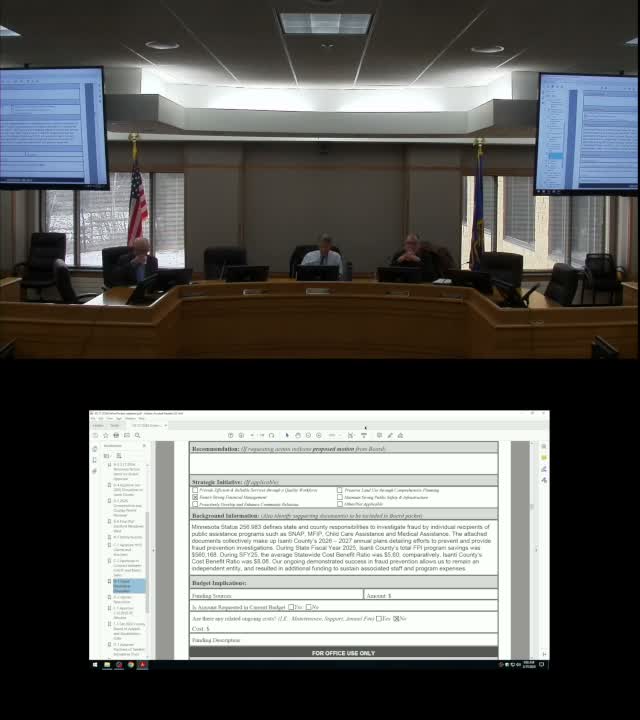
Health and Human Services leaders told the county board their fraud-prevention program produced $560,168 in program savings during state fiscal year 2025 and a local cost–benefit ratio of $8.06; staff said the program investigates roughly 25 cases per month and is funded with an $89,000 annual allocation.
Jody Donay, division leader for Isanti County Health and Human Services, told the county board the agency’s fraud-prevention program produced $560,168 in program savings during state fiscal year 2025 and achieved a local cost–benefit ratio of $8.06, compared with a statewide average of $5.60.
Donay said the county receives $89,000 annually to support fraud-prevention staff and associated expenses, and that funding currently covers payroll, fringe benefits, travel, training and other basic program costs. The program investigates roughly 25 cases per month, she said, and those outcomes support Isanti County’s ability to operate its own fraud-investigation unit rather than regionalize with neighboring counties.
“On an annual basis, our ongoing demonstrated success in fraud prevention allows us to remain an independent entity,” Donay said, summarizing the county’s written plan submitted to the Minnesota Department of Human Services.
Carrie, who supervises the county’s fraud-prevention program, described how investigations have changed over time, saying investigators now rely more on subpoenas and search warrants to obtain third-party records and that financial institutions can take weeks to respond to requests. “Now we’re having to do more subpoenas, search warrants,” she said, noting request turnaround times of 30–60 days from some institutions.
Commissioners pressed staff on how fraud is detected. Carrie said referrals come from eligibility interviews, public tips, provider reports and a state-level anonymous reporting website that feeds complaints into the county system. She emphasized that a referral does not by itself prove fraud: investigators must show intent before classifying conduct as fraud.
Board members also asked how the county monitors spending by outside providers that receive county funds. Donay said the county maintains close relationships with contracted providers, requires supporting documentation for invoices and payroll, and can request audits or withhold funds where contractual requirements are not met. She noted the state investigates provider fraud while the county investigates individual recipient cases.
The presentation was informational; no board action was required. Donay said the county’s annual submission to the Department of Human Services includes organizational charts, the welfare-fraud investigator job description and a budget workbook describing anticipated fraud-prevention activities.