Get Full Government Meeting Transcripts, Videos, & Alerts Forever!
Get email alerts on the Capital Projects Highway Facility topic
No spam. Unsubscribe anytime.
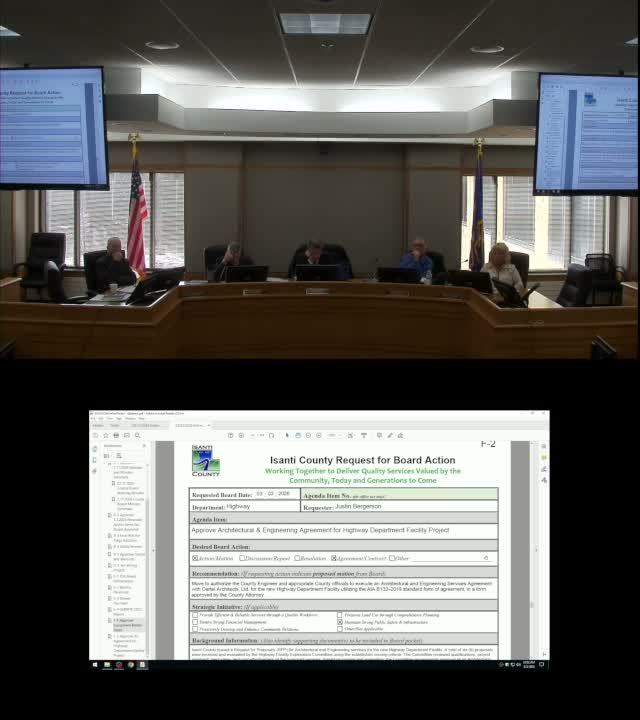
Isanti County hires Ortel Architects to design new highway facility after debate over cost, scope
Summary
The Isanti County Board voted 4–1 to hire Ortel Architects for $1,137,678.25 to design a replacement highway facility, advancing the project into schematic design amid concerns from one commissioner about scope, indoor storage and contract exposure; legal counsel described termination and suspension terms in the AIA agreement.
The Isanti County Board voted 4–1 to hire Ortel Architects for architectural and engineering services to design a new county highway facility, approving the contract amount of $1,137,678.25 and moving the project from planning into schematic design.
The decision follows a recommendation from the county’s highway facility exploration committee, which reviewed six proposals and recommended Ortel — a St. Paul firm whose fee came in significantly lower than competing bids and under the county’s CIP line for the project. County Highway Engineer Justin Bergerson told the board the committee vetted Ortel’s team, schedule and subcontractors and was comfortable with the firm’s ability to deliver the work.
"Ortel is based in Saint Paul. They focus in public works," Bergerson said. "They specialize in this type of work. Their portfolio has a lot of similar projects, and the committee was comfortable with their proposal and fee." (Justin Bergerson, County Highway Engineer)
Why it matters: the county says the existing highway shop is an aging 75‑year facility with deferred maintenance and operational limitations. The board heard the design work is intended to give the county a concrete plan—renderings, phased budgets and specifications—needed for seeking construction bids and for any public outreach tied to potential financing options, including a referendum-backed sales-tax reimbursement if approved by the legislature and voters.
Board debate focused on scale, indoor storage and financial exposure. One commissioner said they were "still not totally comfortable" with approving a more than $1 million professional-services contract before firm decisions on the final building program and funding, and voted no.
Legal counsel addressed contract protections: under the agreement’s Article 9, the architect would be compensated for services performed up to any suspension or termination, and either party may terminate with written notice under specific circumstances. Counsel said that if the project were suspended for more than 90 cumulative days the architect could terminate after seven days’ notice; otherwise the county would pay for the work completed to the suspension date.
Timing and next steps: Bergerson and staff said schematic design materials and renderings would begin to appear in upcoming months, with a design timeline that anticipated moving toward bidding late in 2026. The board discussed staging public tours of comparable facilities and scheduled a staff/commissioner site‑visit day to review examples and inform final decisions about interior layout and storage needs.
Votes at a glance (other board actions that morning): the board also approved by resolution the Judicial Ditch 6 joint drainage authority reformation (unanimous), authorized a DNR cooperative agreement to pave the Beckley Homestead County Park parking lot and road (unanimous; construction cost borne by the state, maintenance responsibility to Isanti County), approved acquisition of two John Deere mowers funded through the parks budget (unanimous), and adopted 2026 county equipment rental rates for highway work (unanimous). A late charitable-gambling permit application for the Cambridge Isanti Hockey Association was tabled to the March 17 meeting for additional public-notice and legal review.
What remains unclear: the board continues to deliberate the final size of indoor vehicle storage and other program choices that materially affect project cost. Commissioners asked staff and the architect to prioritize options for reducing indoor storage if that is needed to lower overall costs. The contract approval authorizes work to proceed on design; it does not commit the county to construction financing or to building the exact design produced if future votes or funding decisions change.
The project is expected to continue through design milestones over the coming months, with staff returning to the board at key checkpoints for schematic review, budget calibration and public‑outreach planning.