Get Full Government Meeting Transcripts, Videos, & Alerts Forever!
Get email alerts on the Hyatt Hotel topic
No spam. Unsubscribe anytime.
Conroe council approves Hyatt Regency FY2026 budget despite multi‑million dollar debt shortfall
Summary
Council approved the Hyatt Regency hotel’s FY2026 operating and capital budget after budget presenters and finance staff warned the hotel will not cover all debt service in the near term, producing an estimated FY2026 shortfall of about $2.58 million; council asked staff for a multi‑year capital plan and additional financial analysis.
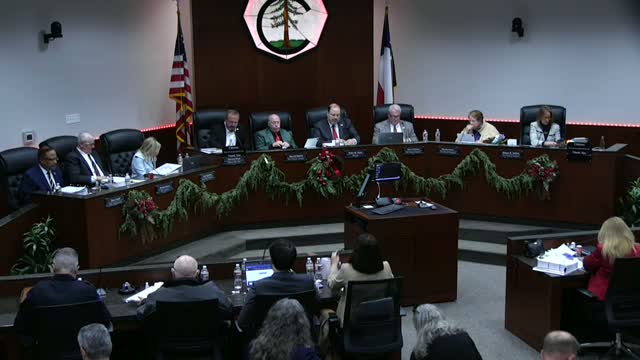
The Conroe City Council approved the FY2026 operating and capital budget for the Hyatt Regency hotel and convention center on Dec. 11, after a detailed presentation that showed operating revenue rising but insufficient to cover the hotel’s debt obligations.
Walter Possecki, the owner’s‑representative/asset manager appearing for Garfield Assets Management, told council that proposed room and food‑and‑beverage revenue would yield modest year‑over‑year gains but would not eliminate a structural shortfall once debt service and reserve requirements were counted. Finance staff explained the numbers during a question‑and‑answer session: available operating cash for debt service was about $1.787 million for FY2026, while the combined debt service for three lien payments totals roughly $4.37 million, leaving an estimated shortfall of $2,584,087 for the fiscal year.
That gap reflects three principal pressures, Possecki said: a large one‑time cancellation expense in FY2025, a ramping management fee, and increased furniture/fixtures/equipment (FF&E) reserves. "There is no argument from me — the hotel is not self‑sustaining under current financing," Possecki told council, adding that a stabilized occupancy could take seven or more years. Finance staff said the hotel’s projected EBITDA less reserves was essentially flat versus prior year once those factors were included.
Councilmembers pressed for additional detail. One councilmember asked whether the hotel’s revenue figure was net of management fees and operating reserves; finance staff and the presenter confirmed it was and reiterated the multi‑lane debt schedule. Councilmembers also asked about the $16 million capital rehabilitation penciled in for 2029 and whether sufficient FF&E reserves would be available; staff said current FF&E reserves were roughly $715,047 and that additional funding or a future financing action would be required to cover the larger anticipated capital need.
Despite the concerns, a motion to approve the FY2026 Hyatt operating and capital budget carried. Council directed staff to provide a multi‑year capital plan and additional scenarios showing the tax‑rate or other budgetary impacts required to meet debt obligations if revenues remain below projections.
The hotel’s operator highlighted positive customer feedback and occupancy trends but acknowledged a long ramp to stabilization. "Reviews are phenomenal," Possecki said, while adding that he did not foresee occupancy increasing quickly enough to erase the shortfall without further actions. Council agreed to continue financial oversight of the hotel and to request further analysis on options to address the debt service gap.
Next steps: staff will deliver a five‑year capital plan and updated debt‑service scenarios for council review; the council’s follow‑up direction was to explore options that could include revised capital timing, reserve strategies or other fiscal measures.