Get Full Government Meeting Transcripts, Videos, & Alerts Forever!
Get email alerts on the Animal Welfare topic
No spam. Unsubscribe anytime.
Veterinarians and shelter staff urge Conroe to allow trap-neuter-return; council defers ordinance review
Summary
Veterinarians and shelter staff presented evidence that Trap-Neuter-Return (TNR) reduces feral cat populations, cited recent state legislative changes and grant funding, and asked for ordinance changes; the council deferred the item for administrator and legal review.
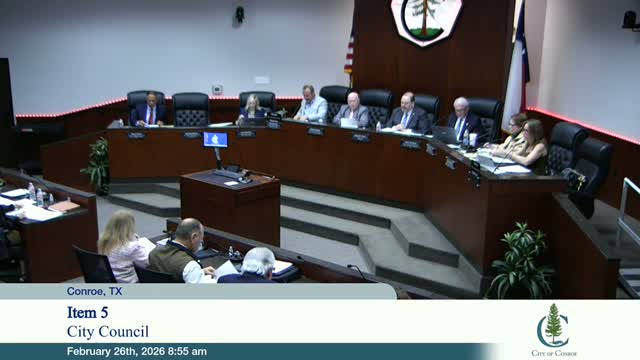
Veterinarians and shelter staff asked the Conroe City Council on Feb. 26 to change city ordinances to allow trap-neuter-return (TNR) for community cats, citing reduced shelter intake and long-term cost savings.
Dr. Jennifer Money, who performs spay and neuter surgeries for the Conroe shelter, told the council the shelter trapped 544 cats in 2024 and 337 cats in 2025 and that current local ordinances prevent volunteers and the shelter from returning altered cats to city limits. "If we were to allow TNR, we could take some of that off of them," she said, describing the time and logistical burdens placed on shelter staff.
Dr. Kira Ramdus, a feline behavior and medicine specialist, argued TNR reduces population growth, is cost-effective and lowers euthanasia rates over time. She cited recent state measures (reported in the presentation as House Bill 3660) and said the Texas Department of State Health Services has funding available to subsidize spaying and neutering.
Shelter staff and veterinarians emphasized that the program could initially proceed with volunteer capacity and grant support and that the city would not need to provide new funds immediately; they asked council to remove cats from the "at large" impoundment definition or adopt a TNR ordinance. Council members asked staff and the city administrator to review the proposed ordinance and legal implications before taking final action.
Why it matters: TNR changes affect animal-control practice, shelter intake and budgets and intersect with recent state law and grant programs that subsidize sterilization efforts.
Next steps: Council deferred the item so the city administrator and legal staff can review the draft ordinance; staff indicated a pathway to implement changes administratively if the council supports removing cats from the "at large" impoundment definition.