Get Full Government Meeting Transcripts, Videos, & Alerts Forever!
Get email alerts on the Events Permitting topic
No spam. Unsubscribe anytime.
Conroe council adopts special-events permitting guide after lengthy debate over fees and downtown impact
Summary
After hours of public comment from downtown merchants and event organizers, Conroe City Council adopted a new special-events application and fee structure (base $500 nonrefundable application) with provisions for additional cost-recovery charges, insurance minimums and a target 30-day internal review window; council members asked staff to refine tiering and flexibility for small events.
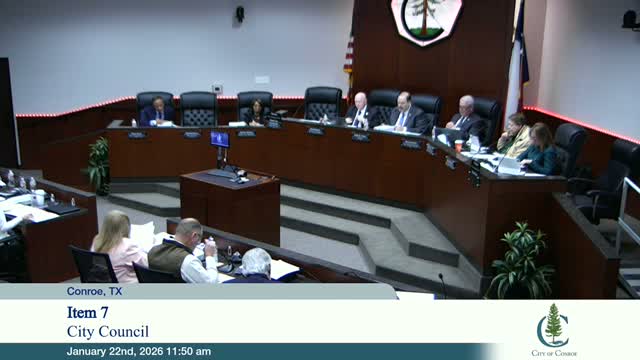
The Conroe City Council voted Jan. 22 to adopt a comprehensive special-events permit guide and application process intended to standardize how street closures, festivals and other public events are reviewed and permitted across the city.
Staff described a detailed application packet, a proposed nonrefundable $500 starting application fee for standard street-closure events, a 30-day internal target for staff turnaround, and an expectation that additional costs (traffic control, police overtime, barricades, park rentals) would be charged as applicable. The guideline also includes insurance minimums and references to TABC requirements when alcohol is involved.
Downtown business owners and event promoters told the council the draft would create a paywall for small and recurring community events. Speakers argued that a single $500 fee and a 6-month filing window are excessive for small street-block closures or neighborhood markets and urged a tiered approach that scales fees by event size and complexity.
Council debate focused on three choices: a one-size $500 base fee, a tiered fee structure with smaller charges for low-impact gatherings, or more flexibility to refund or discount fees for nonprofits and recurring community markets. Several councilmembers proposed a multi-tier approach and asked staff to produce definitions for "street closure" versus "event/festival" so permits and fees match expected city costs.
Safety and cost recovery were central points. Councilmembers emphasized the city's responsibility to ensure proper insurance, traffic control and sanitation, noting prior liability settlements from event incidents. Staff said the $500 application fee was intended to cover the multi-agency review steps that typically total several hundred dollars of staff time; additional permit charges would reflect actual recovery of police, fire and public-works costs.
Outcome: Council approved the permit guide and $500 nonrefundable base application with the understanding staff will refine tiering, turnaround expectations and insurance language as needed; council members asked staff to return with clarified timelines and options that protect small downtown events while ensuring cost recovery and public safety.
Next steps: Staff will finalize the ordinance language for recording and return with clarified tier definitions and, where appropriate, refundable or deposit-based mechanisms to incentivize cleanup and compliance.