Get Full Government Meeting Transcripts, Videos, & Alerts Forever!
Get email alerts on the Public Safety And Surveillance topic
No spam. Unsubscribe anytime.
Oro Valley council approves drone-as-first-responder lease; resident raises privacy concerns
Summary
After a resident urged tabling a DPS-funded drone lease citing privacy and mission-creep concerns, council approved Resolution R26-04 authorizing the police chief to sign an Arizona Department of Public Safety grant-funded drone lease to deploy a Drone-as-First-Responder program aimed at faster response to in-progress crimes and search-and-rescue.
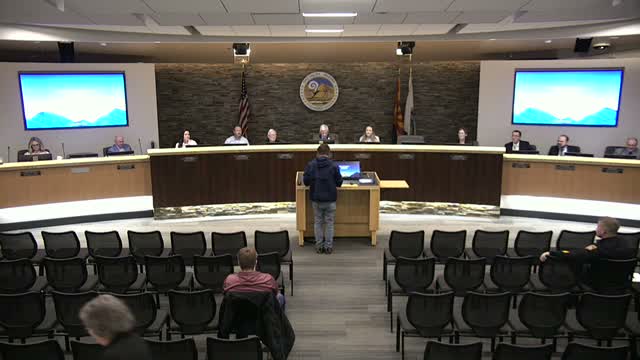
The Oro Valley Town Council voted on Jan. 28 to approve Resolution R26-04 authorizing the chief of police to sign an agreement with the Arizona Department of Public Safety to fund leased drones to support a Drone-as-First-Responder (DFR) program.
Resident Sean Glaser used his allotted public comment time to urge council to vote no or table the measure until a formal privacy impact assessment is completed. Glaser warned of "mission creep" in the grant language and argued the agreement "permits [the police] to work outside the regular jurisdictional boundaries" and could import surveillance practices. "By accepting border funds to fly drones over our backyards, we are proving them right," Glaser said, urging council not to "trade our liberty and our peace for a temporary grant."
Lieutenant Kevin Peterson and other commanders described DFR as a tool for faster situational awareness and officer safety rather than a persistent surveillance platform. Peterson said the grant-funded program would place automated docking stations on government-owned buildings (not private property), with two drones per docking station and an approximate 3.5-mile radius of coverage. "This is not a surveillance tool," Peterson said, adding the platform is intended for in-progress crimes, fleeing suspects, missing persons and thermal-imaging uses for fire response.
Council members pressed for specifics on policies governing deployment, recording and data retention. Command staff said the drone would not record continuously and that recording would follow law-enforcement evidence policies, redaction laws and the town's existing records practices. A vendor-provided transparency page will log flights, flight paths, distance and duration; staff said they would provide further details such as data-retention periods on request. Peterson also said the first-year cost (after vendor negotiation) was reduced to about $158,000 and that the overall multi-year program cost was being finalized; he noted a 90-day opt-out clause once operations begin.
Assistant Chief Grant Cezaric of the Golden Ranch Fire District supported siting docking stations at fire stations and said the district sees no direct operational impact from hosting the units. Council members cited officer safety, search-and-rescue benefits and prior positive experiences with drones in the region in explaining support for the resolution. The motion to approve the resolution passed on a recorded voice vote with council saying "Aye" and the mayor declaring "The ayes have it."