
Sacramento library officials say safety incidents have stabilized after 2024 spike, cite targeted security measures
Get AI-powered insights, summaries, and transcripts
Subscribe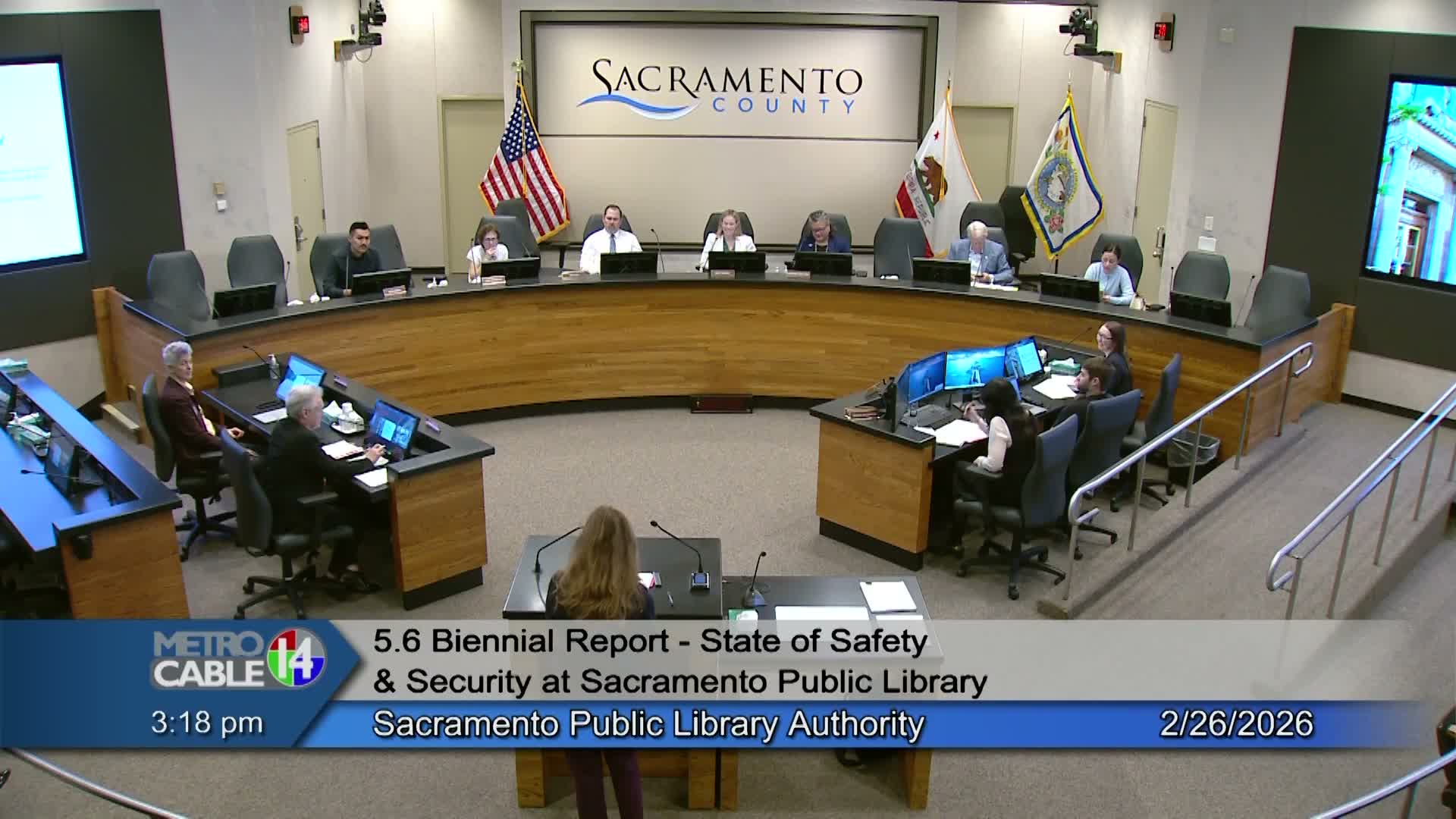
Summary
The Sacramento Public Library Authority heard a systemwide safety and security update showing incident growth leveled after 2024; staff pointed to targeted security deployments, a new vendor and social‑work partnerships as key responses and agreed to provide additional metrics to the board.
Karen Leland, the library system’s safety and security manager, told the Sacramento Public Library Authority that incident activity across the system surged earlier in the last five years but has stabilized since 2024, and that staff are using targeted security deployments and partnerships to manage risk.
Lede: In a presentation to the board, Leland said total unique incident responses rose sharply between fiscal 2019 and fiscal 2024—earlier reporting showed a 68% increase—but that projected figures for fiscal 2026 indicate ‘‘manageable, predictable growth’’ rather than uncontrolled escalation.
Nut graf: The update, provided at the board’s regular meeting, outlined the library’s approach to reducing escalation and protecting staff and patrons: a new security vendor (BlueKnight Security and Patrol), added after‑hours coverage at problem branches, installation of security gates at Sylvan Oaks, deployment of internal library security officers during open hours, panic buttons, staff de‑escalation training and social‑work partnerships downtown.
Body: Leland said three behavioral categories account for most incidents: verbal aggression (profanity, slurs, hostile gestures), noncompliance (refusal to follow staff direction, trespass, misuse of facilities) and property incidents (opportunistic theft and, recently, branch burglaries). She noted specific recent criminal activity at Valley High and Del Paso Heights branches and said the system had seen a reduction in some categories after interventions.
"After significant growth, we're now seeing a period of relative stability across the system," Leland told directors during the presentation.
Directors asked for more granular data and benchmarks. Tim Reed, a board director from Galt, said he was concerned that an 11% overall increase and a 20% behavioral increase over two years sounded significant and asked at what point staff would become more alarmed. Leland said staff continuously monitor the data and that escalated behaviors have declined, attributing improvements to added security hours and stationed officers at specific branches.
On police response, Leland said staff have used panic buttons at North Sacramento and that police have responded. She acknowledged the board’s interest in tracking how often police are called and agreed to provide information in a future briefing.
On alternatives to security officers, Leland confirmed the library uses social workers downtown and said library social‑work staff and partners have been asked to step in for certain incidents. "Those have been successful," she said, while noting social work is a complement to, not a replacement for, security deployments.
The presentation also summarized operational changes that affect incident trends, including the transition to BlueKnight Security, installation of gates, reopening or temporary closure of branches for renovations and the creation of an internal security officer role to cover public hours and support staff training.
Ending: The board thanked Leland and asked staff to return with clearer, benchmarked metrics on incident categories, police responses and the impact of social‑work interventions. No formal board action was taken on the report.