
SacRT reviews Ride Free RT findings, proposes youth advisory committee and hears K‑16 JPA funding ask
Get AI-powered insights, summaries, and transcripts
Sign Up Free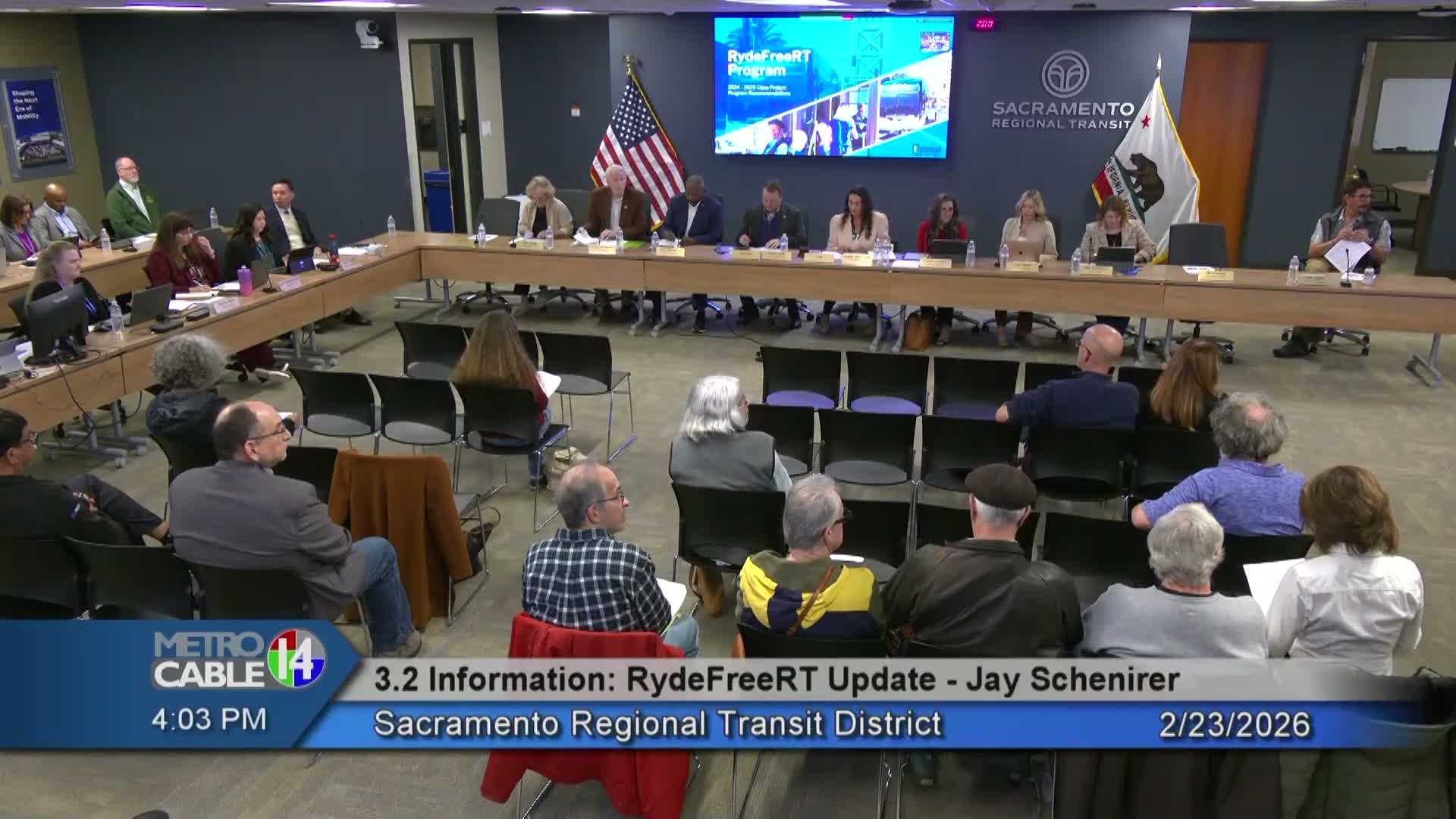
Summary
SacRT staff and Nehemiah Emerging Leadership Program presenters reviewed findings from outreach on the Ride Free RT student program, proposed a youth advisory committee to improve program design, and heard a related K‑16 collaborative presentation that asked SacRT to consider a $200,000, two‑year founding contribution to a programmatic JPA.
Chris Flores and community partners briefed the Sacramento Regional Transit Board on the Ride Free RT student program on Feb. 23, highlighting outreach results and proposed governance changes.
Jasmine Advinokla, who spoke on behalf of the Nehemiah Emerging Leadership Program (NELP), said the project used focus groups, surveys and one‑on‑one interviews with community organizations, school districts and elected officials to evaluate the program. "We focused on ensuring we were taking the time to meet with community organizations, school districts and schools specifically to really understand the perspectives, the values, and the benefits that Ride Free RT brings to the community," she said, summarizing the NELP findings. She identified two recurring themes: the need for stable funding and a standing convening for community and youth input.
Jay Cheniere, who described a proposed youth advisory committee that would be appointed by board members and participating school districts, said the program has grown from about 1,000,000 rides to roughly 5,000,000 student rides since it began. Cheniere described the committee as a quarterly convening of young people and community representatives to provide strategic recommendations on program operations and outreach. "We think it's really important to give young people a voice," he said, adding that school districts asked for "a voice and a seat at the table" when program decisions are made.
Director Dickinson said staff should prioritize data infrastructure to quantify the program's impact and to better align district contributions with attendance and average daily attendance (ADA) funding. "We need more granularity…who's riding where," Dickinson said, adding that better data would help demonstrate return on investment to district partners. Cheniere and Flores said staff are working on more detailed rider data to improve routing and to inform funding conversations.
The presentation also included a related briefing on the Sacramento K‑16 Collaborative. Alex Tagavian of Capital Impact, which manages the collaborative, told the board the regional effort drew down an $18.1 million competitive grant in 2022 to design and scale career pathways across an eight‑county footprint: "We are now on the cusp of moving into this…how does this become a permanent endeavor rather than something that's a one‑and‑done cycle based on the state budget." He asked SacRT to consider joining as a nonvoting, founding member and to provide $200,000 over two years to help stand up a joint powers authority that will regrant funds to education partners and coordinate employer demand signals.
Public commenters urged permanence for Ride Free RT. Sue Simonelli, representing the SAC ACT Education Committee, said annual renegotiation creates risk and urged the board to "make Ride Free RT a permanent part of your budget." The presenters said the update was informational and staff sought board feedback; no formal action was taken on the youth advisory committee or the requested SacRT contribution to the K‑16 JPA at the meeting.
The board asked staff to continue outreach with school districts and stakeholders, to refine committee structure and term lengths for youth participants, and to bring additional data and proposed governance language back to the board for consideration.