Sacramento LAFCO approves Airport South annexation after mixed public comments on jobs and environmental safeguards
Loading...
Summary
The Sacramento Local Agency Formation Commission voted unanimously to approve the Airport South Industrial Reorganization — an annexation and detachment that moves roughly 472–474 acres into the City of Sacramento and the Sacramento Area Sewer District — after staff presentation, applicant remarks, and public comment both supporting job creation and raising concerns about habitat permits and health risks.
The Sacramento Local Agency Formation Commission voted unanimously, 6–0, to approve the Airport South Industrial Reorganization, a package of detachments and annexations that would move roughly 472–474 acres of unincorporated land into the City of Sacramento and the Sacramento Area Sewer District.
The action, taken during LAFCO’s public hearing on item 8, approved staff’s recommendation to waive a conducting‑authority (protest) hearing based on reported landowner consent, adopt LAFCO resolution LAFCO 2026‑04 with any additional conditions the commission may require, and direct the executive officer to complete the statutory filings and transmittals. Executive Officer Jose Henriques presented the staff report and framed the commission’s role as limited to boundary, service responsibility and orderly growth considerations rather than a rehearing of city land‑use entitlements.
Why it matters: The annexation aligns jurisdictional boundaries with existing city planning for the Airport South area near Metro Airpark and is intended to facilitate urban services — water, sewer, fire and police — and future industrial development. Proponents said the project will create apprenticeship and construction jobs and strengthen the local tax base; opponents warned the proposal threatens agricultural land, could undermine the Natomas Basin Habitat Conservation Plan (HCP) unless incidental‑take permits and amended mitigation are secured, and may increase air‑pollution risk for nearby residents and a K–8 school.
Staff presentation and legal context Jose Henriques, LAFCO’s executive officer, told the commission the proposal is a reorganization that includes annexation to the City of Sacramento and the Sacramento Area Sewer District and detachment from several special‑district service providers. He described the project as roughly a 472.4‑acre industrial site located outside the county’s urban services boundary but inside the city’s adopted sphere of influence. Henriques cited the government‑code factors the commission must consider in reorganization proposals and recommended waiving the conducting‑authority hearing because staff had received no written landowner opposition at the time of the hearing.
Henriques also summarized that the city certified the final environmental impact report (EIR) and adopted a mitigation monitoring and reporting program on 12/02/2025; LAFCO staff noted two errata sheets that make only minor administrative edits and do not change the substance of the EIR. Henriques identified the need for a property‑tax exchange agreement as part of the annexation and described the statutory bases the commission used to analyze services, costs and effects on affected agencies.
Applicant framing and mitigation commitments Applicant representatives — counsel Nick Abdis on behalf of AKT Development and Jeff Griffin of Northpointe Development — described five years of planning and outreach, voluntary design adjustments to soften impacts near the Westlake neighborhood (including a 125‑foot eastern setback and lower building heights), relocation of an internal connector road away from residences, and proposed off‑site mitigation. Abdis and Griffin said the project site falls within the city’s prior sphere of influence determinations and stressed LAFCO’s limited role on the boundary question.
On mitigation, applicant representatives said they have purchased specific parcels (referred to as the "Rosa" properties) that they plan to donate to the Natomas Basin Conservancy as part of the EIR‑required mitigation, and they said grading and construction would be conditioned on satisfying those mitigation commitments in the EIR. Rod Stinson, who prepared the EIR, confirmed that noise‑study mitigation requirements (including a potential sound wall where indicated) remain part of the project and would be addressed in improvement plans for future development on nonparticipating parcels.
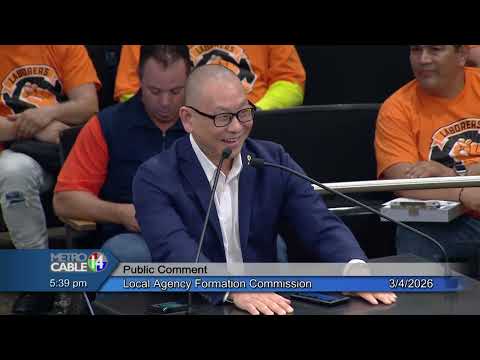
Public reaction: support for jobs, concerns about permits and health risks Public comment split along predictable lines. Multiple labor and trade representatives — including officials from UA Local 447, the Carpenters locals, IBW Local 340, IBEW Local 340, Laborers Local 185 and related councils — urged approval, emphasizing apprenticeship opportunities, long‑term skilled jobs, local hiring and the project’s contribution to the regional construction economy.
Environmental groups and local advocates urged delay or denial. Heather Fargo of the Environmental Council of Sacramento (and a former Sacramento mayor) asked the commission to postpone action until the city obtains the incidental‑take permits required under the Natomas Basin HCP; ECOS and allied groups argued the staff report and EIR did not adequately evaluate off‑site alternatives and said the project’s engineering (including three feet of fill over large areas and multiple detention basins) creates additional environmental and operational concerns. Air‑quality expert Ralph Propper warned that diesel emissions from truck traffic near an elementary school could raise health risks beyond thresholds used in the EIR and urged exclusion of select parcels or further analysis.
Commission discussion and vote Commissioner Desmond thanked both advocates and labor representatives, described careful consideration of the LAFCO factors, and moved approval of the staff recommendation and the draft resolution. The motion received a second and the clerk called a roll vote; the motion passed unanimously, 6–0. The commission’s approval included direction that the executive officer complete the required filings and determine the effective date five working days after recordation of the executive officer’s certificate of completion, provided imposed conditions are satisfied.
What the decision does and does not do LAFCO’s approval aligns service boundaries for the proposed Airport South industrial area with the City of Sacramento and the Sacramento Area Sewer District, and is intended to streamline service delivery and infrastructure planning. The commission’s action does not substitute for the city’s land‑use entitlements or remove requirements placed on the project by the certified EIR; several speakers and the EIR preparer noted that mitigation obligations and any required permits remain enforceable through the city’s processes and the HCP framework.
Next steps Staff will complete the statutory filings and transmittals following the recorded certificate of completion; the effective date of the reorganization will be set per the resolution’s terms once conditions are met. Several speakers urged further procedural steps — notably, that the city secure incidental‑take permits or amended HCP coverage for areas outside the city’s prior permit area — and those concerns are likely to figure in future city and agency reviews.