
Boone County board rejects US 20 solar special‑use permit after neighbors cite drainage, view and health concerns
Get AI-powered insights, summaries, and transcripts
Subscribe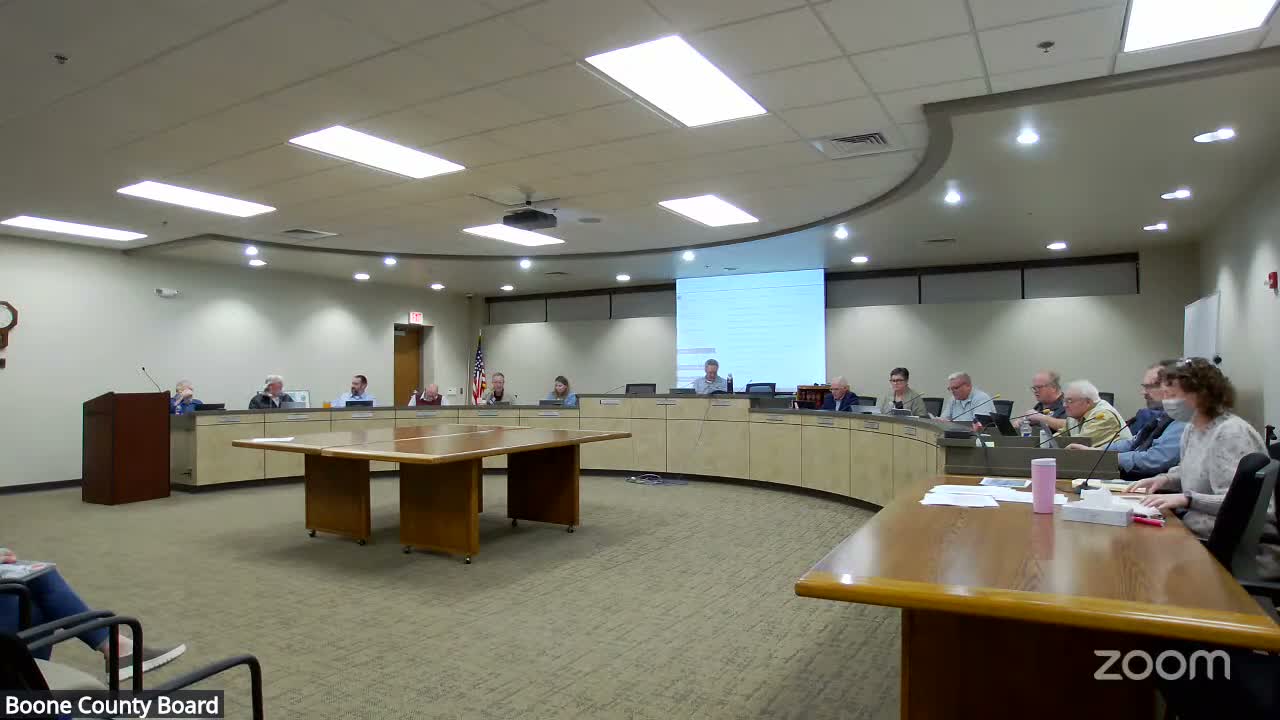
Summary
After hours of public comment and debate, the Boone County Administrative Committee failed to approve a special‑use permit for a 5 MW solar array along U.S. Route 20; the applicant and staff said revised plans mitigate impacts, but several board members sided with neighbors on setbacks, tree loss and long‑term decommissioning.
Boone County’s Administrative Committee declined to approve a special‑use permit for a proposed 5‑megawatt ground‑mounted solar array near U.S. Route 20 on March 5, after more than two hours of public comment and a lengthy staff and applicant presentation. The motion to approve failed on a roll‑call vote after the board adopted staff findings and conditions and then took a vote on the project.
The project proponent, represented by attorney Rick Porter, described the proposal as a roughly 20‑acre array on a 106‑acre parcel and said the developer had revised the plan to preserve mature oaks, increase non‑participating setbacks to 150 feet on the northern boundary and split the array into two fenced areas to preserve wildlife corridors. Connor Sales of Solarstone said the facility would produce approximately 8,000,000 kilowatt‑hours annually — about the equivalent of credits for roughly 1,100 homes — and that the interconnection is to a local ComEd distribution line serving the Belvidere substation.
“We have agreed to screening, increased setbacks and a decommissioning bond,” Sales said, adding that the company will seed native vegetation and carry insurance or performance assurances. Porter reminded the board that Illinois law (55 ILCS 5/5‑12020 and the Clean and Reliable Grid Affordability Act) constrains counties’ ability to ban commercial solar development and that staff had found the application consistent with zoning and the county’s solar ordinance.
Neighbors and dozens of residents urged denial. Gloria, a resident who said her disabled, elderly mother relies on the site’s tranquility, asked the board to “please vote no” and described the prospect of panels and maintenance traffic changing the character of the neighborhood. Several speakers raised similar concerns: potential well contamination from herbicide use, heavy‑metal runoff from damaged panels, increased stormwater and erosion if tree lines are trimmed or removed, inverter noise and the difficulty of ensuring decommissioning decades from now if ownership changes.
“I’m worried about fire, I'm worried about who removes these panels, and I'm worried about our property values,” a number of neighbors told the board. Mark Fonson, a nearby homeowner with rooftop solar, said rooftop systems give individual credit that neighbors would not directly see from a remote utility‑scale field, and Jerry Bierney circulated photos of nearby arrays and said adjoining subdivisions were closer than a published 1.2‑mile guideline he cited.
County staff and conservation partners documented concerns during earlier reviews; staff and the applicant negotiated several changes to the site plan between hearings, including shifting panels out of an oak stand and moving arrays away from a central greenbelt. The U.S. Army Corps of Engineers provided a concurrence letter showing no federal wetland impact for the proposed layout, and the applicant said it would obtain a Boone County SWPPP and any necessary NPDES coverage before construction.
Board members were split. Several members praised staff and the revisions but said the location — adjacent to multiple residential parcels, with remnant old‑growth trees and a drainage corridor — weighed heavily against the project. Others said the statutes and recent state policy limit the county’s authority to deny properly permitted projects and noted that staff had recommended approval with conditions.
When the board took the roll‑call vote on the motion to approve the special‑use permit (after adopting staff’s findings of fact and the project conditions), the motion failed. The chair said the item will return to the county board for further consideration in two weeks.
The applicant and staff say the revised plan includes triple‑required setbacks in some places, a decommissioning financial assurance, native seeding programs and noise‑mitigation design; neighbors say the changes are insufficient and asked the county to prioritize residential character, water and long‑term land‑use protections. The board did not adopt any ordinance change at this meeting; the project will be on the full board agenda at the next meeting for final consideration.
The county packet and staff conditions referenced during the meeting are available in the board documents; the applicant provided a noise analysis, a wetland delineation and a revised site plan to the record. The board will take up the matter again at its next scheduled full meeting.