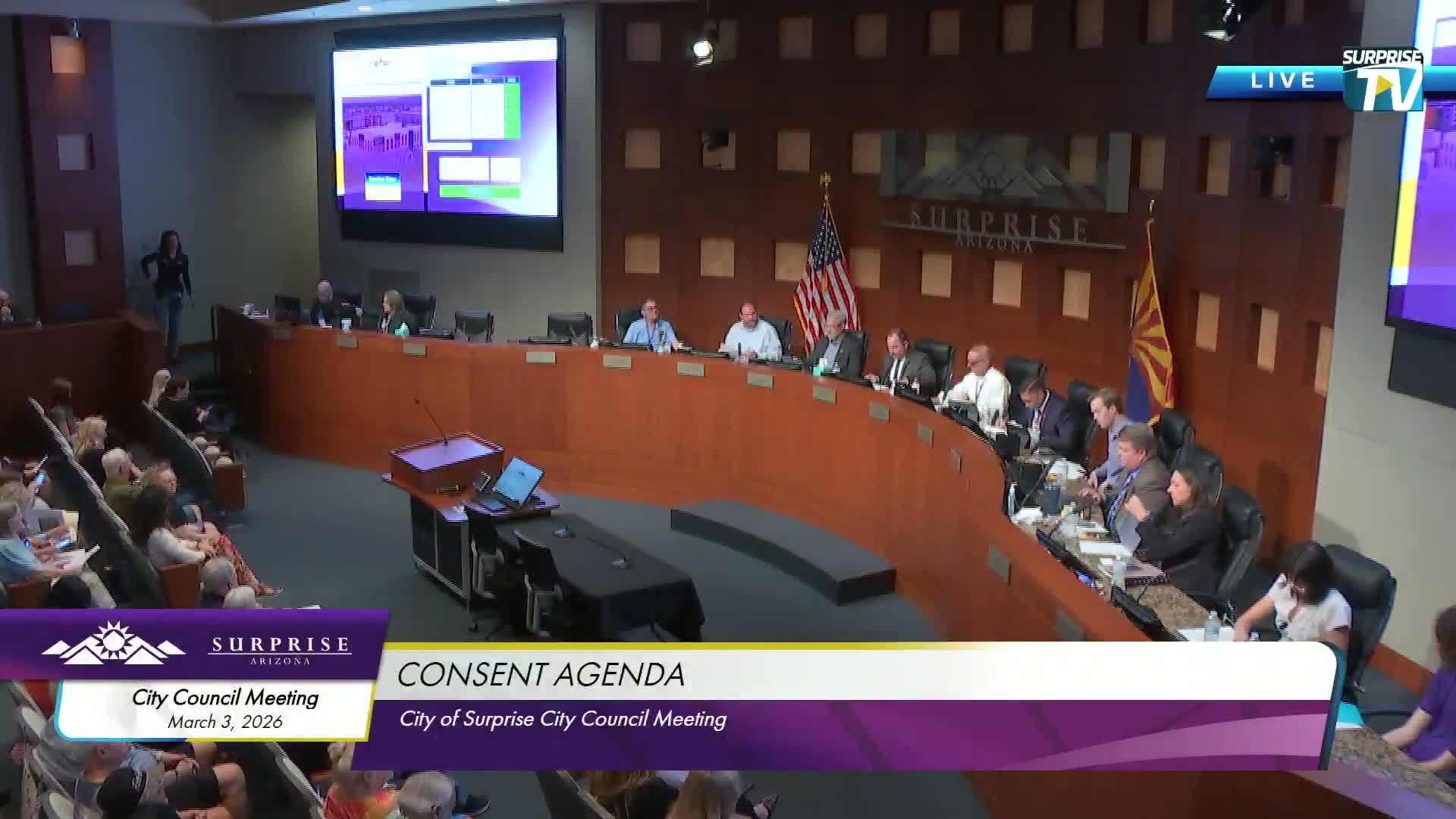
Surprise council continues Mesquite Mountain Ranch rezoning after concerns about wash, traffic and unit cap
Loading...
Summary
After extended public comment and detailed questioning of the developer, the Surprise City Council moved to continue consideration of a rezoning for Mesquite Mountain Ranch to April 7 so staff and the applicant can add engineering detail and draft stipulations addressing an open‑space wash corridor, road improvements and unit caps.
The Surprise City Council on March 3 continued a public hearing on a rezoning for the Mesquite Mountain Ranch project to allow more time for engineering details and formal stipulations on floodway protection, roadway links and unit counts.
City planner Mr. Wessel told the council the applicant seeks to rezone about 264.9 gross acres south of Deer Valley Road (Case FS24‑0765, Ordinance 202606) from a planned area development (PAD) to a mix of residential low density (R1), residential medium density (R2) and open space conservation (OS‑1). Planning and Zoning recommended approval with stipulations; commissioners added a 975‑unit cap. The staff presentation included reference to the Luke Air Force Base density concept that was used only for context in calculating theoretical maximum units.
Residents and council members pressed developers and staff about traffic, water and the width and treatment of the wash corridor that runs through the site. "You're thrown in a ton of homes, and there's no roadways to go in," resident Richard Stutzman told the council, citing current congestion on Sun Valley Parkway and local flooding concerns. The applicant, speaking in the record as Jeff, told the council the property already has PAD zoning and said the rezoning under consideration would add specific obligations: "...this project will now be adding additional travel lanes...and all that has to happen before homes go in," he said, and added the project would contribute "about $10,000 per home" toward water infrastructure. He also said the developer would not exceed the 975‑unit cap recommended by P&Z: "We're not gonna exceed 975 units." (Applicant statement attributed to Jeff Deli.)
Council members asked for clearer engineering evidence of the floodway and floodplain widths, and whether trails and buffers would be placed in the hard‑zoned open space or in the required 75‑foot buffers that accompany engineered floodplain limits. Land planner Mark Reddy said the illustrated green corridor is the minimum floodway that will be preserved at zoning, and that engineering and federal FEMA processes during later phases will determine the final floodplain and buffer widths. He estimated the minimum corridor shown is roughly 150 feet but cautioned it could become wider during engineering.
Council members asked the applicant whether the narrow strip of R2 adjacent to existing rural residential could be switched to R1 and whether single‑story restrictions were possible for homes nearest the rural overlay; the applicant said changing the zoning to R1 was feasible but that guaranteeing single‑story construction across all lots would be difficult given builder contracts. Councilmembers also discussed whether to convert the density cap to a units‑per‑acre metric; the applicant and staff said the proposed plan averages about three dwelling units per acre across the project footprint.
Because several members wanted the applicant and staff to memorialize stipulations in a revised ordinance and provide more precise engineering and mapping of the wash corridor before final action, Councilman Duffy moved to continue the rezoning item to the first meeting in April (April 7) so staff and the applicant could draft stipulations and a revised ordinance for public posting. The motion passed.
The council did not make final decisions on zoning or unit counts at the March 3 meeting; members asked staff and the applicant to return with a revised ordinance that incorporates the engineering clarifications and any stipulations the developer will accept.